Fifteen claims about AI and marketing, tested against the evidence
Fifteen claims about AI and marketing, tested against the evidence. What holds when assistants compare, recommend and start to buy.
By Manuel Casalta Petitjean· Essay · 28 min · Search & GEO· Published 20 November 2026
Contents
- First: two kinds of marketing, not one
- 1. Information asymmetry: does marketing live on it, or cure it?
- 2. Perfect competition: a horizon, not a destination
- 3. The brand: mental shortcut, quality pledge, or training data?
- 4. Veblen and the status signal: what the agent cannot switch off
- 5. Emotions, biases and nudges: the agent that decides for you
- 6. Who does the agent serve? The old problem of the proxy
- 7. Efficient markets: the paradox waiting for agents
- 8. Advertising: diminishing returns that long predate AI
- 9. Commoditisation and intermediaries: who actually loses margin?
- 10. Work: juniors, training, freelancers and talent
- Verdict: what holds, what does not
- Sources
Build a strong brand, invest in advertising, train your teams: these principles have guided marketing and management for decades. AI assistants and agents, which compare, recommend and are starting to buy on the consumer’s behalf, now put them to the test. A few voices even announce their obsolescence. This essay works through the questions that transition raises, against economic research and the data available at the end of 2026.
One method for each claim: the economic concept behind it, what the studies measure, what holds.
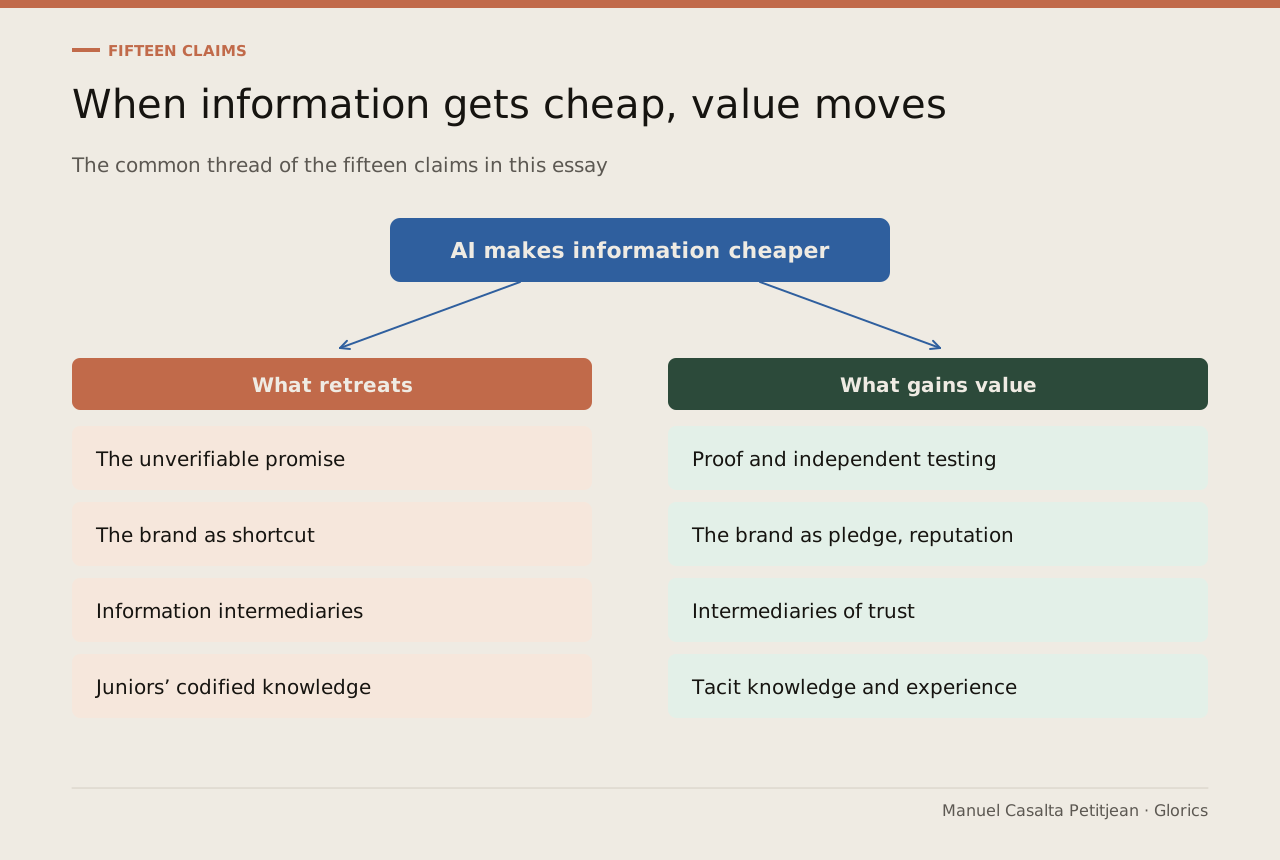
The result should reassure practitioners without letting them off the hook. The fundamentals hold. Brands, advertising and training keep their value. But they change in nature. AI makes information cheaper. What lived on the customer’s ignorance retreats; what rests on proof and trust gains value.
First: two kinds of marketing, not one
When people talk about AI and marketing, they almost always merge two activities that share one word. One designs what you sell. The other persuades people to buy it. Shopping agents treat them very differently.
A distinction as old as management
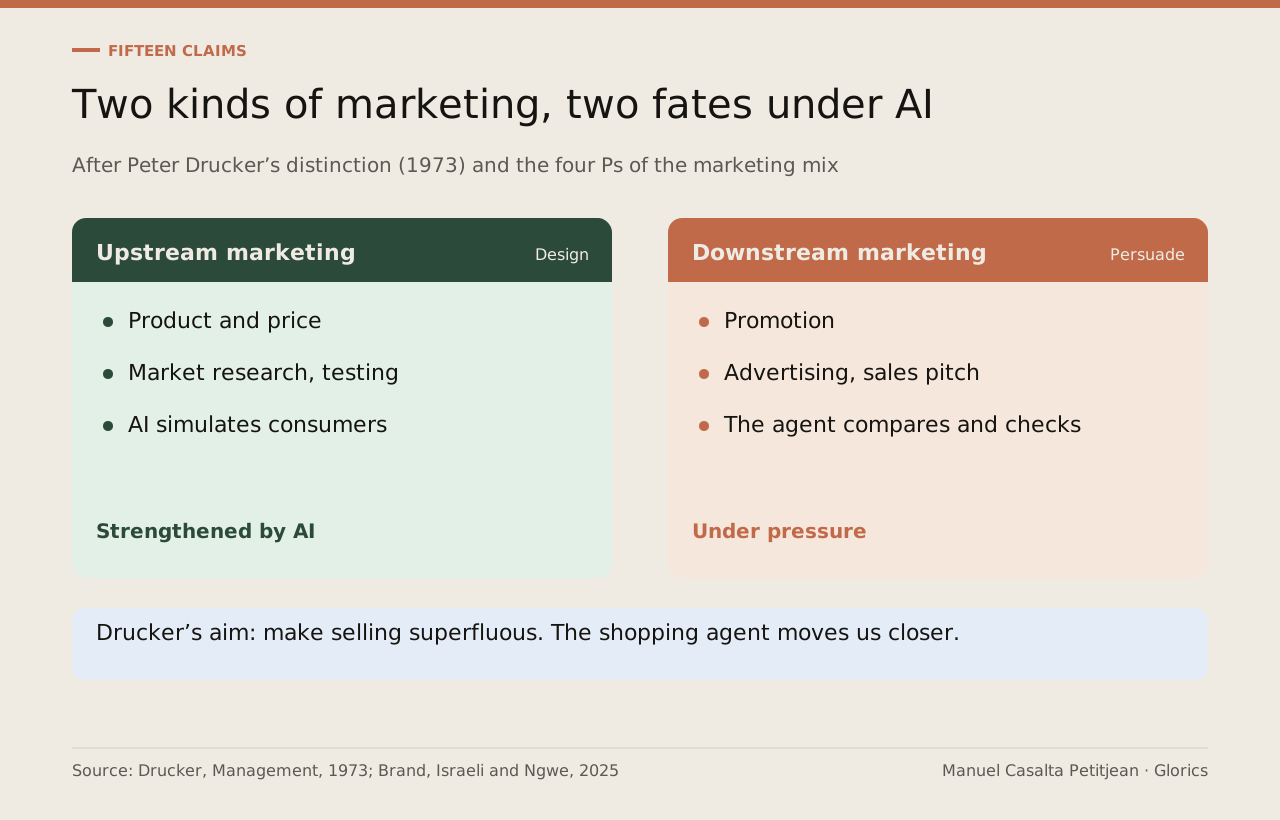
Peter Drucker drew it in 1973. Selling and marketing, he argued, are not complementary but opposite. There will always be some need for selling, he wrote, but the aim of marketing is to make selling superfluous: to know the customer so well that the product fits and sells itself (Drucker, Management: Tasks, Responsibilities, Practices, excerpt). Ideally, all that remains is to make the product available: logistics rather than salesmanship (full quotation).
Textbooks kept the trace of that split in the marketing mix, the four Ps: product, price, place, promotion. The first two belong to design, upstream. The last belongs to persuasion, downstream.
Upstream marketing: understand and design
This is the set of techniques that tell you what to make, for whom and at what price: market research, testing, sales data. AI does not threaten it. It multiplies it. James Brand, Ayelet Israeli and Donald Ngwe asked a language model to answer survey questions as a consumer would. Its willingness-to-pay estimates were realistic: $3.40 for fluoride in a toothpaste, against $3.27 measured among real buyers (Harvard Business School, Working Knowledge).
The authors still recommend combining these synthetic consumers with human research, especially for new or complex products. And a tool available to everyone gives no one an edge. Your competitor will run the same studies, as fast and as cheaply.
Downstream marketing: signal and persuade
This is the marketing everyone sees: advertising, promotion, brand staging, the sales pitch. It is the one shopping agents put under pressure. When the buyer hands the choice to a machine that compares and checks, persuasion loses its grip, except where nothing can be checked.
The paradox: the agent completes Drucker’s programme
Seen this way, AI does not threaten marketing as a whole, only its downstream half. It even moves us toward Drucker’s ideal: a customer already ready to buy, a sale reduced to logistics. The agent does not kill marketing. It sides with the half that designs against the half that persuades.
Drucker’s idea always had its critics, starting with sales practitioners, for whom persuasion is as old as trade itself (CBS News). The sections that follow deal mostly with downstream marketing. Upstream marketing returns in the parts on competition and commoditisation.
1. Information asymmetry: does marketing live on it, or cure it?
First claim: marketing exploits what the seller knows and the buyer does not. Close the gap and persuasion loses its hold. The idea rests on one of the most famous concepts in modern economics. It forgets half of it.
The market for lemons
In 1970, George Akerlof published a paper on the used-car market. The seller knows the car’s real condition; the buyer does not. Unable to tell good cars from bad ones, the lemons, the buyer only pays an average price. Owners of good cars withdraw, average quality falls, and the market can collapse (Nobelprize.org).
The analysis earned Akerlof the 2001 Nobel Prize in economics, shared with Michael Spence and Joseph Stiglitz, for their analyses of markets with asymmetric information (Royal Swedish Academy of Sciences). Spence showed how the better-informed party can send a credible signal. Stiglitz showed how the less-informed party can extract information, for instance by offering a menu of contracts that forces the other side to reveal itself.
The detail that changes everything
Akerlof did not see brands as the cause of the problem, but as part of the solution. He cited dealer guarantees, brand names, chains and franchises as institutions that arise to counteract asymmetry (Nobelprize.org). A brand is a commitment. If the product disappoints, the brand pays.
Marketing therefore has two faces. One exploits asymmetry: exaggeration, the unverifiable promise. The other reduces it: reputation put up as collateral. A well-informed agent erodes the first. It does not make the second useless. It tests it, constantly.
A shopping agent is a screening device in Stiglitz’s sense. It asks the questions, cross-checks the answers and forces the seller to show its hand. That is its real strength, more than the sheer volume of data.
The internet precedent
The argument is not new. In the late 1990s, the internet was supposed to create a frictionless market where everyone could compare everything in one click. Erik Brynjolfsson and Michael Smith tested it on books and CDs, products strictly identical from one seller to the next.
Online prices were indeed 9 to 16% lower than in physical stores. But posted prices differed across online retailers by 33% on average for books and 25% for CDs (Brynjolfsson and Smith, Management Science, 2000). The cheapest retailers did not make the most sales. The authors’ conclusion: branding, awareness and trust remained major sources of difference.
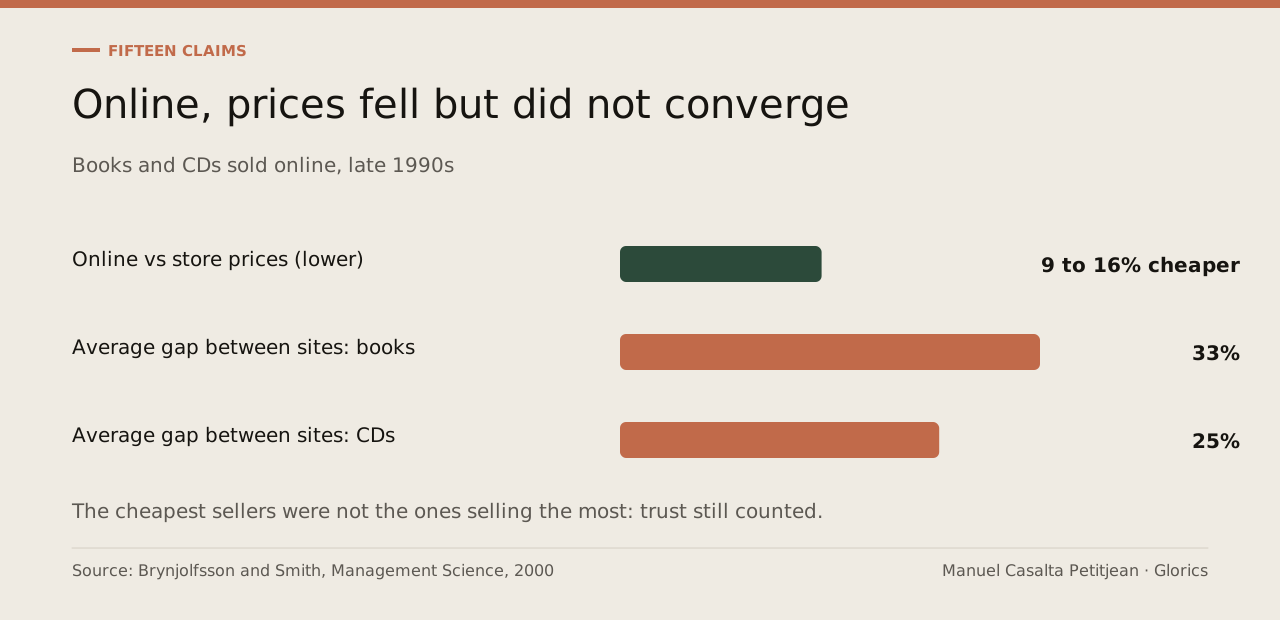
Today, the shopping agent raises the same question with one major difference: it never tires of comparing. The internet’s lesson still holds. When searching gets cheaper, prices fall. They do not converge, because trust is not compared like a price.
2. Perfect competition: a horizon, not a destination
Second claim: a market where everyone knows everything moves toward perfect competition, and margins melt toward production cost. This is the “commoditisation of everything” argument. Theory confirms it under conditions. Those conditions are precisely the ones firms work to undo.
Five conditions, rarely met
Textbook perfect competition rests on five assumptions. Atomicity: many buyers and sellers, none able to move the price. Homogeneity: interchangeable products. Free entry and exit. Transparency: everyone knows every price and every quality. Mobility of the factors of production.
A shopping agent acts on only one of these, transparency. It creates neither atomicity nor homogeneity. It may even increase concentration. If every agent recommends the same best product, the market tightens around a few winners.
Bertrand’s paradox: the promise
The mathematician Joseph Bertrand showed in 1883 that two firms are enough to reach the competitive price. If products are identical and buyers perfectly informed, each firm has an incentive to undercut the other, all the way down to cost. That is the implicit promise of the shopping agent: a tireless buyer that lets no price gap go unpunished.
Diamond’s paradox: the fragility
Peter Diamond showed the opposite in 1971, with an assumption barely changed. If searching costs the consumer anything at all, even very little, the equilibrium can tip to the monopoly price. The lesson cuts both ways. Transparency has to be near total to work. And agents, by pushing search costs close to zero, genuinely move markets toward Bertrand. That is the strongest argument in the claim’s favour.
The sellers’ response: blur the comparison
Firms do not stand still. Glenn and Sara Ellison studied computer-parts retailers whose sales ran almost entirely through a price comparison site. For some products, demand there became extraordinarily price-sensitive. But retailers practised obfuscation: paid add-ons, stripped-down bait products, extra fees. The result was far lower price sensitivity on other products, and margins large enough to survive (Ellison and Ellison, Econometrica, 2009).
A shopping agent will be harder to fool than a hurried human. But the logic stands. When comparison becomes perfect, the seller’s interest is to make products less comparable.
The other response: prices that collude on their own
Sellers have algorithms too. Emilio Calvano and his co-authors pitted reinforcement-learning pricing algorithms against each other in a standard model of competition. Without ever communicating, they consistently learned to charge supracompetitive prices. They sustained them through temporary punishments followed by a return to cooperation, and the result held across changes in costs, demand and the number of sellers (Calvano et al., American Economic Review, 2020).
The likeliest future is therefore not an omniscient buyer facing disarmed sellers. It is a race between buying algorithms and pricing algorithms, and nobody knows how it ends. Whether buyer agents can break tacit collusion between seller algorithms remains an open question.
The classic exit: differentiate
Firms have one old exit left: differentiation. If products are no longer identical, Bertrand’s logic no longer applies. There is an irony here. Personalisation taken to the extreme, one product per customer, is the exact opposite of the homogeneity perfect competition requires. You cannot announce the commoditisation of everything and the hyper-personalisation of everything at the same time.
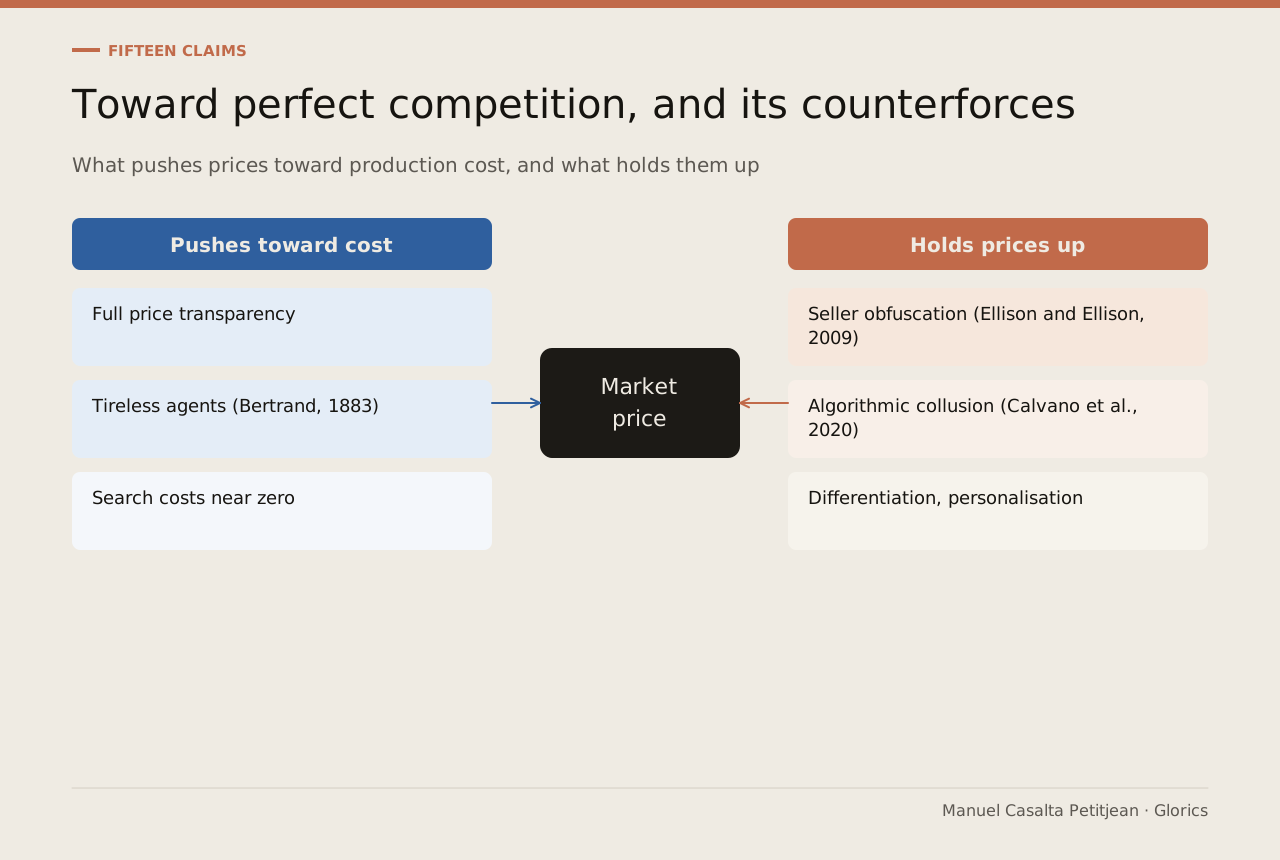
Perfect competition remains what it always was: a theoretical benchmark. Agents move markets for standardised products closer to it. They do not make it real.
3. The brand: mental shortcut, quality pledge, or training data?
Third claim: brands exist because the human brain retains only a few criteria per product. An agent that compares thousands has no need for the shortcut. The argument is right on its cognitive premise. It is incomplete on what a brand is.
A brain with four slots
The limited capacity of working memory is well established. George Miller’s famous “seven, plus or minus two” (1956) was mostly a turn of phrase. Nelson Cowan reviewed the evidence in 2001: the central limit is closer to four items held at once (Cowan, Behavioral and Brain Sciences, 2001). A human never really compares dozens of criteria. We rely on summaries, and a brand is one.
An agent has no such limit. On this point the claim is solid: the brand as shortcut loses part of its reason to exist.
The brand as a costly signal
Yet a brand is not just a summary. It is also a signal in Michael Spence’s sense: a visible, costly investment, credible because a low-quality seller would have more to lose by making it. The Nobel committee put it this way: a signal only works if its cost differs enough between those who send it (Nobelprize.org).
Research on reputation adds a mechanism. A brand that has invested years in its name loses a great deal by cheating once, so it has an incentive to keep quality up. That pledge does more than inform the buyer. It names someone accountable.
What online reviews have already done to brands
We have a full-scale experiment: the rise of online reviews. Brett Hollenbeck matched fifteen years of US hotel revenue with millions of reviews. Chain-affiliated hotels earn significantly more than comparable independents. But that premium fell by more than 50% between 2000 and 2015, largely because of online reputation mechanisms (Hollenbeck, Journal of Marketing Research, 2018).
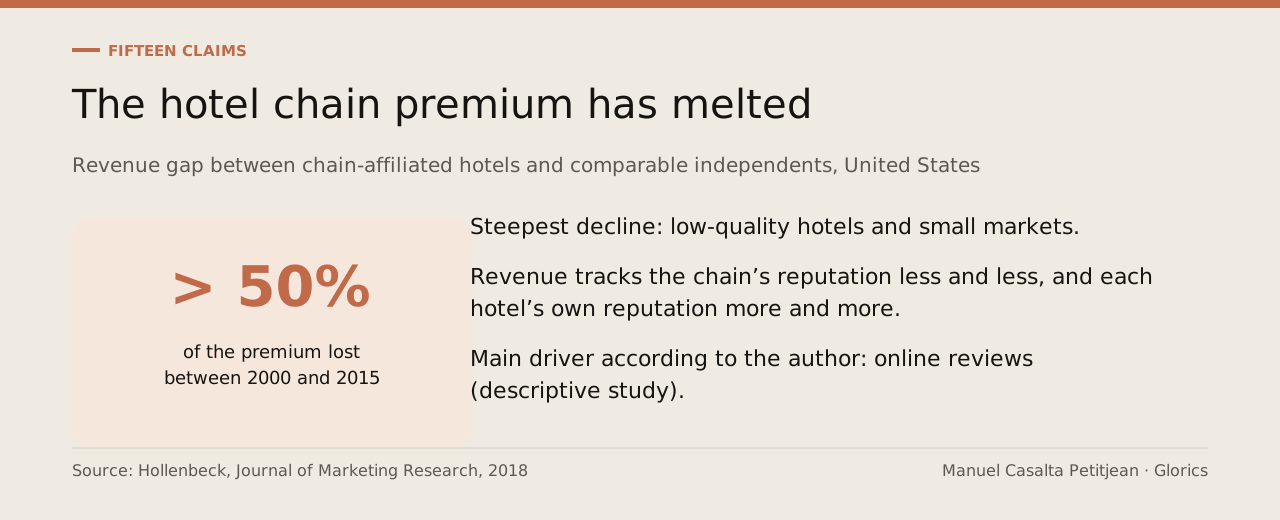
Two details matter. The decline is steepest for low-quality hotels and small markets, where the name covered for weaknesses. And revenue depends less and less on the chain’s reputation, more and more on each hotel’s own. The author is clear that his results are descriptive, not strict causal proof.
The lesson is valuable. When information flows, value does not leave the brand. It moves from the umbrella brand to proven quality, unit by unit. Shopping agents extend that shift.
The paradox: models like brands
One irony is often missed. Language models learned the world from text in which big brands are everywhere. A June 2026 study shows that, with strictly identical product attributes, several models systematically recommend the well-known brand over unfamiliar names. The advantage gives way to a competitor rated only slightly higher (Chu and Hou, arXiv, 2026).
What ChatGPT actually answers: the sunscreen case
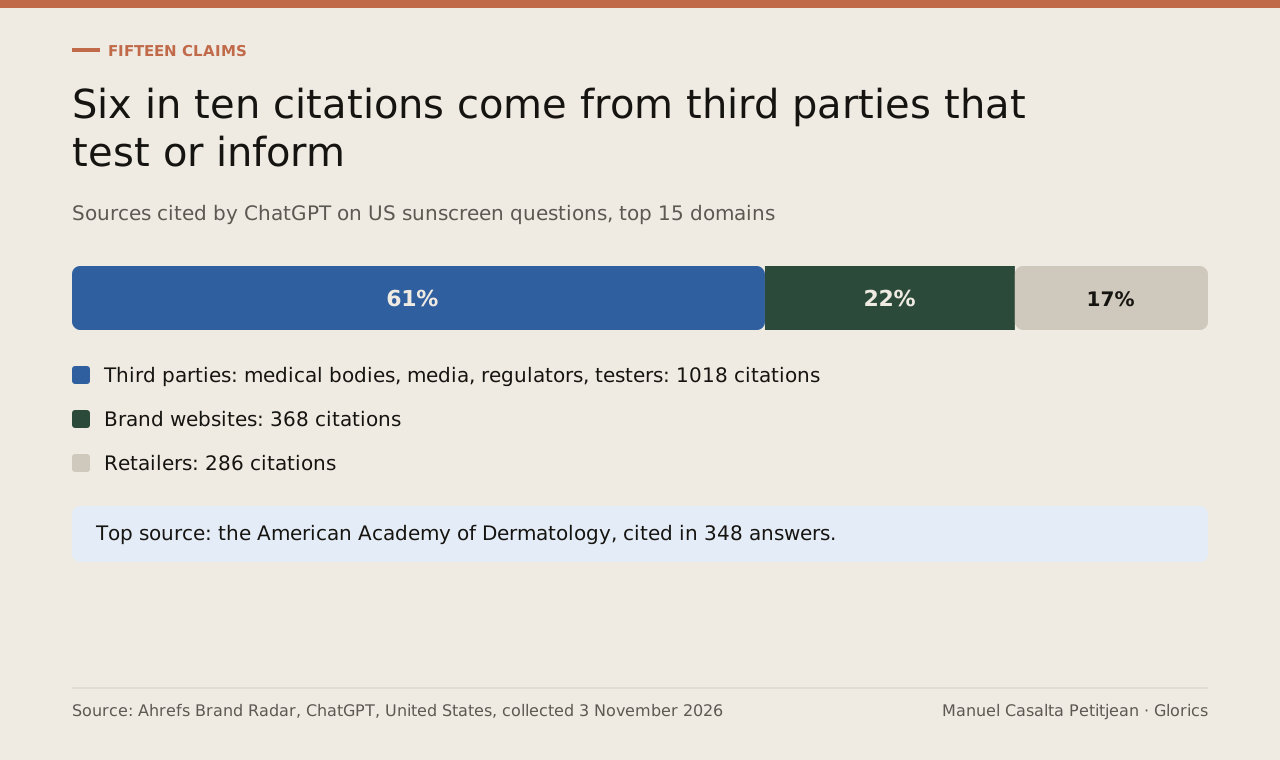
Real answers point the same way, with a useful nuance. Ahrefs Brand Radar tracks the brands AI assistants mention. On US questions about sunscreen, ChatGPT overwhelmingly mentions brands with dermatological credentials.
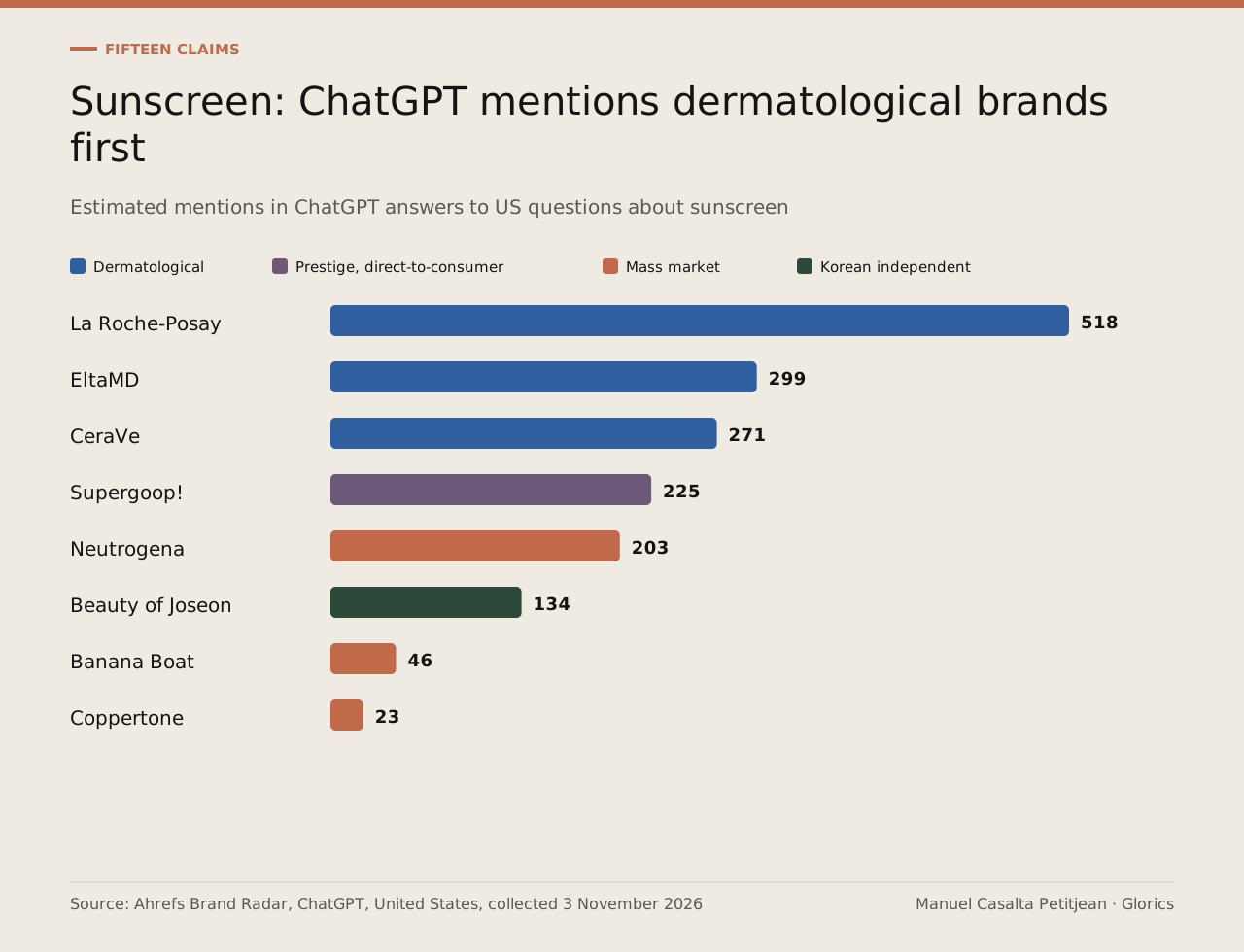
The gap is not about corporate muscle. La Roche-Posay and CeraVe, both L’Oréal dermatological brands, sit in the top three. The mass-market names that built the category on advertising, Banana Boat and Coppertone, trail far behind an independent Korean brand, Beauty of Joseon. The efficacy of a sunscreen cannot be checked before purchase, so the model defers to medical credibility, as a careful buyer would. The brand remains a pledge, provided the pledge is credible.
These are estimates, drawn from Ahrefs’ prompt database, for ChatGPT only, at a given date. They illustrate the mechanism. They do not prove it.
The brand as shortcut is fading in the consumer’s head. For now, it survives in the machine’s.
4. Veblen and the status signal: what the agent cannot switch off
Fourth claim: the agent will warn its user that they are about to pay for image rather than use, and talk them out of it. The argument underestimates a striking property of status goods. Their value lies precisely in what they cost.
Conspicuous consumption
In The Theory of the Leisure Class (1899), Thorstein Veblen described consumption whose purpose is not use but the display of rank. Economists have since called it a “Veblen effect” when demand for a good rises with its price. For these goods, expense is not a flaw to correct. It is the product.
Hence a counter-intuitive consequence. An agent that makes every price transparent does not destroy the status signal. It makes it more legible. Everyone now knows exactly what you paid.
Quiet luxury is not the end of the signal
You often hear that ostentation is out and real wealth is now discreet. Research confirms part of the intuition, not its conclusion. Young Jee Han, Joseph Nunes and Xavier Drèze showed that luxury brands charge more for their quietest items, with small or invisible logos (Han, Nunes and Drèze, Journal of Marketing, 2010).
Their typology separates wealthy consumers with little need for status, who pay a premium for signals only their peers can read, from wealthy consumers who want recognition and prefer loud logos. Counterfeiters copy almost exclusively the loud, cheaper items (USC Marshall).
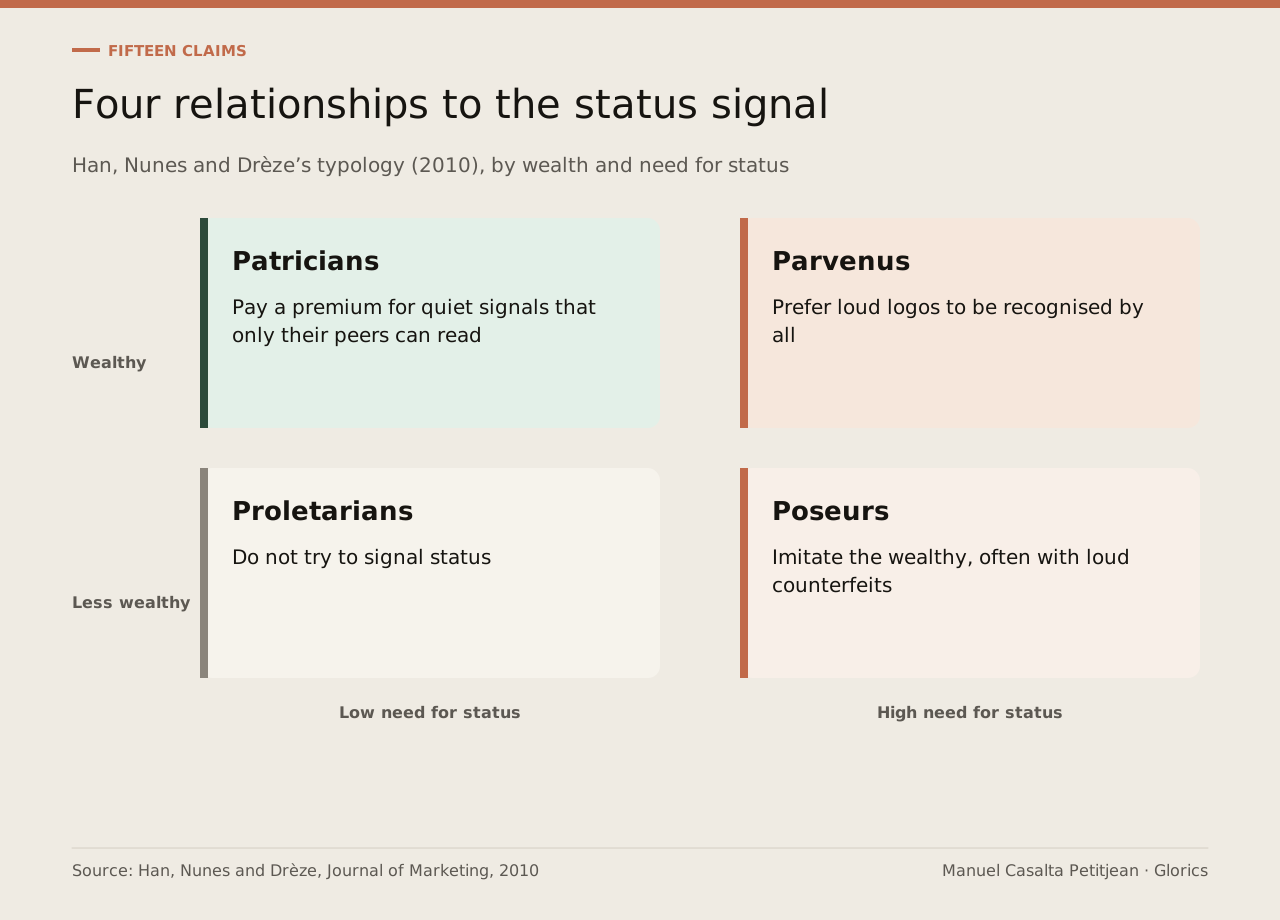
Discretion does not abolish the signal. It reserves it for a narrower audience, and it costs more. A loud logo can indeed betray a lower rank than the one it claims. But the status game goes on, with finer rules.
A market that holds, a premium that wears thin
The luxury market shows no sign of collapse. Personal luxury goods reached €358 billion in 2025, flat at constant exchange rates, and Bain and Altagamma expect 2 to 4% growth in 2026 (Altagamma, June 2026).
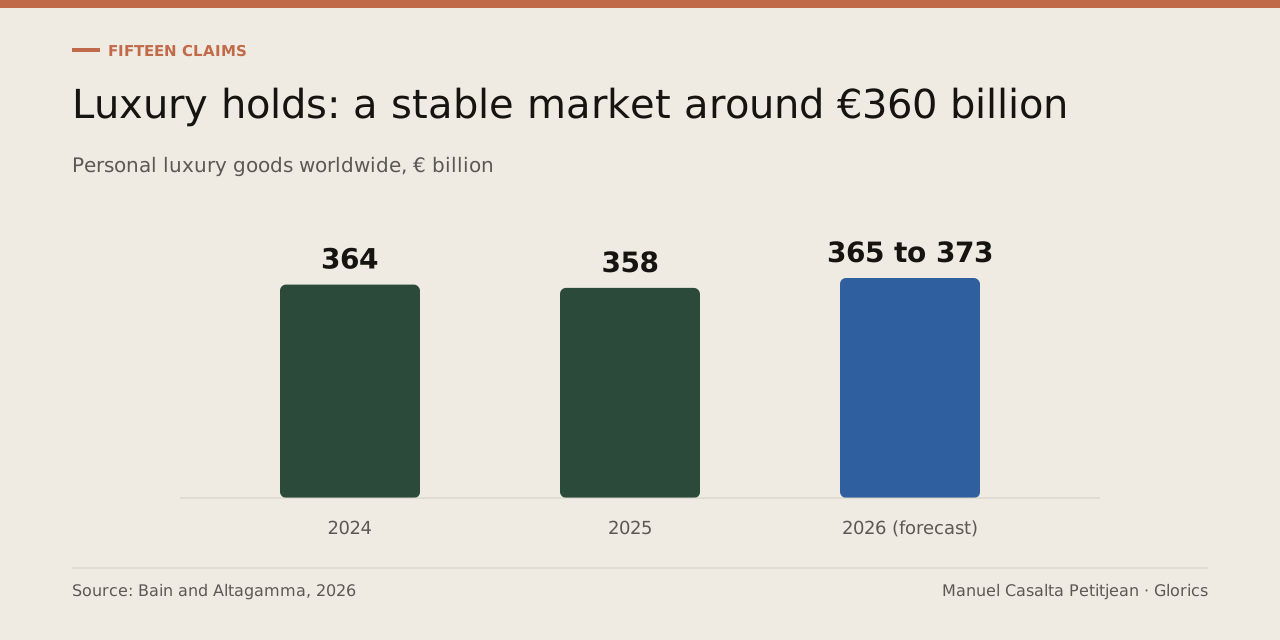
The same firm notes fatigue, though. Years of aggressive price increases have left clients feeling “betrayed”, and the biggest spenders have stopped increasing their spending (Cyprus Mail, from Reuters). That is where an agent can weigh in. Not on the desire for status itself, but on the gap between what the brand promises and what it delivers: craftsmanship, durability, service.
An agent may tell its user that a handbag costs ten times its use value. The user already knew. That is exactly why they are buying it.
5. Emotions, biases and nudges: the agent that decides for you
Fifth claim, the most ambitious: the agent will protect its user from their emotions, correct their biases and quietly steer them toward their own interest. Three different ideas are tangled here. Research treats them very differently.
Emotion is not the enemy of decision
The idea that a decision without emotion would be better runs into the work of the neurologist Antonio Damasio. His patients, with damage to a region of the prefrontal cortex linked to emotion, reasoned normally but decided poorly in life. To measure it, Antoine Bechara and Damasio designed a card game, the Iowa Gambling Task. Healthy participants developed a physical warning response before drawing from the losing decks. Patients did not, and kept drawing from them even when they knew the decks were bad (Bechara et al., Trends in Cognitive Sciences, 2005).
The so-called somatic marker hypothesis is still debated. A 2006 critical review argued it needs more evidence to remain tenable (Dunn, Dalgleish and Lawrence, 2006). But the core is settled: emotion carries part of our preferences and our learning. An agent that “neutralised” its user’s emotions would also erase part of what it is meant to serve.
Biases: flaws or efficient shortcuts?
From the 1970s, Daniel Kahneman and Amos Tversky documented systematic biases in human judgement: anchoring, loss aversion, framing effects. Herbert Simon had earlier described “bounded” rationality: unable to compute everything, we settle for the first satisfactory option. Here an agent that computes more can genuinely correct some errors, especially on large purchases, where anchoring and haste are expensive.
Another school, around Gerd Gigerenzer, points out that heuristics are not just flaws. In highly uncertain environments, a simple rule often does as well as a complex model, sometimes better. Replacing every heuristic with computation is not always progress, especially when the agent has biases of its own, inherited from its data.
The hidden benevolent nudge: the red line
The nudge, popularised in 2008 by Richard Thaler and Cass Sunstein, steers a choice without imposing it: fruit at eye level, automatic enrolment in a pension plan. Their doctrine, libertarian paternalism, rests on two conditions. The freedom to choose otherwise must stay intact, and the nudge must be defensible in public. An agent that manipulated its user “for their own good” without telling them falls outside that frame.
It also comes close to a legal ban. Since 2 February 2025, Article 5 of the EU AI Act prohibits systems that use subliminal, purposefully manipulative or deceptive techniques to materially distort a person’s behaviour, where this causes or is likely to cause significant harm (Bundesnetzagentur). A Polish digital ministry document even cites, as an example, a “personal assistant” for older people using advanced manipulation techniques (Codozasady).
The nuance matters. The ban requires significant harm, and the European Commission specifies that personalised advertising is not manipulative in itself (Covington). An agent that quietly makes you walk a bit more probably does not break the law. But it crosses the line the inventors of the nudge drew themselves: transparency.
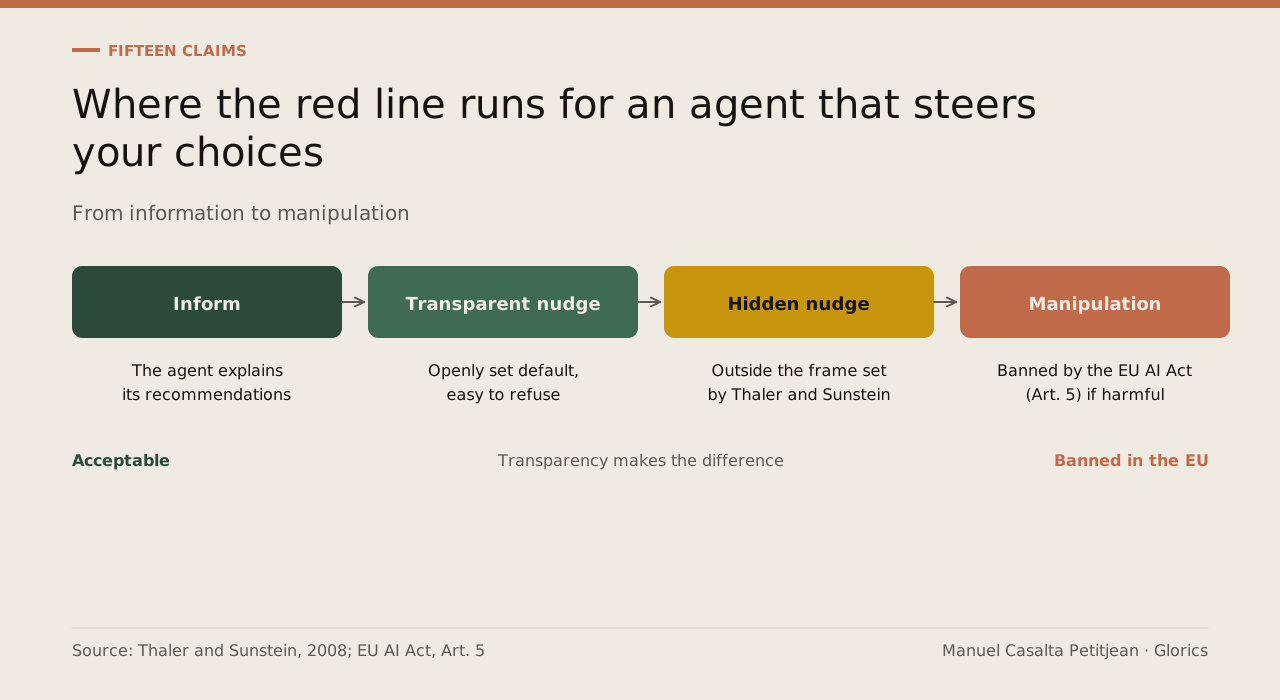
Delegating a decision to an agent is a legitimate choice. Being manipulated by it, even for your own good, is not.
6. Who does the agent serve? The old problem of the proxy
Sixth claim: the agent will serve its user loyally, because competition between providers will punish any betrayal. Switching assistants costs little, so an unfaithful agent would quickly be dropped. The argument is classic economics. It rests on two conditions that are not given.
The principal-agent problem
Economists call an “agency relationship” any situation in which one party, the principal, delegates a task to another, the agent, who has interests of their own and knows more. Michael Jensen and William Meckling formalised it in 1976 for executives and shareholders. The vocabulary fits perfectly: an AI agent is literally a proxy. It acts for you, but it is designed, hosted and funded by a company with its own accounts to answer for.
The heart of the problem is called hidden action. You see the product the agent recommends. You do not see the ones it set aside, or why. To punish an unfaithful agent, you first have to be able to see the infidelity.
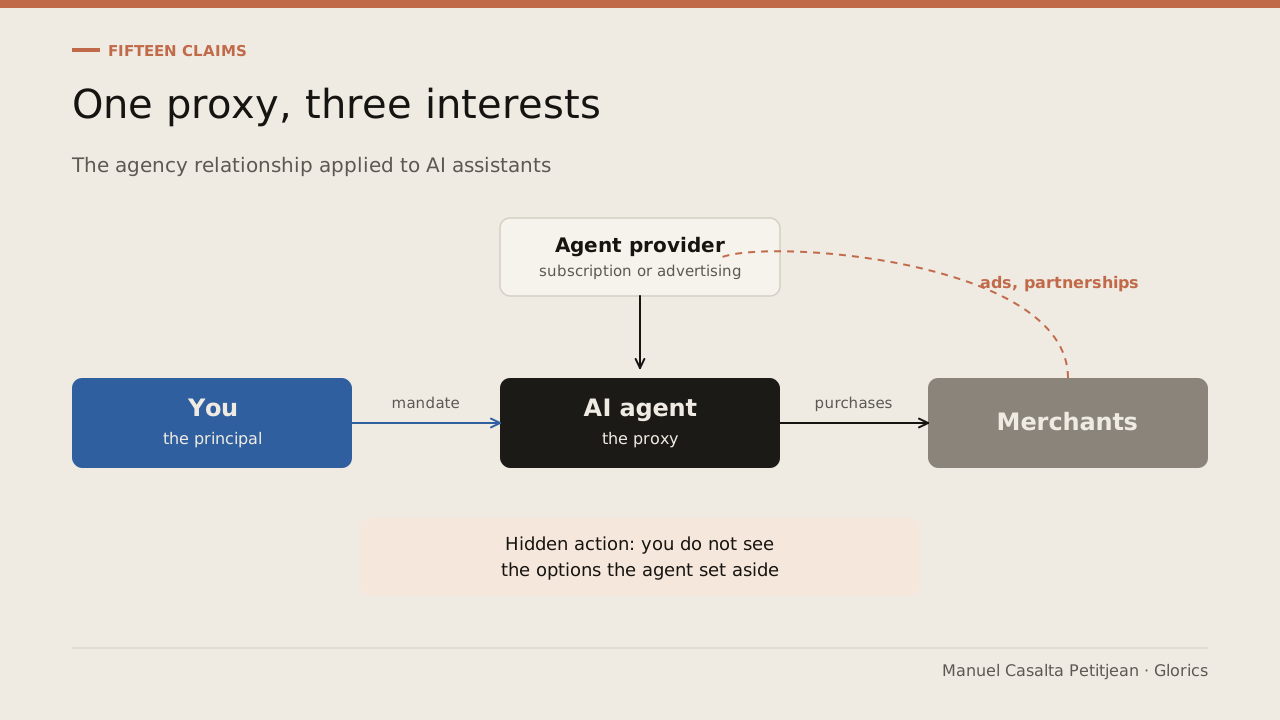
Will competition discipline agents?
The competitive argument first assumes betrayal is observable. Yet an agent can favour a commercial partner without ever making a visible mistake. It only has to pick a good product rather than the best one. That is exactly the situation of a credence good, where the buyer cannot judge the quality of the service, even afterwards.
It then assumes switching costs little. True for a chatbot. Less and less true for a personal agent that accumulates your memory, preferences, access and habits. Economists know switching costs well: the higher they rise, the more a provider can drift without losing customers. The agent that knows you best is also the one you will find hardest to leave.
The business model, the first conflict of interest
How an agent is funded matters as much as how it is built. OpenAI introduced advertising in ChatGPT in February 2026, committing that ads would not influence answers (Searchable). Anthropic made the opposite choice: Claude products remain ad-free, on the grounds that even a separate ad creates an incentive to maximise engagement (OfficeChai). Both promises can be kept. Either way, the user has to take them on trust.
From market to law: a duty of loyalty
Hence an old legal idea. More than a decade ago, the legal scholars Jack Balkin and Jonathan Zittrain proposed treating digital platforms as “information fiduciaries”, bound by duties of loyalty, care and confidentiality, like a doctor or a lawyer. The idea shaped the debate without ever becoming law (Marks, AI Fiduciaries and the Law, 2026).
AI agents revive it, because they bring together what was missing: explicit delegation and real trust. On 25 August 2026, Stanford HAI recommended imposing a duty of loyalty on the developers and deployers of agents, especially in finance and health. They should act in the user’s interest, within the scope of the task, without hidden conflicts of interest (Stanford HAI).
Competition can discipline agents, but only if betrayal is visible and leaving costs nothing. Neither condition is guaranteed. That is why the debate is moving from markets to law.
7. Efficient markets: the paradox waiting for agents
Seventh claim: with agents that know everything, every transaction would find its fair price, like an efficient financial market where prices already reflect all available information. The analogy is fertile. It leads straight into one of the most famous paradoxes in economics.
The efficient market hypothesis
Formalised by Eugene Fama in 1970, the efficient market hypothesis holds that prices reflect available information, so no one can consistently beat the market using public information. Carried over to consumer markets, the idea is appealing: a market where agents read everything would always charge fair prices.
Perfect efficiency is impossible
In 1980, Sanford Grossman and Joseph Stiglitz pointed out a logical contradiction. If prices perfectly reflected all information, those who spend money to gather it would earn nothing for it. No one would gather it, and prices would stop reflecting it. An informationally efficient market is therefore impossible. There is an “equilibrium degree of disequilibrium” that rewards those who inform themselves (Grossman and Stiglitz, American Economic Review, 1980).
The parallel with shopping agents is direct. An agent does not create the information it uses. It reads journalists’ tests, customer reviews, expert comparisons, forums. If agents capture all the value of that information without paying those who produce it, the source eventually dries up. That is already the dispute between publishers and AI answer engines, which preferentially cite the press and independent publications (Chen et al., 2025).
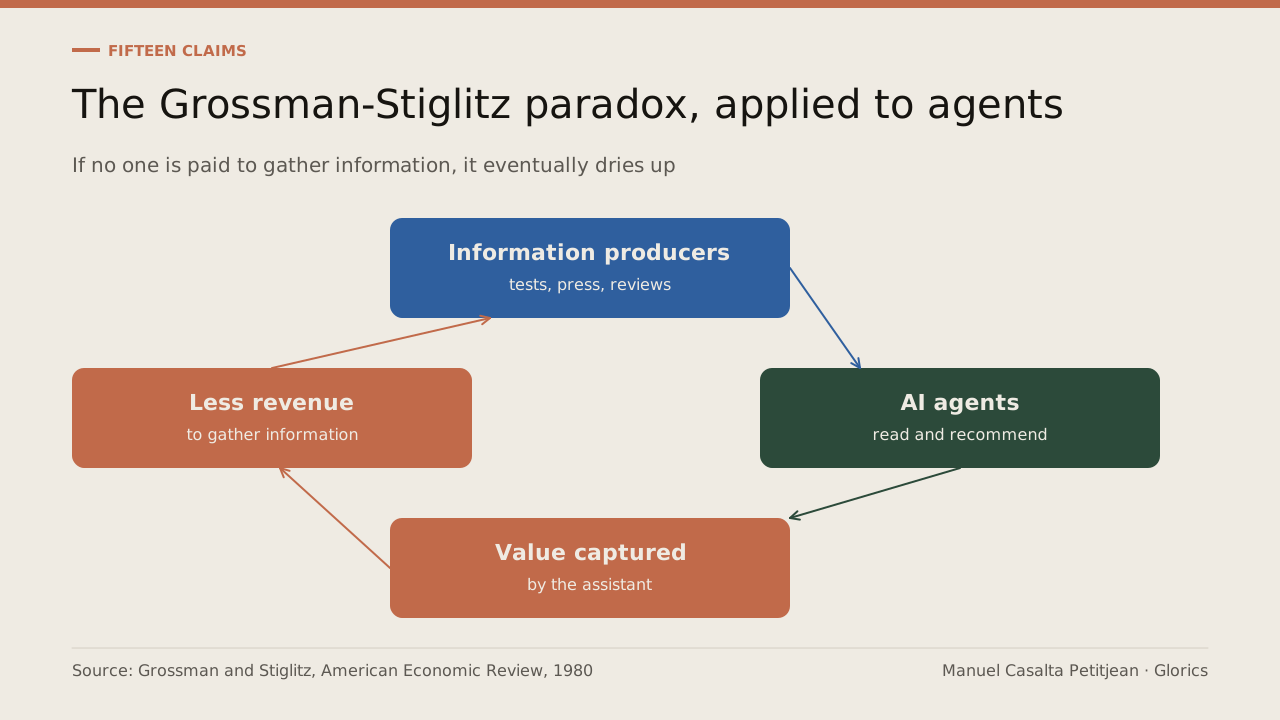
One example makes it concrete. On US questions about sunscreen, the source ChatGPT cites most is the American Academy of Dermatology, in 348 answers, ahead of NBC News, with the FDA and Consumer Reports also in the top fifteen (Ahrefs Brand Radar, November 2026). Guidance written by a professional body and reporting paid for by newsrooms feed the answers of a commercial assistant: the Grossman-Stiglitz paradox in one number.
The “perfect transaction” assumes perfect information. That assumes someone to produce it, and to be paid for producing it.
The risk of unanimity
A second problem comes from finance itself. In a November 2024 report, the Financial Stability Board warned that widespread use of common models and data sources could increase correlations in trading, lending and pricing. It added that this could amplify market stress and worsen liquidity crunches (FSB, 2024).
The same mechanism threatens consumer markets. If millions of agents apply similar decision rules, they will send their users to the same products at the same moments. The result is stockouts, demand spikes and more concentration, not a calmer market. The diversity of human tastes and mistakes was quietly acting as a shock absorber.
A perfectly informed market is not a reachable horizon. It is an asymptote, and approaching it too fast creates its own fragilities.
8. Advertising: diminishing returns that long predate AI
Eighth claim: advertising costs more and more for a smaller and smaller marginal effect, and agents will finish it off. The first half is old and well documented. The second depends on a question advertising has never managed to settle: what would have happened without it?
The law of diminishing returns
That advertising has diminishing returns is nothing new. The first dollars reach the most receptive customers; the next ones reach less and less responsive people. The response curve flattens, and each additional sale costs more than the last. Advertisers have known this for decades.
The conversion trap
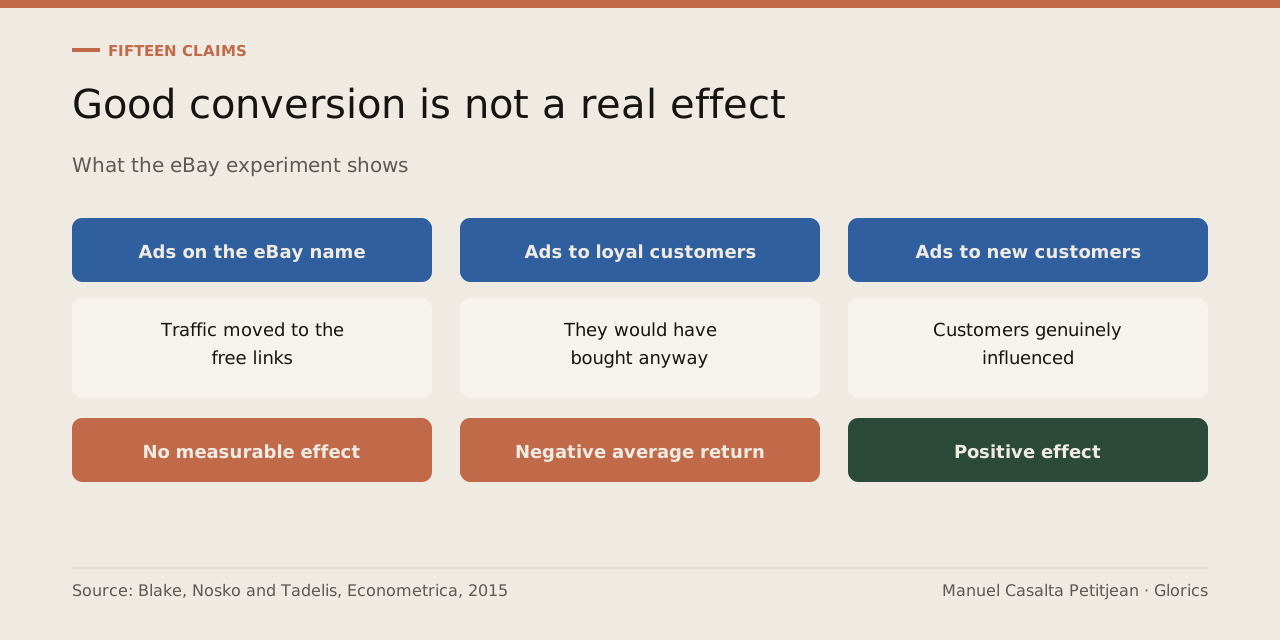
The real difficulty lies elsewhere, and an experiment at eBay made it famous. Thomas Blake, Chris Nosko and Steven Tadelis randomly switched off the company’s paid search ads in parts of the United States. For searches containing the eBay name, stopping the ads had no measurable short-term effect: traffic moved almost entirely to the free links (Blake, Nosko and Tadelis, Econometrica, 2015).
For other keywords, new and occasional customers did respond to ads. But most of the spending went to loyal customers who would have bought anyway, so the average return was negative (NBER). The authors show the true return was only a fraction of the usual estimates.
The lesson runs against a common intuition. Better targeting improves an ad’s conversion rate, the share of people reached who buy. It does not necessarily improve the ad’s real effect, because it targets exactly those who were going to buy. A campaign can post excellent numbers and cause nothing.
What agents change
Shopping agents make this problem worse rather than create it. An ad shown to a user whose agent has already chosen the product looks like eBay’s ads on its own name: it intercepts a decision made elsewhere. The more the agent decides upstream, the smaller the share of advertising that does any real work.
Advertising does not disappear. It moves. Assistants themselves become ad media, from ChatGPT, which has shown sponsored product cards since February 2026, to Amazon’s Rufus (Thrad). The question is no longer how to convince a distracted human, but how to buy a place in a machine’s answer, or to persuade the machine directly. Researchers have already shown that fabricated clinical claims can sway the recommendations of several models (Chu and Hou, 2026).
AI does not kill advertising. It forces it to finally answer the question it has always dodged: what would the customer have done without it?
9. Commoditisation and intermediaries: who actually loses margin?
Ninth claim: everything will be commoditised, margins will fall toward production cost, and intermediaries that live on opacity will be wiped out. The facts support the trend, not always its explanation.
Korean cosmetics: commoditisation that strengthens marketing
Cosmetics are a textbook case, and South Korea is the laboratory. Its exports reached a record $11.4 billion in 2025, up 11.8%, making it the world’s second-largest exporter behind France and its $24.3 billion (Korea JoongAng Daily).
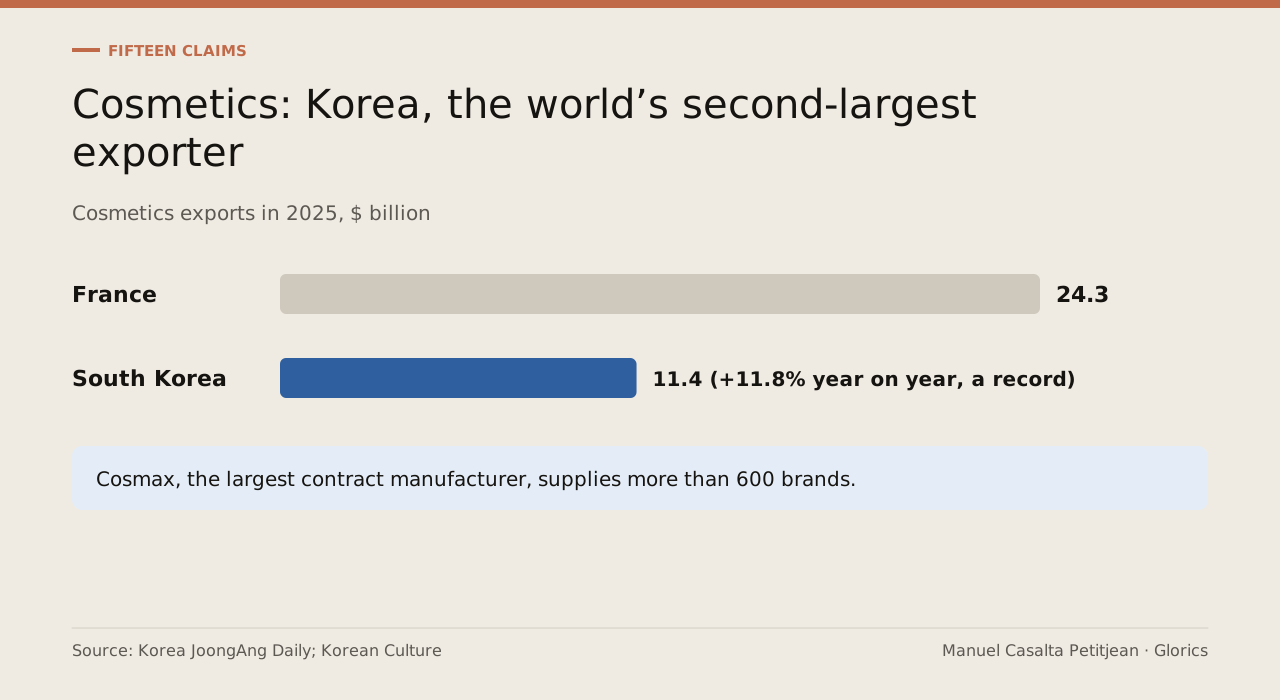
The engine of that success is a very powerful contract-manufacturing industry. Cosmax, the world’s largest contract manufacturer, supplies more than 600 brands, and small and medium-sized firms account for more than 75% of Korean exports in the sector (Korean Culture). Manufacturing has indeed become a commodity: any brand can get a quality formula within weeks.
Here is the detail that flips the reading. By outsourcing production, independent brands concentrate their resources on branding and marketing (Korea Product Post). When production is commoditised, the difference is made elsewhere: social media, speed, story. Commoditising the factory did not kill marketing. It made marketing the main field of competition.
One product per person
Mass customisation, theorised in the early 1990s, promises a product designed for each customer. Agents can bring it closer: they know their user’s precise needs and can turn them into an order. The limits remain economic: economies of scale, the cost of returns, logistics. And, as we saw, one product per customer by definition leaves perfect competition behind.
Why intermediaries exist
In 1937, Ronald Coase asked the founding question: why do firms exist, if the market is enough? His answer: because using the market has a cost, the cost of searching, negotiating and monitoring. Intermediaries thrive on these transaction costs. An agent that reduces them logically threatens those whose only service is information: comparison sites, directories, some agencies.
History counsels caution. The internet was already supposed to “disintermediate” the economy. Mostly, it gave birth to new giant intermediaries, in travel as in retail. Researchers call this reintermediation.
Hotels: the law opened the door, not technology
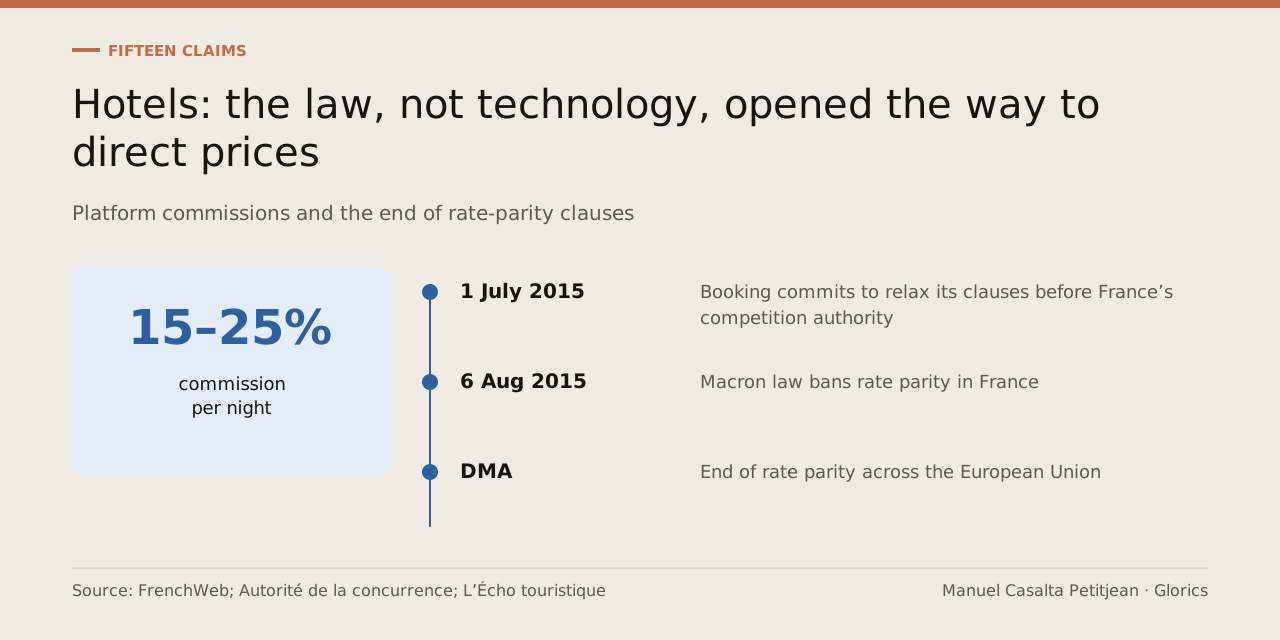
Hotel booking shows the mechanism well. Booking platforms take a commission of 15 to 25% on each night (FrenchWeb). For years, their rate-parity clauses prevented hotels from offering a lower price on their own sites.
Europe offers a clear case: law, not technology, changed the game. In France, Booking.com committed before the competition authority to change its clauses from 1 July 2015. The Macron law of 6 August 2015 then banned any clause restricting hoteliers’ pricing freedom (Autorité de la concurrence). Since the EU Digital Markets Act, hotels across the European Union can offer better prices on their direct channels (L’Écho touristique).
Agents can now exploit that freedom by systematically comparing direct and platform prices. They did not create it.
The new intermediaries
One last point often escapes the debate: the agent is itself an intermediary. It stands between customer and seller, and relies on payment and trust infrastructure that are intermediaries too. Information intermediaries retreat; intermediaries of trust and execution advance. Margin does not disappear. It changes hands.
10. Work: juniors, training, freelancers and talent
AI does not only change how things are sold. It changes the work of the people who sell them. Who will AI replace? Should employees be trained? Will the best people go freelance? Can talent be learned? Data exists on each of these points, and it corrects several common intuitions.
Juniors first, not the most expensive
You might expect a company looking for savings to replace its best-paid staff first. Early data shows the opposite. Erik Brynjolfsson, Bharat Chandar and Ruyu Chen analysed payroll records for millions of US workers. Since generative AI spread, employment for 22- to 25-year-olds in the most exposed occupations has fallen by 13% in relative terms, controlling for firm-level shocks. Employment for more experienced workers in the same occupations has held steady or grown (Stanford SIEPR, 2025).
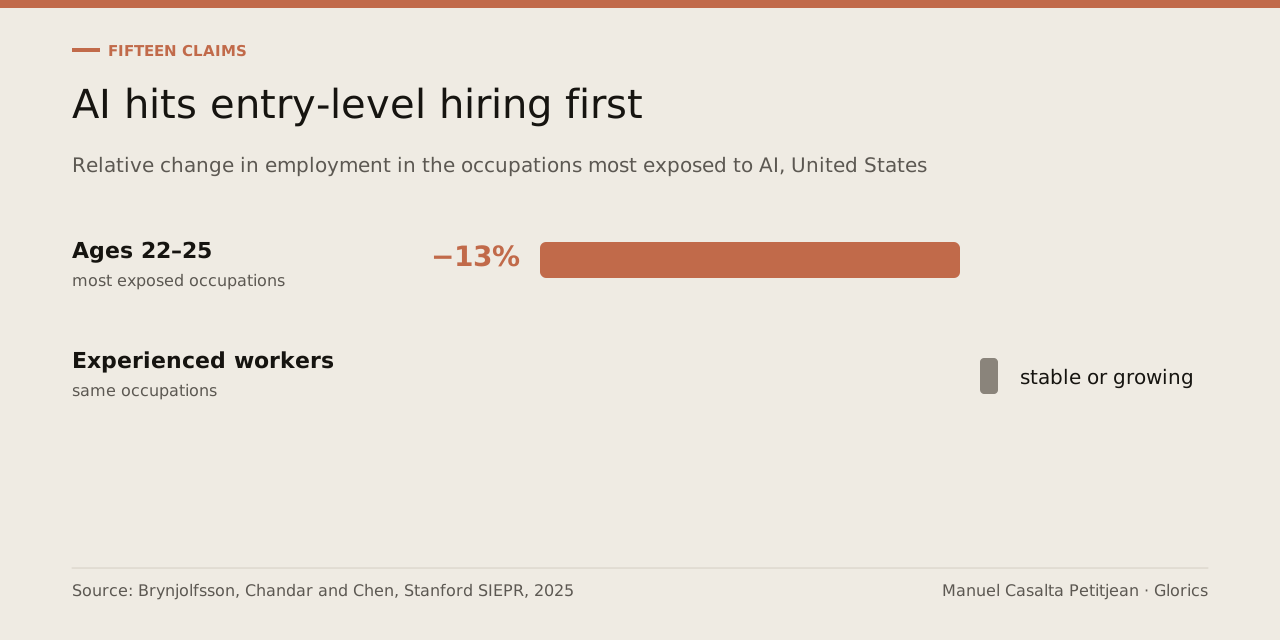
Two details matter. The adjustment happens through hiring, not wages. And the decline is concentrated in occupations where AI automates work, not where it augments it. One common reading: beginners mostly bring codified knowledge, which AI reproduces well, while seniors hold tacit knowledge that is harder to replace. The authors remain cautious: factors other than AI may be at play.
Is training employees useless?
The argument that AI is so intuitive it needs no training runs into the best available data. Anders Humlum and Emilie Vestergaard surveyed tens of thousands of Danish workers, linked to the country’s administrative registers. In 2024, workers cited the need for training and employer restrictions as the main barriers to using ChatGPT (Humlum and Vestergaard, NBER).
Employer initiatives change the picture. They raise usage for the typical worker from 47% to 83%, and narrow the gender gap from 11.9 to 5 points (BFI, University of Chicago, 2025). In their latest study, adoption ranges from 41% in firms with no AI policy to 93% where the employer combines encouragement, company tools and training (Rockwool Foundation Berlin, 2026).
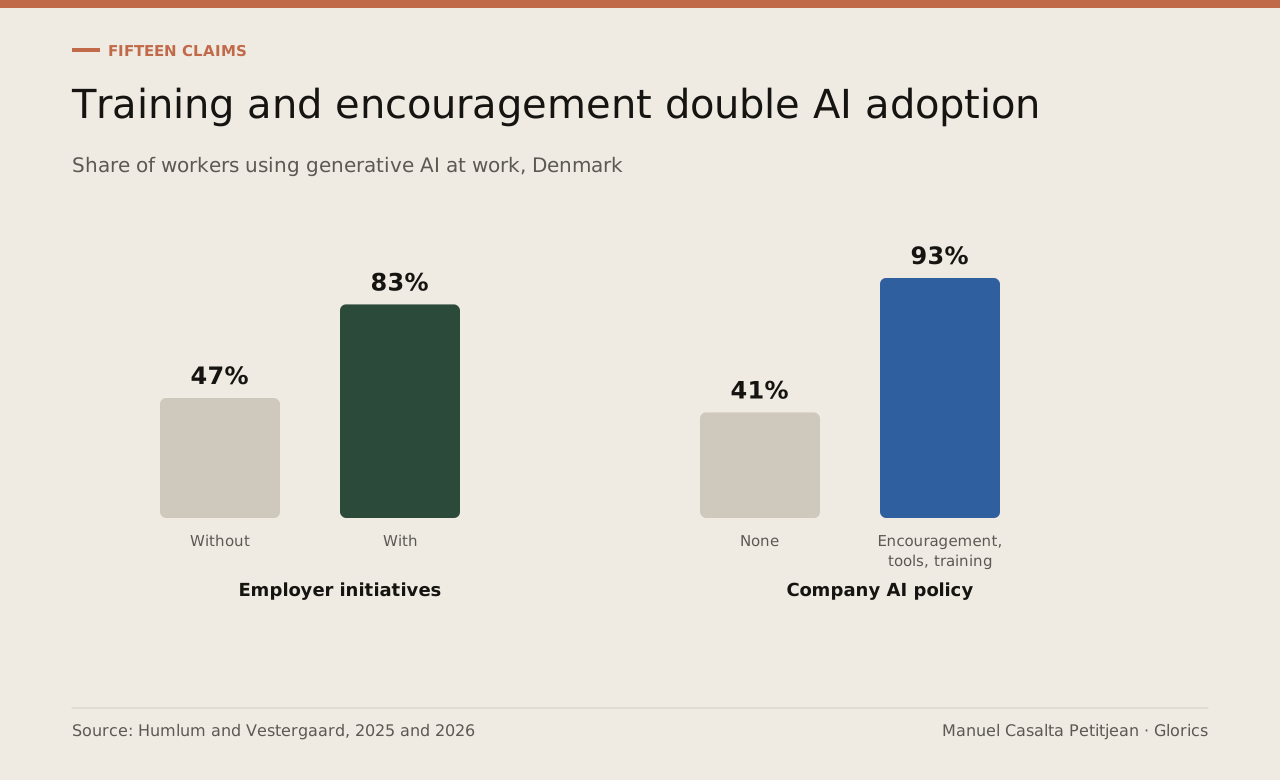
The nuance lies elsewhere: an intuitive interface does not guarantee productive use. Generic training recited in front of a screen probably does little. Training embedded in a real usage policy, with tools and rules, doubles adoption. The same research has so far found no measurable effect on wages.
Employee or freelancer: Coase’s question
Why work inside a firm rather than sell your services on the market? Coase’s 1937 answer: because contracting case by case is expensive. If AI reduces the costs of coordination, finding clients and monitoring, the boundary should shift toward the market. More freelancers, fewer employees: the prediction is consistent with theory.
France, which measures self-employment closely, is already moving that way. It had 4.4 million self-employed workers in 2022, 13% of employment, slightly below the EU average of 14% (Insee). According to Insee, the number of non-farm self-employed rose 72% between 2008 and 2022, driven by micro-entrepreneurs; a quarter of the self-employed depend economically on a single client (Économie Matin, from Insee).
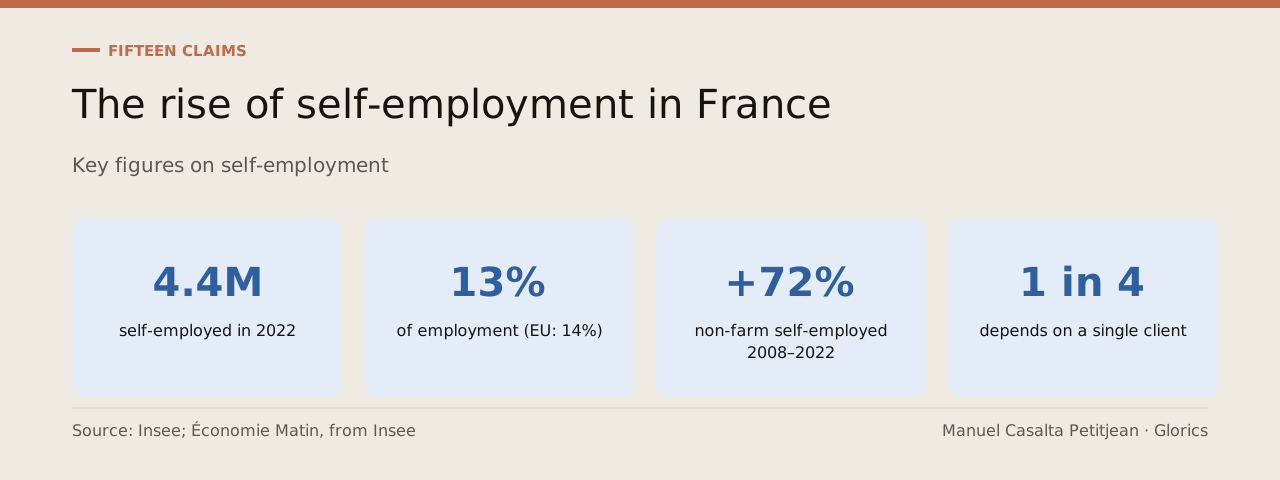
Self-employment is growing, then, but it does not gather only the best. It runs from the sought-after expert billing high fees to the precarious worker hanging on a single client.
Is talent fixed at birth?
The debate often invokes the work of the geneticist Robert Plomin. The facts are solid: the heritability of intelligence rises from about 20% in infancy to 60% in adulthood, and perhaps 80% later in life (Plomin and Deary, Molecular Psychiatry, 2015).
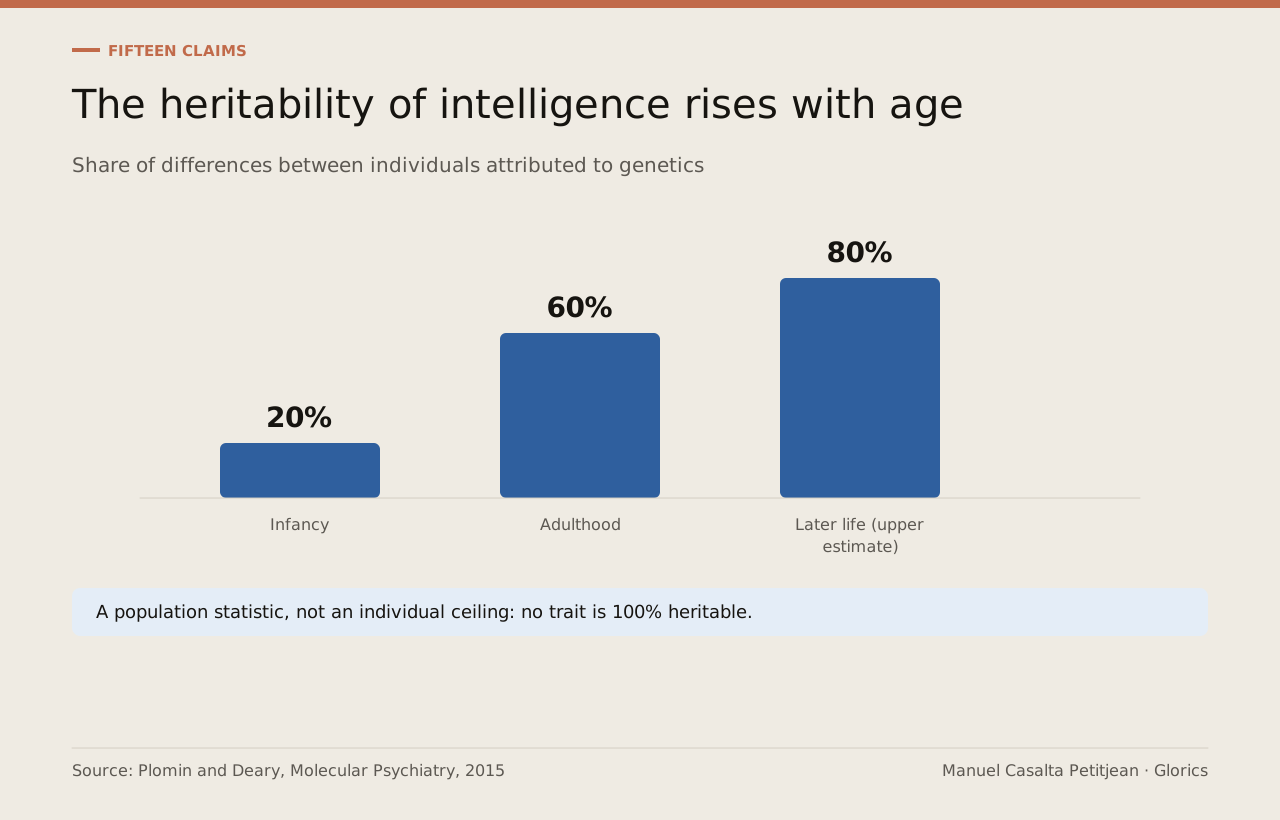
But heritability measures the share of differences between individuals in a population that genetics explains, in a given environment. It does not set an individual ceiling. The same authors stress that no trait is 100% heritable. And the Danish evidence shows that AI use depends heavily on the work environment. Concluding that people who do not pick it up on their own cannot be taught goes beyond what the data says.
Inertia: Planck was partly right
The argument from time remains. The physicist Max Planck wrote that a new scientific truth does not triumph by convincing its opponents, but because they eventually die. Pierre Azoulay and his co-authors tested it in the life sciences. After the premature death of 452 star scientists, articles by researchers outside their circle increase by 8.6% in their field, and are more often highly cited (Azoulay et al., American Economic Review, 2019).
Applied to buying habits, the principle suggests that delegation to agents will advance by generations rather than by conversions. It is an analogy, not proof. It is a useful reminder that technology moves faster than habits.
Verdict: what holds, what does not
Of the fifteen claims examined, two hold, seven hold in part and six do not survive the evidence. The strongest describe a trend. The weakest announce a destination.
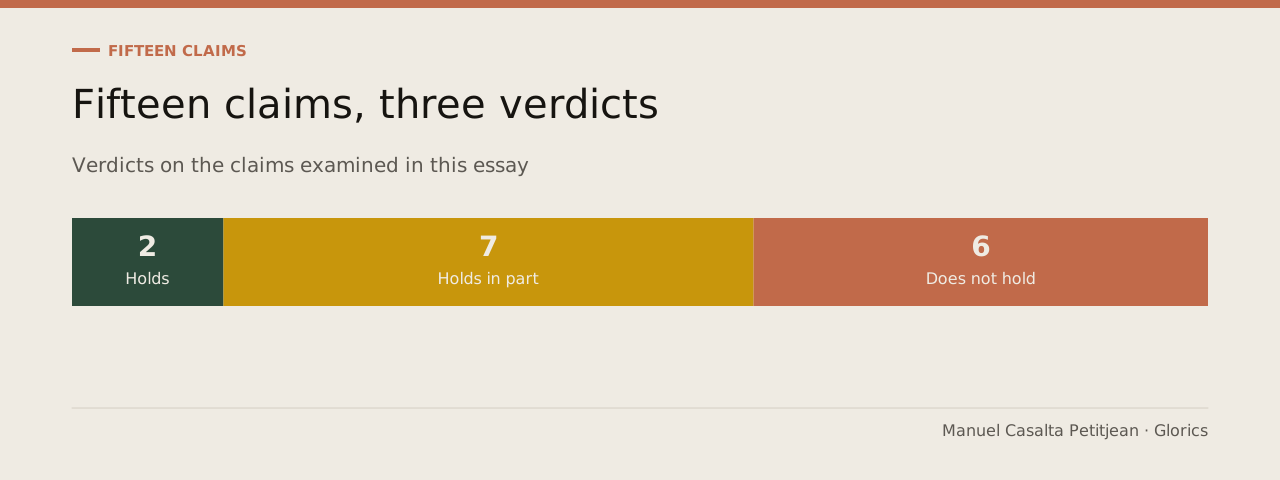
| Claim | Concept | What the evidence shows | Verdict |
|---|---|---|---|
| AI will also take over upstream marketing | Drucker’s marketing, the four Ps | Synthetic consumers give realistic results in known categories; the authors advise pairing them with human research | Holds in part |
| Marketing lives on the customer’s ignorance | Information asymmetry (Akerlof) | Brands also arose to reduce asymmetry; online, prices fell without converging | Holds in part |
| Transparency drives margins down to cost | Perfect competition, Bertrand | Seller obfuscation, algorithmic collusion, differentiation | Holds in part |
| The agent makes the brand useless | Signalling (Spence), working memory | The hotel chain premium more than halved; but models favour familiar names | Holds in part |
| The agent will talk people out of status purchases | Veblen effect | Price is the signal; luxury is stable; discretion is a pricier signal | Does not hold |
| The agent will protect people from their emotions | Somatic markers (Damasio) | Emotion is part of good decisions; heuristics are sometimes efficient | Does not hold |
| The agent may manipulate its user for their own good | Nudge (Thaler and Sunstein) | Contrary to the nudge’s transparency principle; harmful manipulation banned by the EU AI Act | Does not hold |
| Competition guarantees the agent’s loyalty | Agency theory | Hidden action, rising switching costs; the debate is moving to a duty of loyalty | Holds in part |
| Agents will produce perfect transactions | Efficient markets (Fama) | Grossman-Stiglitz paradox; correlation risk flagged by the FSB | Does not hold |
| Advertising costs more for less marginal effect | Diminishing returns | Confirmed; the eBay experiment adds that good conversion is not a real effect | Holds |
| Everything commoditises, intermediaries disappear | Transaction costs (Coase) | Manufacturing commoditised but marketing strengthened; new intermediaries of trust | Holds in part |
| AI will replace expensive seniors first | Labour substitution | Employment falls among 22- to 25-year-olds in exposed jobs, not among the experienced | Does not hold |
| Training employees in AI is useless | Technology adoption | Encouragement, tools and training raise adoption from 41% to 93% | Does not hold |
| The best people go freelance | Boundary of the firm (Coase) | Self-employment is rising fast, but it is heterogeneous and often precarious | Holds in part |
| Habits change by generation | Planck’s principle | Verified in the life sciences; applied to markets by analogy | Holds |
The common thread is clear. Shopping agents accelerate real shifts: more transparency, less weight for the brand as shortcut, weaker information intermediaries. The most radical claims get the destination wrong. They forget that firms respond, that regulators step in, and that perfect information carries its own paradoxes.
Marketing does not die. The half that designs gets stronger. The half that persuades loses the right to lie.
Sources
Research carried out on 2 and 3 November 2026. Sources are cited from search-result excerpts, with priority given to original documents: published papers, official summaries, institutional reports. Ahrefs data comes from Brand Radar, ChatGPT, United States, collected on 3 November 2026.
Two kinds of marketing
- Drucker, Management: Tasks, Responsibilities, Practices, 1973 — excerpt on selling and marketing
- Testbook — Drucker’s full quotation
- CBS News — a critique of Drucker’s thesis
- Harvard Business School, Working Knowledge — can AI replace market research?
- Brand, Israeli and Ngwe, Marketing Science Institute, 2025 — Using LLMs for Market Research
Ahrefs data
- Ahrefs Brand Radar — brands mentioned and sources cited by ChatGPT on US sunscreen questions, collected on 3 November 2026
Information, competition and prices
- Nobelprize.org — Akerlof, Spence, Stiglitz: markets with asymmetric information (2001)
- Royal Swedish Academy of Sciences — 2001 prize announcement
- Brynjolfsson and Smith, Management Science, 2000 — Frictionless Commerce?
- Ellison and Ellison, Econometrica, 2009 — Search, Obfuscation, and Price Elasticities on the Internet
- Calvano et al., American Economic Review, 2020 — Artificial Intelligence, Algorithmic Pricing, and Collusion
- Grossman and Stiglitz, American Economic Review, 1980 — On the Impossibility of Informationally Efficient Markets
- FSB, 2024 — The Financial Stability Implications of Artificial Intelligence
Brands, status and advertising
- Cowan, Behavioral and Brain Sciences, 2001 — The magical number 4 in short-term memory
- Hollenbeck, Journal of Marketing Research, 2018 — Online Reputation Mechanisms and the Decreasing Value of Chain Affiliation
- Chu and Hou, arXiv, 2026 — brand bias and manipulation in model recommendations
- Chen et al., 2025 — sources cited by AI search engines
- Han, Nunes and Drèze, Journal of Marketing, 2010 — Signaling Status with Luxury Goods (Newswise)
- USC Marshall — summary of the quiet-logo study
- Altagamma, June 2026 — Altagamma-Bain Monitor
- Cyprus Mail, from Reuters — luxury client fatigue
- Blake, Nosko and Tadelis, Econometrica, 2015 — Consumer Heterogeneity and Paid Search Effectiveness
- NBER — summary of the eBay study
- Thrad — ad formats in AI assistants, 2026
Decisions, nudges and loyalty
- Bechara et al., Trends in Cognitive Sciences, 2005 — Iowa Gambling Task and somatic markers
- Dunn, Dalgleish and Lawrence, 2006 — critical evaluation of the somatic marker hypothesis
- Bundesnetzagentur — practices prohibited by Article 5 of the AI Act
- Codozasady — examples of prohibited practices
- Covington — Commission guidelines on prohibited AI practices
- Searchable — OpenAI’s advertising principles
- OfficeChai — Anthropic’s position on advertising
Manuel Casalta Petitjean
Runs Glorics, a lab, from London and Corsica. Search reputation for Ubisoft since 2020. Contributing author on the Ahrefs blog.
Cite this
Casalta Petitjean, M. (2026, 20 November). Fifteen claims about AI and marketing, tested against the evidence. Glorics. https://glorics.com/fifteen-claims-ai-marketing
Changelog
- 20 November 2026First published.
Related
- Getting cited by AI: SEO is now a distribution game
Essay · 16 min
- Getting cited by AI without giving up SEO
Guide · 22 min
- On the homepage