The GEO guide: getting cited by AI
The November 2026 guide. How AI assistants choose who to cite, what you can change, and how to measure it without kidding yourself.
By Manuel Casalta Petitjean· Guide · 40 min · Search & GEO· Published 20 November 2026
Contents
- In short
- How to read this guide
- 1. GEO on one page
- 2. Why it matters now
- 3. How an AI builds its answer
- 4. Pillar 1: be readable
- 5. Pillar 2: be identifiable
- 6. Pillar 3: be citable
- 7. Pillar 4: be recommended by others
- 8. Measuring without kidding yourself
- 9. Special cases
- 10. A 90-day action plan
- 11. Classic mistakes and myths
- 12. Thirteen months that changed the game
- Toolkit
Figures checked as of 8 October 2026, with additions checked on 23 October 2026, updated 30 October 2026 with my own study on citation stability, and completed on 11 November 2026 with Businesses in ChatGPT. Unless stated otherwise, the studies cited cover the US market.
Reading time: 40 minutes. Short on time? Read The essentials in ten points, then the starter checklist (section 10).
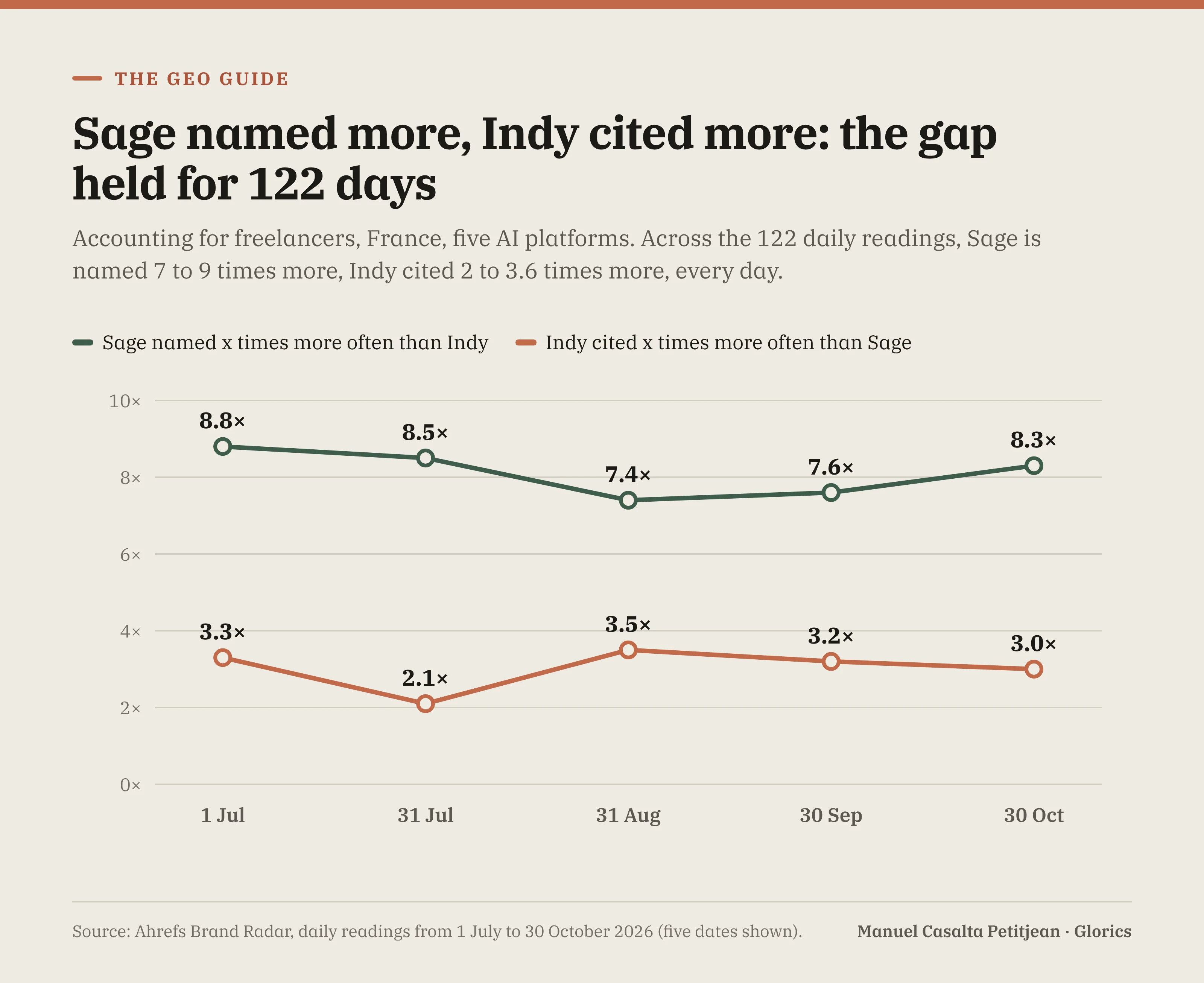
In France, in accounting software for freelancers, Sage is named eight times more often than Indy (a French accounting app for freelancers) in AI assistants’ answers. Yet it is Indy that they cite as a source, twice as often as Sage (Ahrefs Brand Radar, snapshot of 31 July 2026). The gap held on each of 122 daily readings, from 1 July to 30 October 2026 (overlapping readings, since each question is refreshed about once a month). Being known and being cited are two different jobs.
Ask ChatGPT the question your customer is asking. A handful of names come up. If yours isn’t one of them, you don’t exist in that conversation. This guide explains how those names are chosen, what you can work on, what you can’t, and how to measure without kidding yourself.
Contents: The essentials in ten points · How to read this guide · 1. GEO on one page · 2. Why it matters now · 3. How an AI builds its answer · 4. Be readable · 5. Be identifiable · 6. Be citable · 7. Be recommended · 8. Measuring without kidding yourself · 9. Special cases · 10. A 90-day action plan · 11. Classic mistakes and myths · 12. Thirteen months that changed the game · Toolkit
In short
- 1.GEO is a layer, not a replacement. AI Overviews and AI Mode draw on Google’s index. In a study by AirOps and Kevin Indig (815,000 query-page pairs, 2026) 35, a page ranked first in the results ChatGPT consults is cited 58% of the time, against 14% in tenth position. No SEO, no GEO.
- 2.Three conditions follow one another: being retrieved by the engine, being extractable as clear passages, being confirmed elsewhere on the web.
- 3.Being cited is not being recommended. In an Ahrefs experiment, 43% of the answers that cited a page promoting a new brand did not even name that brand.
- 4.AI traffic is still small, between 0.3% and 1% of traffic depending on the panel. The main effect lies elsewhere: influence over the choice, and fewer Google clicks wherever an AI Overview appears.
- 5.OpenAI’s, Anthropic’s and Perplexity’s crawlers do not execute JavaScript, according to the benchmark study by Vercel and MERJ (December 2024) 27, which independent tests published in 2026 largely confirm. Googlebot does. A client-side rendered site can rank well on Google and stay invisible to ChatGPT.
- 6.For ChatGPT Search, the crawler that matters is OAI-SearchBot, not GPTBot. Google-Extended does not remove you from AI Overviews: it governs the training of Gemini models and grounding in the Gemini app and on Vertex AI. To opt out of AI Overviews, the lever is the “Search generative AI” control in Search Console.
- 7.Brand mentions across the web, above all on YouTube, are the signals most correlated with visibility in AI. Correlation, not causation.
- 8.Self-promotional listicles are losing ground in ChatGPT: those “top ten tools” rankings where the author puts themselves first. An honest comparison, clean data and placements on third-party sites hold up better.
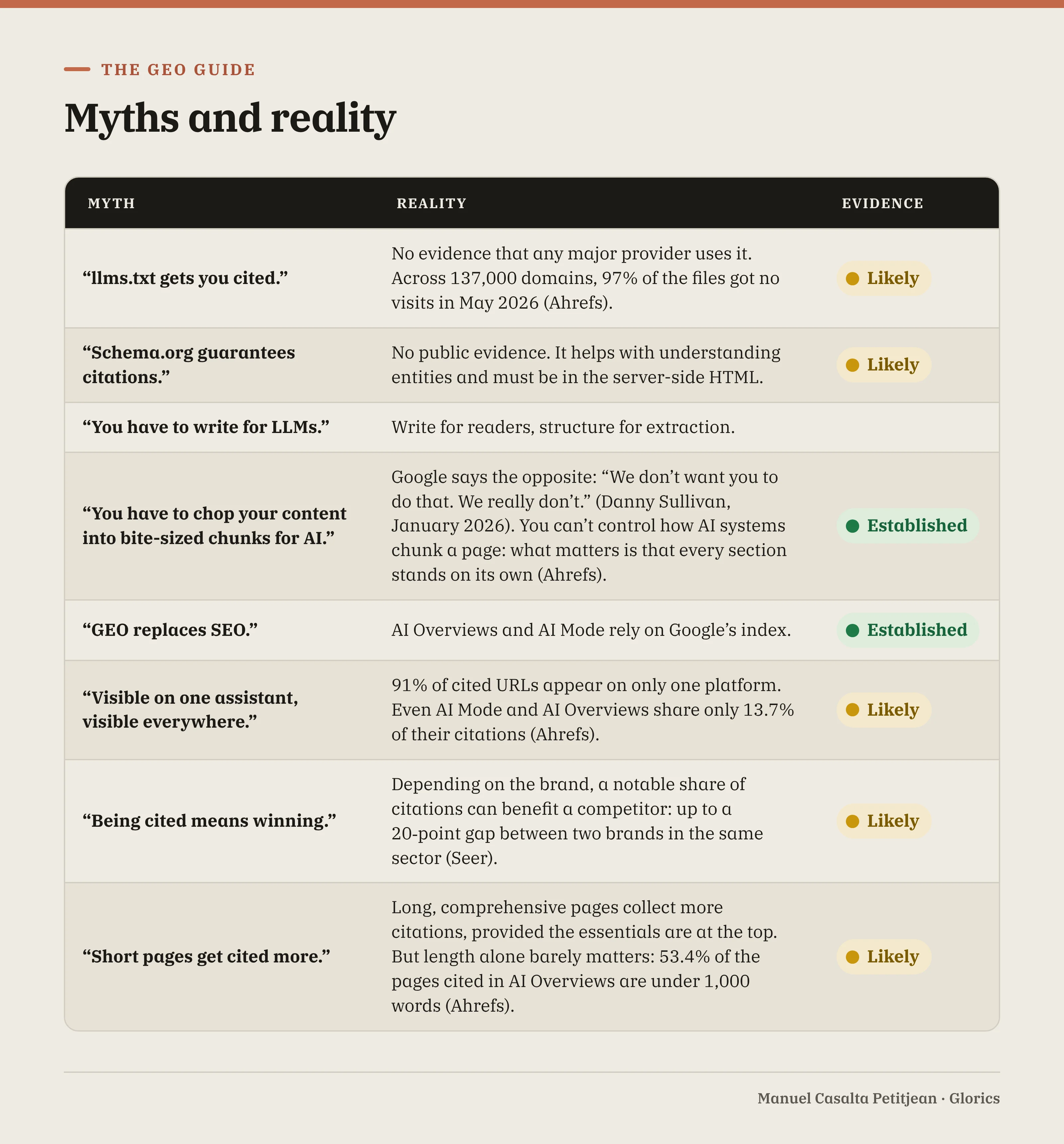
- 9.The same question never gives the same answer twice. Measure by sampling, assistant by assistant: 91% of cited URLs appear on only one platform (Indig, 2026).
- 10.In a locked-up market, aim for a sub-segment, institutional sources and proof that your company exists.
How to read this guide
Every important claim carries a level of evidence.
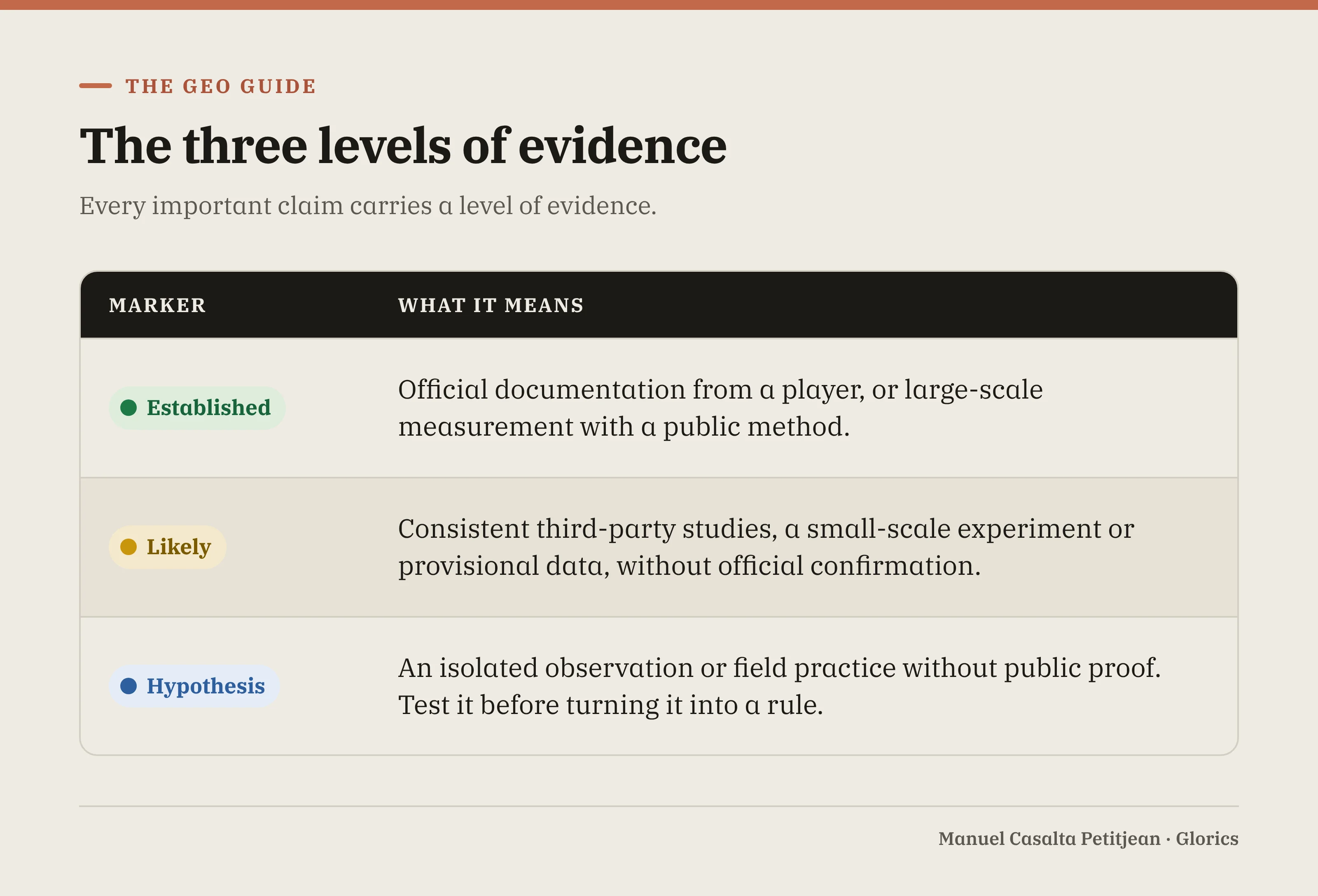
Three caveats before we get into the detail.
- On the sources. Many figures come from vendors of tracking tools (Ahrefs first, then Seer, Promptwatch, Peec, Similarweb), who sell the measurement they publish. Their data is still the best available. Read it for what it is.
- On me. I write, as a guest author, for Ahrefs’ French blog. Several of my articles are referenced here (case studies on Indy, Lemlist and ManoMano, founder personal branding, local SEO, freelance SEO). They are in French, and so are the links to them. Most figures from Brand Radar come from single-day snapshots: they are dated and marked . The gap between Indy and Sage, though, was re-checked over 122 daily readings, which overlap (each question is refreshed about once a month). The guide also includes my own study of how stable citations are from one month to the next (section 8).
- On shelf life. AI assistants change behaviour without warning: in mid-August 2026, Reddit lost most of its share of ChatGPT Search citations within a few days (section 3). Every rule in this guide therefore has a use-by date. The only habit that never expires: measuring.
The examples follow two fictional cases throughout the guide. First, Vinaxe: a software publisher selling management software to wine estates. Second, a roofer in Bristol, for the local angle. Any resemblance to an existing company would be coincidental.
1. GEO on one page
GEO (Generative Engine Optimization) is the work that makes a brand visible in the answers generated by AI assistants: ChatGPT, Gemini, Claude, Perplexity, Copilot, and Google’s AI Overviews. You will also come across the acronyms AEO and LLMO. Same idea, different label.
The work rests on four pillars. Each one sits on the one before, and none replaces the SEO foundation.
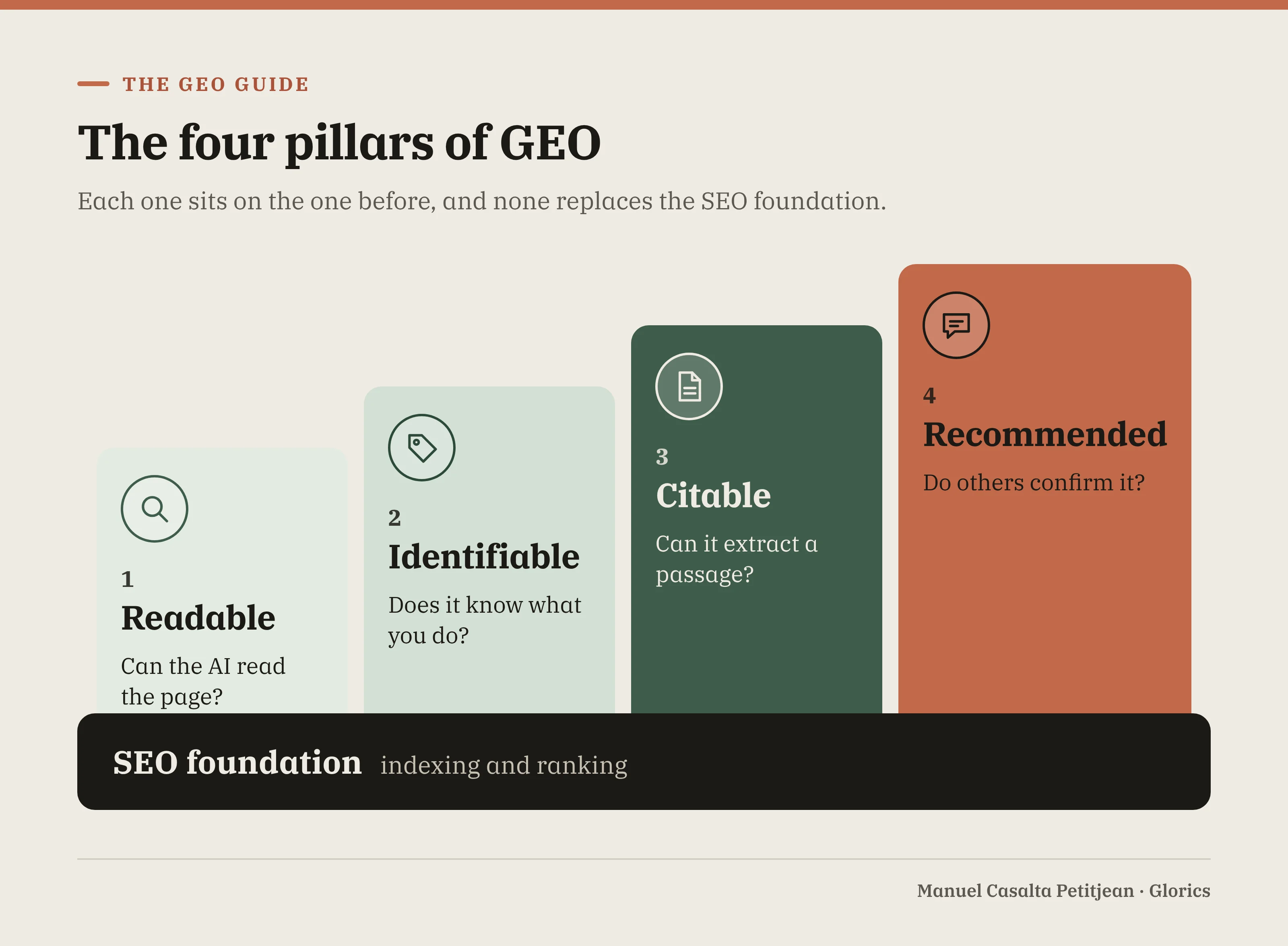
An unreadable site makes all the content work pointless. Brilliant content without a clear category will never be matched to the right questions. And a brand nobody else mentions will remain, at best, an anonymous source.
Good news for smaller players: this work does not only reward the most powerful domain. To answer, the assistant breaks the question down into sub-questions and looks, for each one, for the passage that answers it best (section 3). On a given topic, around thirty domains capture two thirds of ChatGPT’s citations (section 7). But on a precise question, the spot is still open. A lone expert, with a solid, well-structured LinkedIn article or an op-ed in a trade publication, can be cited alongside the biggest sites.
I have seen it in my own line of work. In my article on freelance SEO (in French, September 2026), a freelancer ranked second on Google for “freelance seo”, six places ahead of a far more powerful platform. In ChatGPT, twenty-four domains shared the citations, one answer each, with none of them standing out as the reference (Ahrefs, snapshots of 19 August 2026). I saw it as a windfall for independents, and the reasoning holds for any modest brand (see also section 10). I also noted that Google now pulls LinkedIn articles into its AI Overviews in France. This guide, published on LinkedIn, is a full-scale test of that.
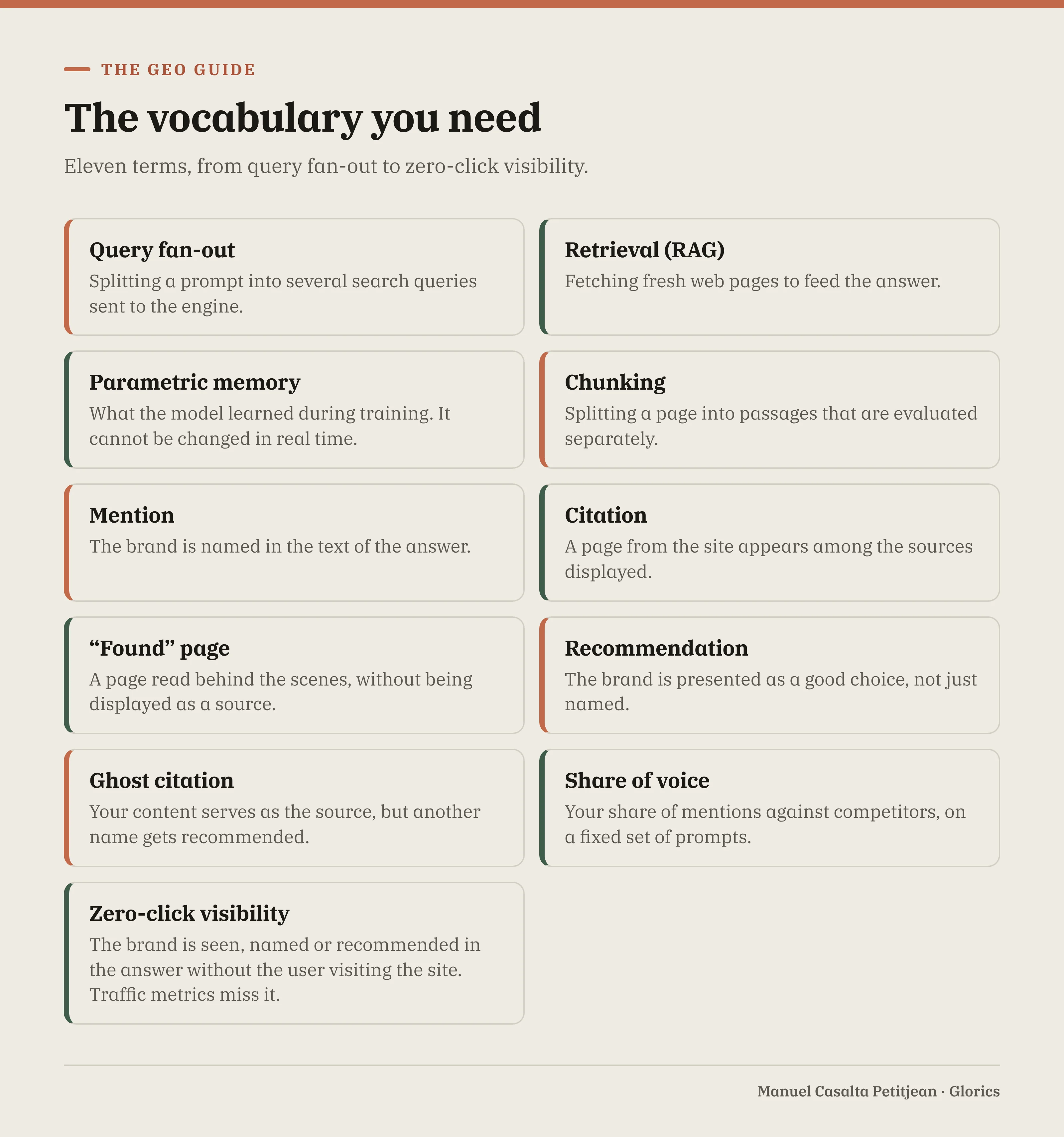
The vocabulary you need
2. Why it matters now
AI traffic is still small
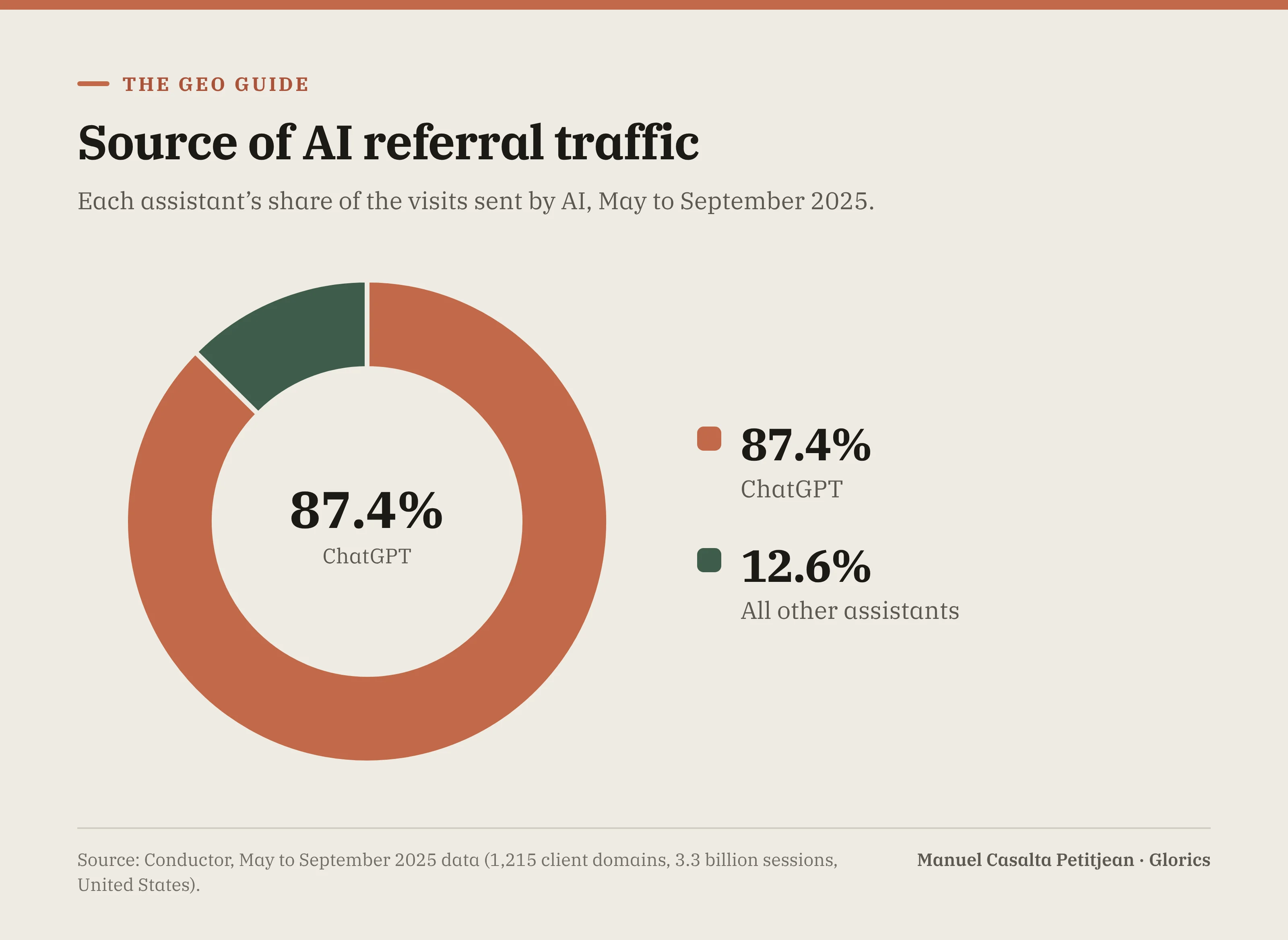
Ahrefs counted 3.5 million visits from AI chatbots in March 2026, across 74,752 tracked sites: 0.28% of total web traffic. ChatGPT sends 2.7 million of them, roughly ten times more than any other assistant.
Other panels see higher numbers. Conductor measures 1.08% of traffic across 1,215 client domains (more than 3.3 billion sessions, United States, May to September 2025), with wide gaps between sectors: IT gets far more than the average. The gap comes down to the panel, the definition of AI traffic and the sector. Keep a range of 0.3% to 1% in mind, growing, with ChatGPT accounting for most of the clicks.
Another way to size it, from an Ahrefs estimate: ChatGPT handles roughly 12% of Google’s search volume for the kind of queries people used to type into a search engine, yet Google sends 190 times more traffic to websites (February 2026). Assistants answer a lot and send very little back.
Don’t confuse clicks with influence. Ahrefs also tracks the sign-ups that its new customers themselves attribute to an AI. In March 2026, Claude accounted for 2,836 of them, against 1,978 for ChatGPT, which nonetheless sends far more visits. An assistant that generates few clicks can carry real weight in the decision.
Those rare visits are worth more than their volume suggests. At Ahrefs, traffic from AI assistants made up just 0.5% of visits but 12.1% of sign-ups: visitors who convert around 23 times better than classic organic search visitors (June 2025). That’s one site, with an audience of marketing professionals, so read it as a signal, not a benchmark.
Clicks land on the homepage
On 7 May 2026, ChatGPT started turning the brand names in its answers into clickable links to the brand’s website. According to Similarweb (desktop panel), the share of ChatGPT clicks landing on a homepage went from around 26 to 32% to nearly 60%, and the volume of visits rose sharply in the wake of the change.
The direct consequence: your homepage now receives a cold visitor, who knows nothing about you beyond the sentence they read in the answer. In three seconds, it has to say what you do, for whom, and what the next step is.
The real cost: fewer clicks from Google
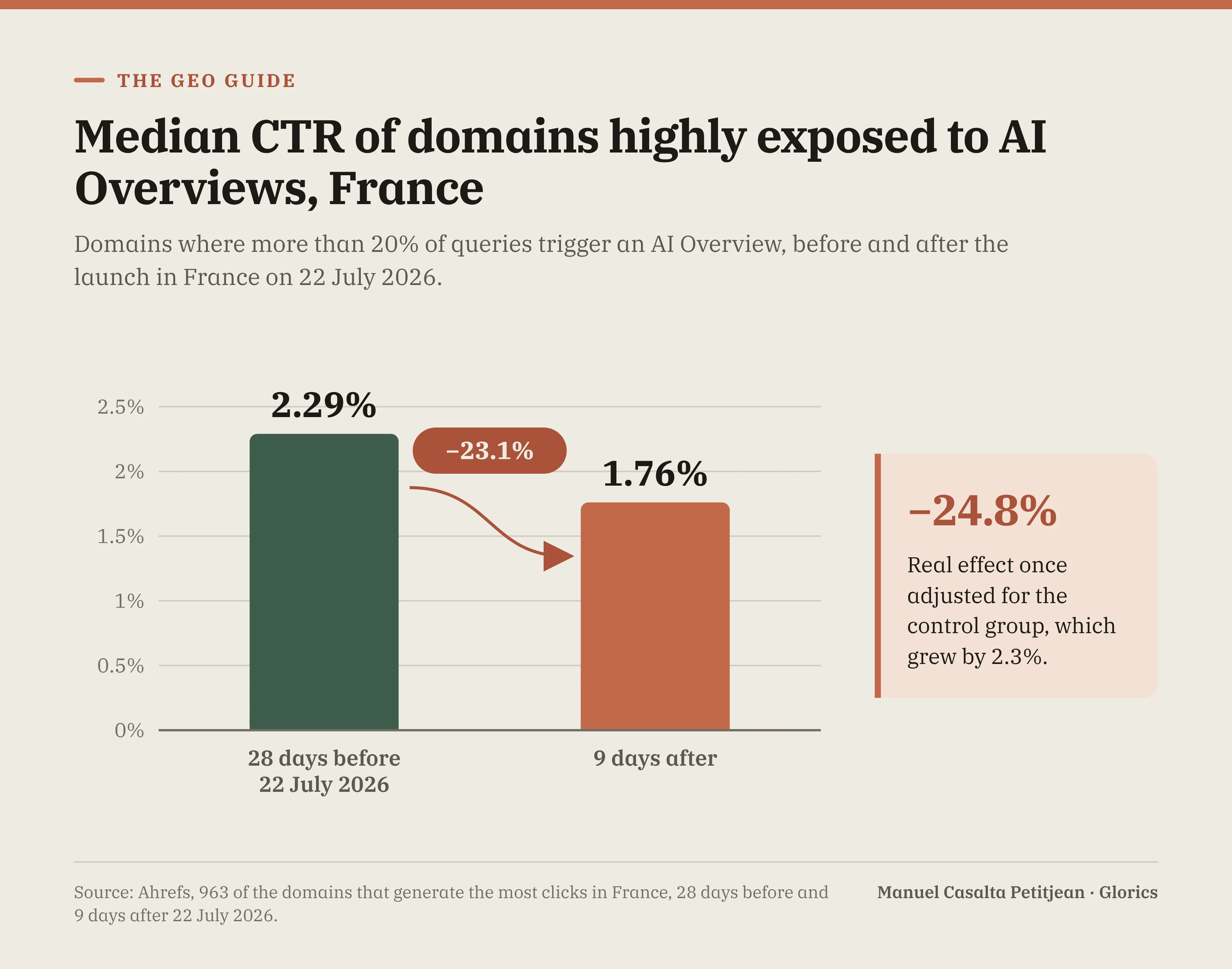
AI Overviews and AI Mode launched in France on 22 July 2026. Across the 963 domains that generate the most clicks in France, Ahrefs compared the 28 days before with the 9 days after. This is French market data.
- Highly exposed domains (more than 20% of their queries trigger an AI Overview) saw their median CTR (click-through rate) drop from 2.29% to 1.76%: -23.1%. Adjusted for the control group, which grew by 2.3%, the real effect reaches -24.8%.
- Across the whole panel, the median is more modest: -5.7% in CTR and -8.8% in clicks.
- A rule of thumb, not a law: over those nine days, the regression gives a slope of -0.9. Remember the order of magnitude. Each point of exposure to AI Overviews costs around 1% of CTR, in relative terms: with 15% of queries exposed, expect roughly 15% less CTR.
- Exposure remains low in France: 5.4% of queries show an AI Overview for the panel’s median domain. Health is the most exposed sector, at 22%.
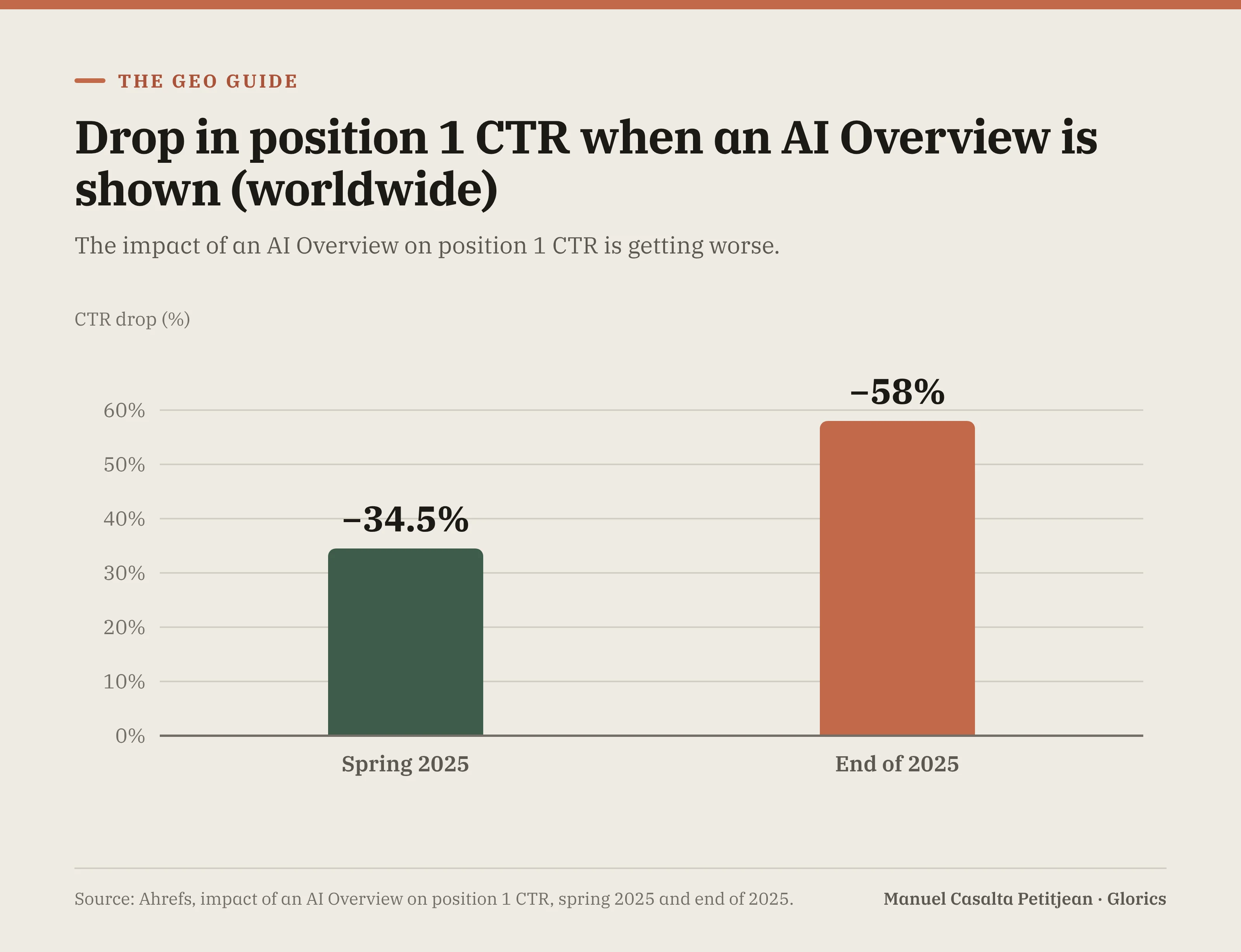
Let’s be honest about the scope: nine days of data is short. But the global trend points the same way, and it is getting worse. According to Ahrefs, the impact of an AI Overview on the CTR of position 1 went from -34.5% in spring 2025 to -58% at the end of 2025.
A reporting trap, which Ahrefs sums up well: an AI Overview doesn’t remove you from the SERP (the results page), it makes you useless on it. Impressions hold, CTR collapses. Reporting on impressions therefore hides the problem.
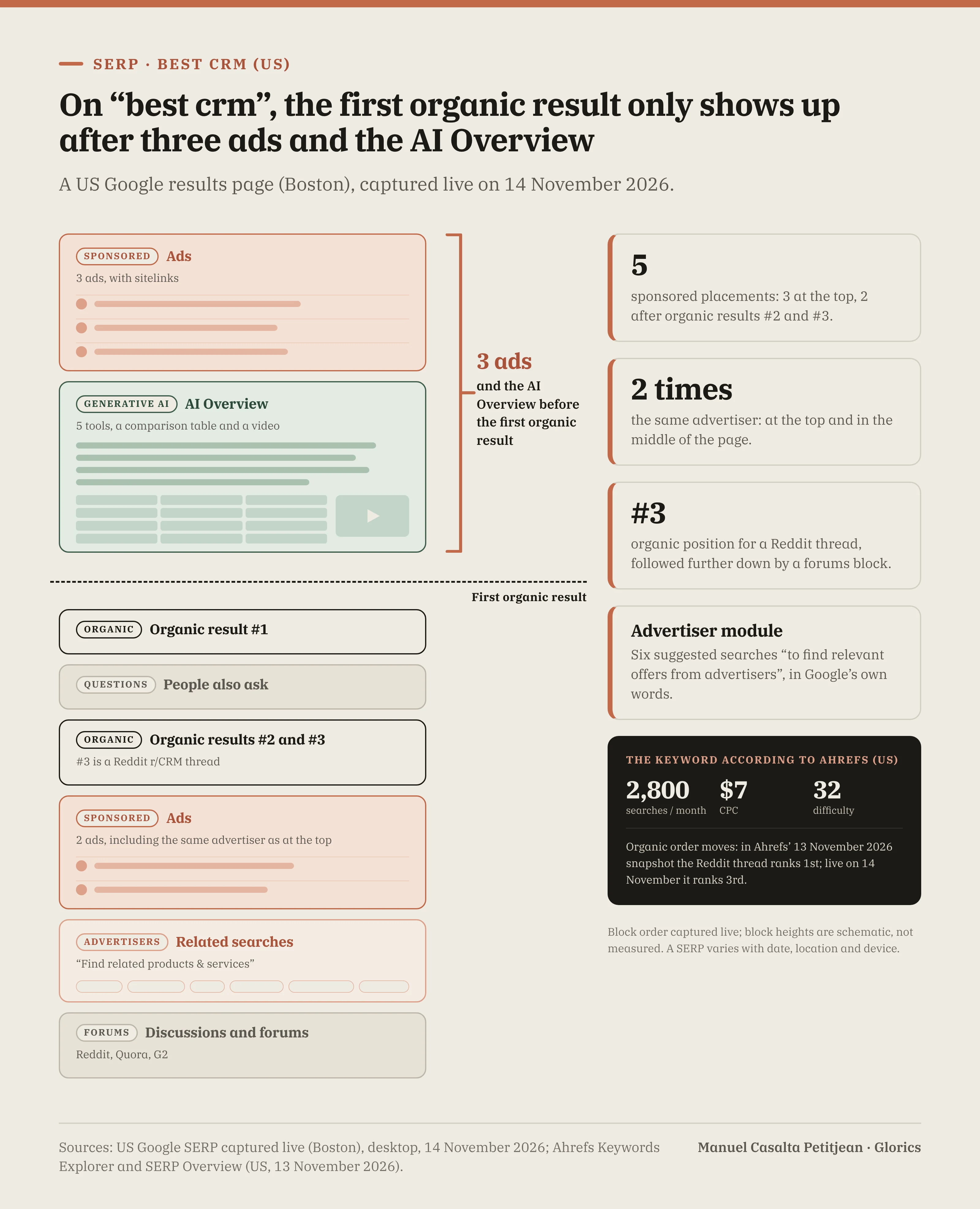
On a competitive keyword like “best crm”, the first organic result only appears after three ads and an AI-generated answer. For the user, the answer is already there. For a brand, being cited in that answer now matters as much as ranking below it.
What holds up, what fades away
Ahrefs analysed 146 million SERPs (desktop, September 2025): 99.9% of keywords that trigger an AI Overview are informational, and 57.9% of queries phrased as a question trigger one. Across the whole sample, an AI Overview shows up on 20.5% of keywords, roughly one in five.
One exception has emerged since: branded queries. Much less exposed in 2025 (13.1% of them showed an AI Overview), they show one on 83% of US desktop SERPs as of 29 September 2026, and on 73.3% on average over the month (Ahrefs). Your own brand name is no longer a protected query.
So sort your keywords by intent before you sort them by topic. The tree below follows Ahrefs’ framework.
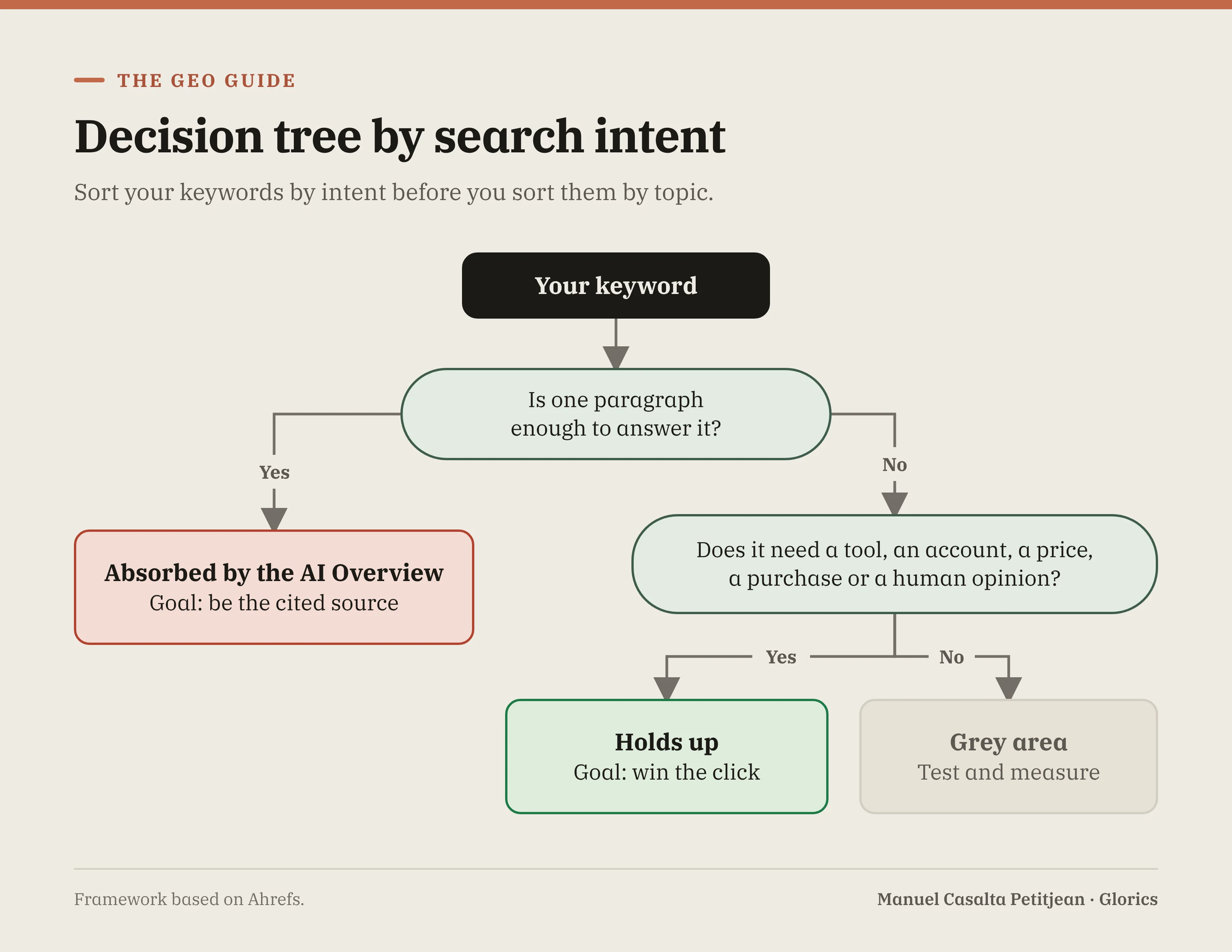
GEO therefore has two sides. A defensive side: remaining the cited source in answers that absorb the clicks. An offensive side: being named where the user makes the decision.
3. How an AI builds its answer
The seven steps
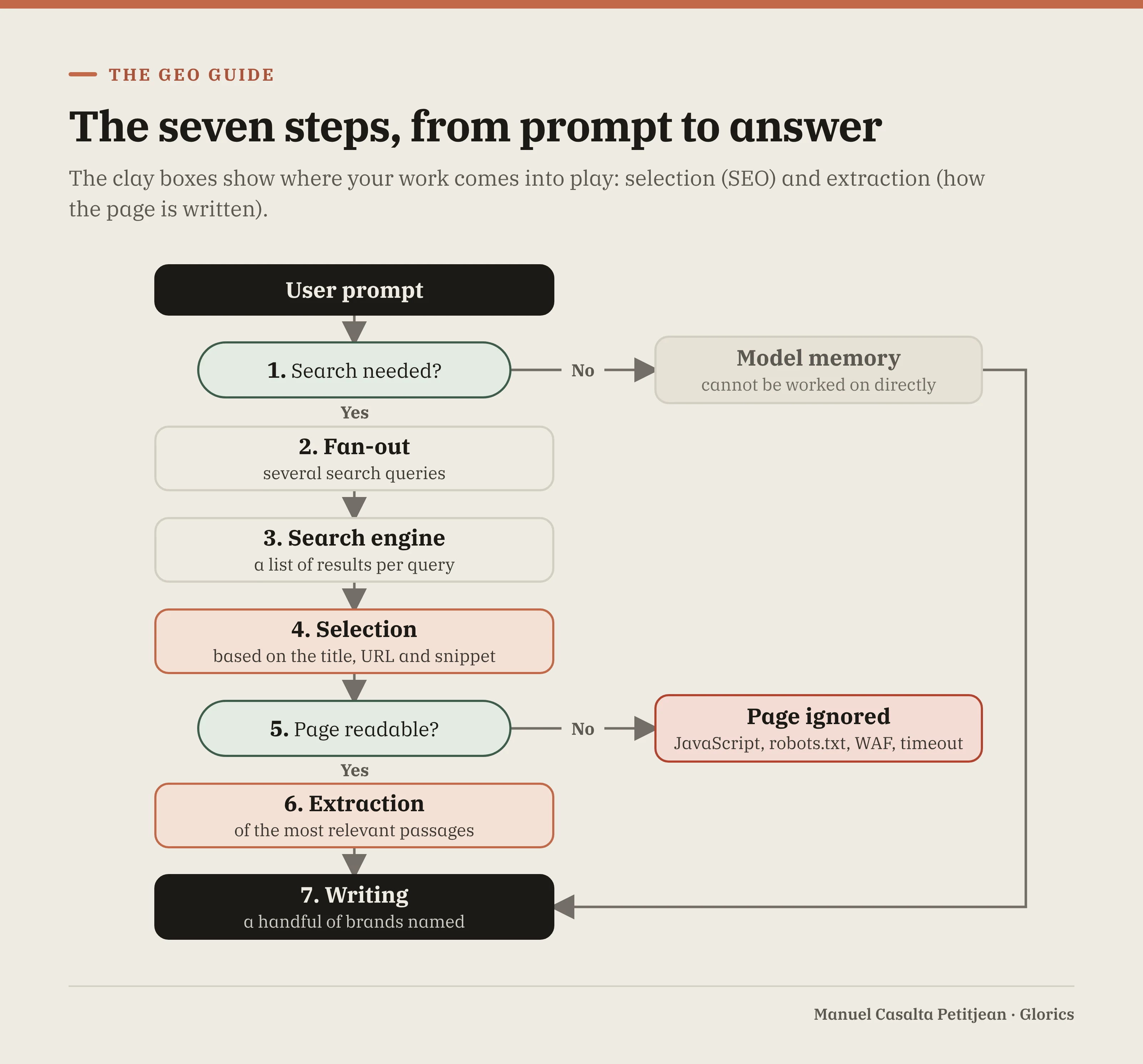
The highlighted boxes show where your work comes into play. Selection depends on your ranking, so on SEO. Extraction depends on how the page is written. Indy ticks both boxes: nearly 39,000 ranking keywords, more than 36,000 of them in the top 10, and guides each built around a single question (see section 6).
- 1.Trigger. The model decides whether to answer from memory or to search. It searches when information is missing, looks out of date, or when the user switches search on. Your influence on memory is only indirect, through what was published and picked up before training.
- 2.Fan-out. The prompt becomes several queries. “What software can track stock for a 15-hectare wine estate with a cellar door shop?” becomes “wine estate management software”, “cellar door stock software direct sales”, “winery software comparison 2026”, and so on. According to AirOps data reported by Kevin Indig, pages found through these derived queries account for around a third of the content ChatGPT cites.
- 3.Retrieval. An engine returns results for each query. Which one depends on the assistant (see below).
- 4.Selection. Before opening anything, the model only has what the engine sends back: title, address, a short snippet. How many results it reviews is not documented, and probably depends on the assistant. One consequence is solid: a page whose title doesn’t say which question it answers starts at a disadvantage.
- 5.Reading. The crawler fetches the HTML. Content missing from the code, access denied or a response that is too slow: the page drops out of the race, and another takes its place.
- 6.Extraction. The page is split into passages, and only the most relevant are kept. ChatGPT retrieves around six times more pages than it cites (AirOps). It mostly cites the top of pages: the bottom 10% of a page only collects 2.4 to 4.4% of citations (Indig, 1.2 million answers analysed).
- 7.Writing. The model assembles an answer that usually names a few brands. For that user, at that moment, the rest of the market does not exist.
Which engine behind which assistant
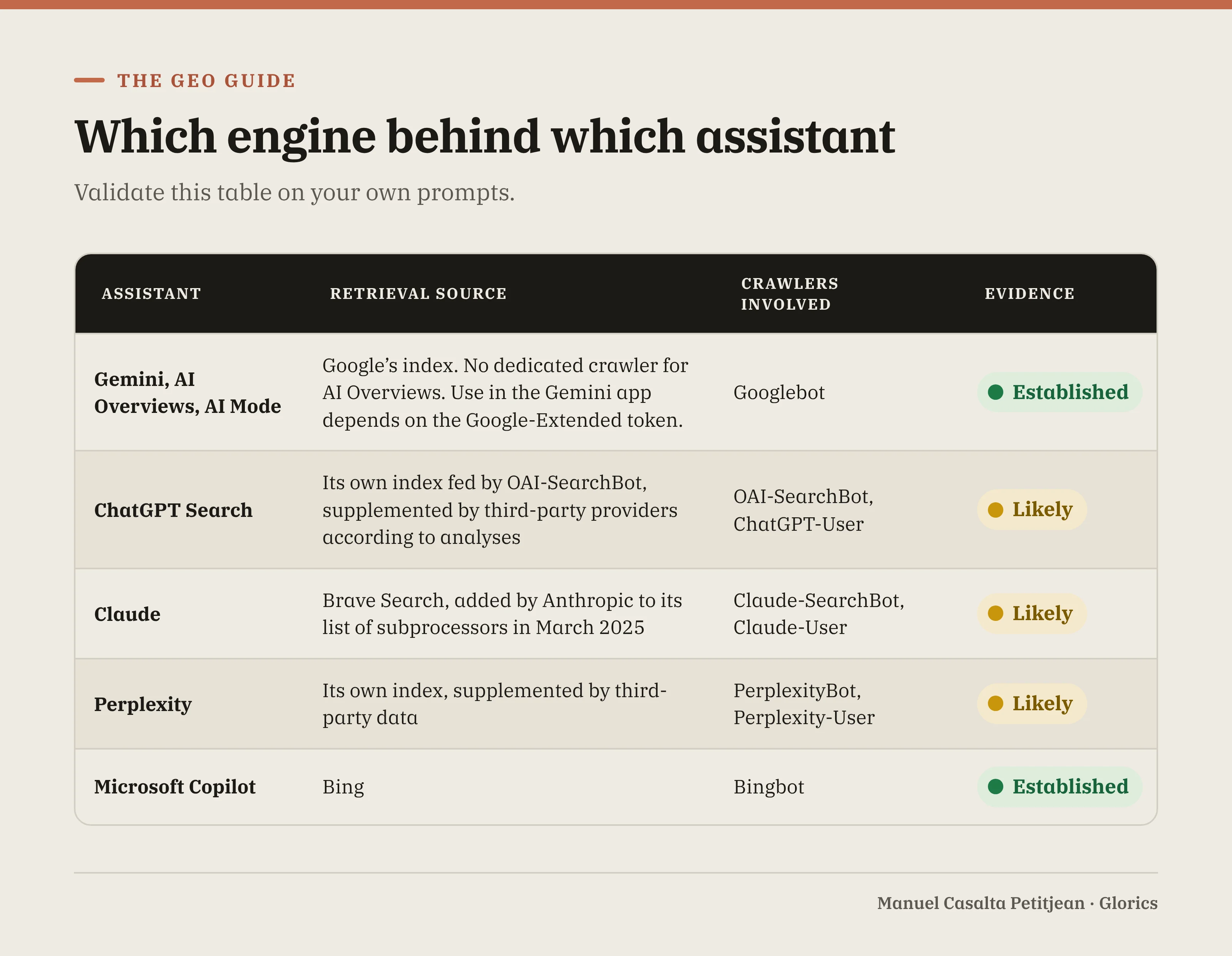
Don’t bet on a single engine. Check indexing in Google and in Bing (Bing Webmaster Tools, IndexNow). Then validate this table on your own prompts: do the URLs cited by an assistant rank in Google, in Bing or in Brave?
Even within Google, rankings no longer predict citations on their own. According to Ahrefs’ research, 76% of the pages cited in AI Overviews ranked in the top 10 in July 2025; a fresh measurement in March 2026 put that figure at 38%. Outside Google the gap is wider still: across 15,000 prompts, 28.6% of the URLs Perplexity cites rank in Google’s top 10, against around 8% for the other assistants studied (Ahrefs, August 2025). Ranking well is still the best way in. It’s just no longer a guarantee. In my study (section 8), URLs that stayed cited from one month to the next were more often in Google’s top 10 than newcomers: 23% against 9%. It is a hint, not proof.
The groundwork benefits every assistant. Measurement, on the other hand, has to be done assistant by assistant: out of 3.7 million URL citations, 91% appeared on only one platform among ChatGPT, Perplexity and AI Overviews (Indig, 2026). Assistants also change their behaviour very quickly. On 31 July 2026, of Indy’s 339 citations, ChatGPT accounted for 154, Copilot 112 and Gemini just one. Until 20 August, Gemini cited Indy only zero to two times per daily reading. Since 31 August, it has cited it between 100 and 168 times (Brand Radar). The change may come from the assistant or from the tool’s data collection. Either way, the lesson is the same: measure each assistant separately, and more than once.
The sources themselves differ too. Of the 50 domains most mentioned by ChatGPT, Perplexity and AI Overviews, only 7 make the list for all three (Ahrefs, June 2025). The same holds inside Google: across 730,000 pairs of answers, AI Mode and AI Overviews reach very similar conclusions (86% semantic similarity) while sharing only 13.7% of their citations. A brand mentioned in an AI Overview has a 61% chance of also showing up in AI Mode (Ahrefs, 2025).
Mention, citation, recommendation: three distinct events
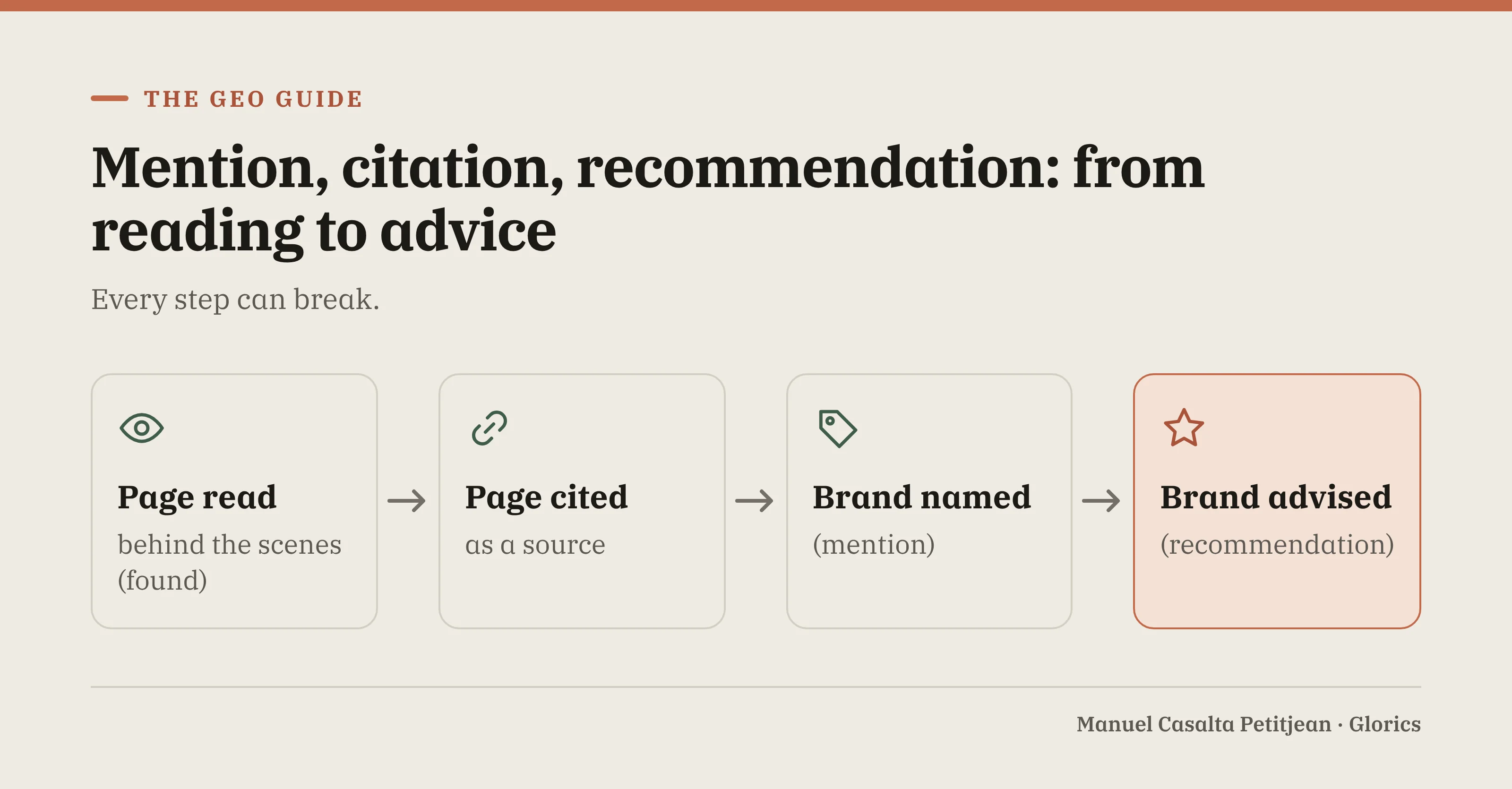
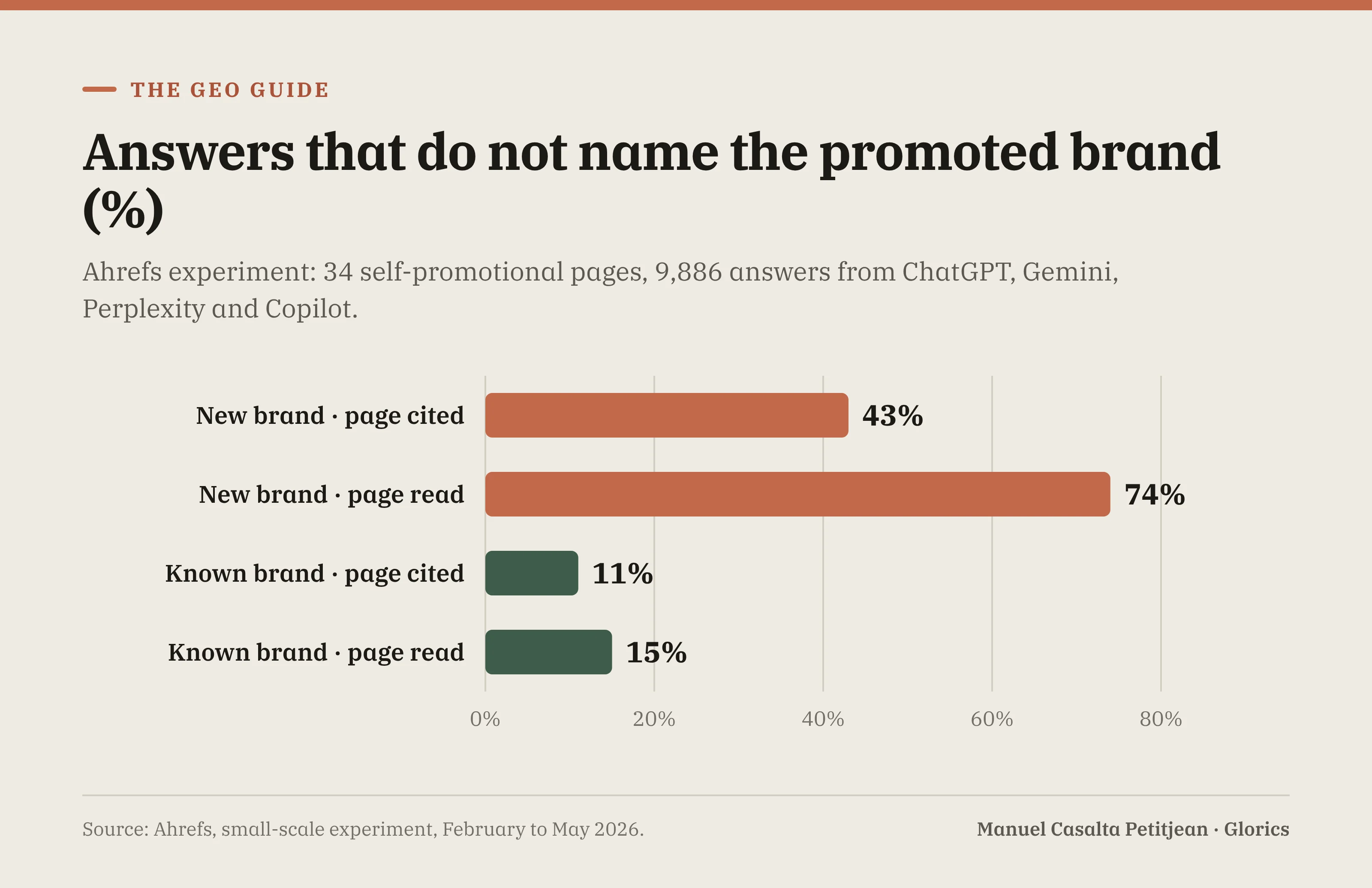
Every step can break. Ahrefs showed it in a small-scale experiment, from February to May 2026, with 34 self-promotional pages and 9,886 answers from ChatGPT, Gemini, Perplexity and Copilot.
- Citing is not recommending. For a recently launched conference, 43% of the answers that cited one of the promotional pages never named the conference. They recommended another one, featured on the same page. For a product that was already well known, that rate fell to 11%.
- A page that is read but not cited does even worse. For the new brand, 74% of those answers ignored the promoted brand.
- Credit depends on the engine, not on the page. Among answers where a page was present, Perplexity left 76% without credit, while ChatGPT credited 61%.
The phenomenon goes beyond this experiment. Seer Interactive compared two established brands in hospitality and travel: a gap of more than 20 points, with nearly 30% of one brand’s citations benefiting competitors, against less than 10% for the other. Semrush and Kevin Indig go further: 61.7% of citations come with no mention of the cited brand. Their definition is broader than this guide’s, since it does not assume that a competitor gets recommended in your place.
The reverse also exists: being named without ever serving as a source. In France, in accounting for freelancers, Sage racks up 10,923 mentions in the answers of five AI platforms, but only 177 citations. Indy has eight times fewer (1,295), but 339 citations, the top spot in the sector (Ahrefs Brand Radar, snapshot of 31 July 2026, for my Indy case study). Awareness gets a brand named. Content gets it cited.
I re-checked this gap over 122 daily Brand Radar readings, from 1 July to 30 October 2026, in France, on the same five platforms (overlapping readings, since each question is refreshed about once a month). It held every single day. Sage is named 7 to 9 times more often than Indy. Indy is cited 2 to 3.6 times more than Sage, despite around 8 times fewer mentions, and stays first in its sector for citations every day, ahead of Sage, Pennylane, Shine, Tiime and QuickBooks. 31 July was in fact close to the low point of its lead. One caution: raw volumes doubled for every brand at the end of July. Compare brands with each other on the same date, not volumes from one month to the next.
A mention without a link isn’t wasted, though. Looking at its own brand, Ahrefs found that assistants add a link only about 28% of the time on average: 51.6% on Perplexity, just 10.7% on AI Overviews (November 2025). Count mentions, not just clicks.
A citation is a time slot, not a given
- In AI Overviews, only around 54% of cited URLs are still there from one check to the next (Ahrefs, more than 43,000 keywords).
- In the Ahrefs experiment, a cited page was on average only cited one eligible day in three.
- Between February and April 2026, ChatGPT’s citation volume fell by 86 to 94% depending on the market, before bouncing back in May: the model had stopped citing anything at all on a large share of queries (seoClarity) 49.
- The reasoning level changes things too: across 100 prompts, the share of answers with at least one citation went from 50% in fast mode to 68% in thinking mode (Semrush and Indig, May 2026) 36.
August 2026: ChatGPT targets specific domains
On 8 August 2026, the share of ChatGPT fan-out queries using the site: operator went from 0.37% to 16.8% in a single day. The average number of queries per answer rose from 1.08 to 1.83 (Promptwatch). Rather than searching the whole web at random, the system queries domains it considers authoritative directly.
In the wake of this, Reddit fell from 3.83% of ChatGPT Search citations (18 July to 7 August) to 0.52% (14 to 17 August).
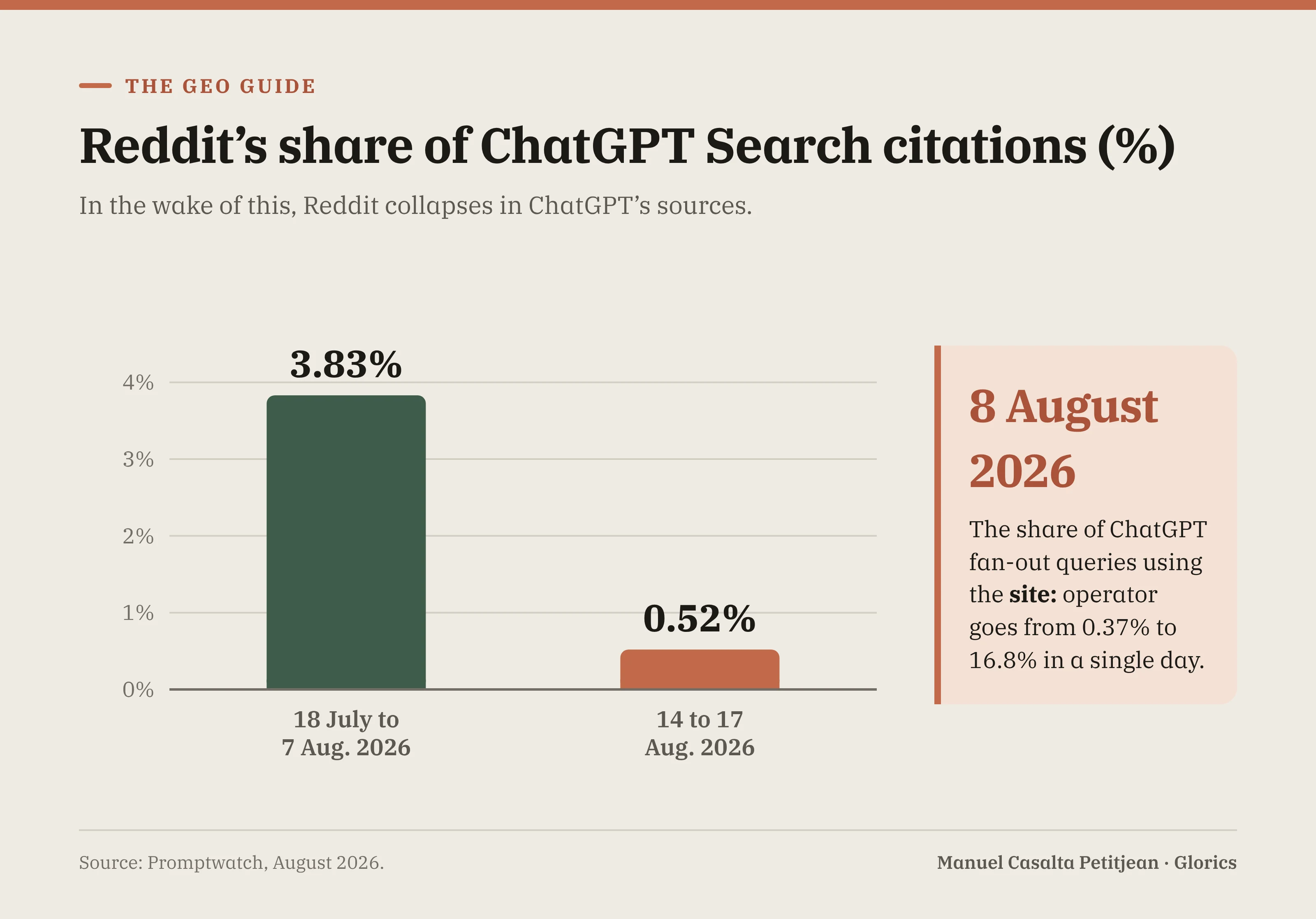
Be careful about causality. The change on 8 August coincides with a first decline, not with the collapse of 14 August, which remains unexplained. Promptwatch itself describes these figures as provisional and doesn’t rule out a data collection issue. OpenAI has confirmed nothing.
Peec’s data, reported by the trade press, points the same way: after a summer ChatGPT update, which runs fewer queries containing “best”, “top” or “vs”, listicles fell to 7.8% of citations (-50.5%) and comparison pages to 6.17% (-32.1%). Otterly observes that the space Reddit left behind mostly benefited reference sources and official pages.
The takeaway, whatever the detail: a domain’s topical authority and a brand’s official pages (documentation, pricing, FAQ, about) carry more and more weight in ChatGPT.
4. Pillar 1: be readable
This is the most thankless pillar, because an unreadable page sets off no alarm. I put it this way in my case study on ManoMano (in French, April 2026), the European online DIY and home improvement marketplace, writing about product pages that AI agents cannot read: no alert in Search Console, no error in your analytics, just an absence. Fix it before any content or link-building work.
JavaScript: the exact rule
“AI can’t read JavaScript” is too broad. The exact rule fits in two lines.
- ChatGPT’s, Claude’s and Perplexity’s crawlers do not execute JavaScript. The benchmark study by Vercel and MERJ (December 2024) 27, covering hundreds of millions of requests, found no execution at all, and independent tests published in 2026 largely confirm the finding. These crawlers sometimes download JS files (11.5% of GPTBot’s requests, 23.8% of ClaudeBot’s), without running them. At the end of September 2026, a developer reported that GPTBot and OAI-SearchBot were now rendering JavaScript on his server. An isolated signal, not confirmed by OpenAI: the advice below doesn’t change.
- Gemini, AI Overviews and AI Mode go through Googlebot, which renders JavaScript in a queue separate from crawling.
A full-JavaScript site can therefore rank well on Google and remain invisible to ChatGPT, Claude and Perplexity. Their timeouts, for their part, are not documented: serve a fast page, without relying on late rendering.
Serve as server-side HTML: main content, prices, listings, tables, FAQs, proof, and the JSON-LD markup (the most common format for schema.org structured data). Schema.org injected through JavaScript is invisible to crawlers that don’t render.
robots.txt: three roles, three consequences
A training crawler, a search crawler and a user-triggered crawler do not have the same effects. Confusing them is the most common mistake.
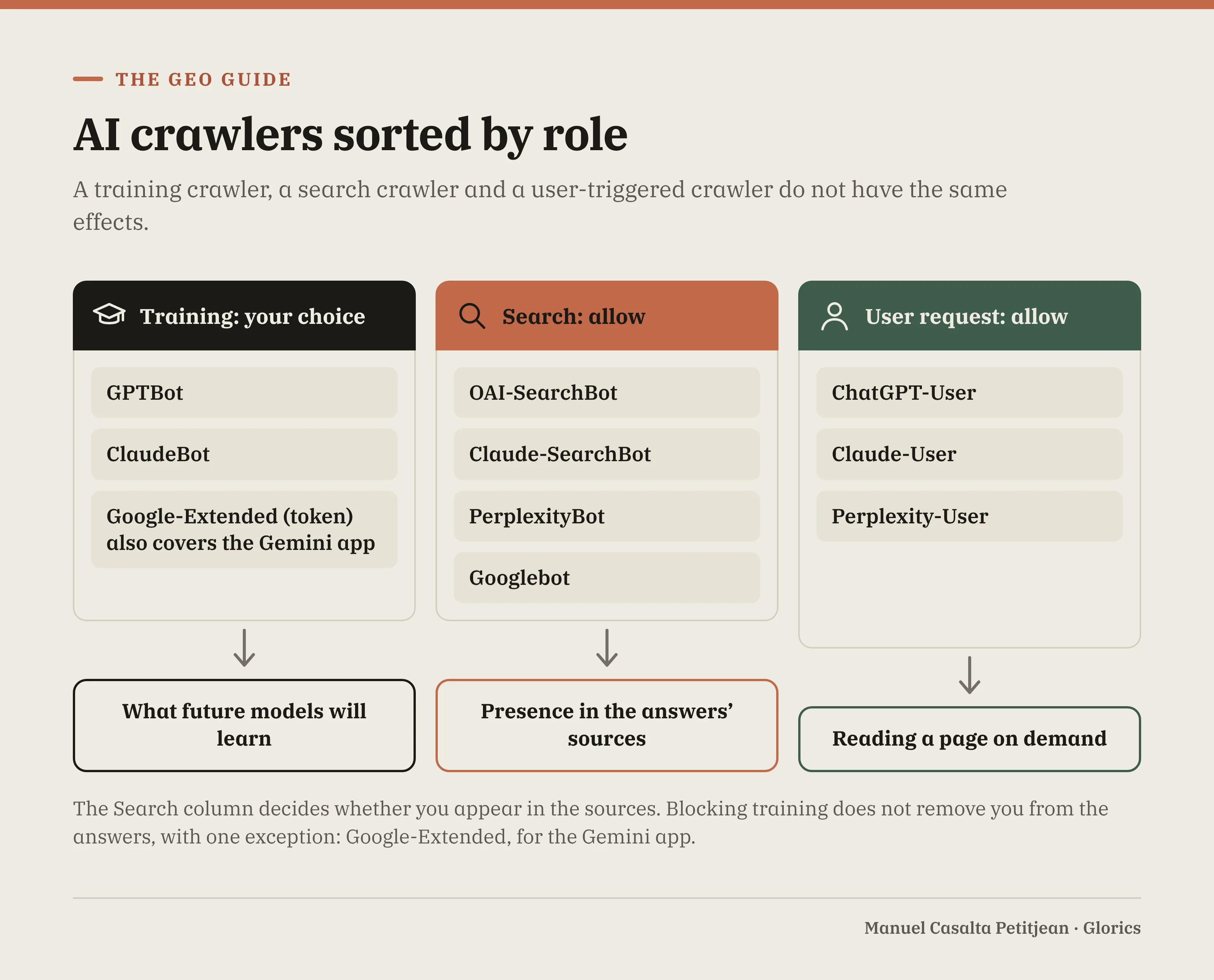
The Search column decides whether you appear in the sources. Blocking training does not remove you from the answers, with one exception, Google-Extended, detailed below.
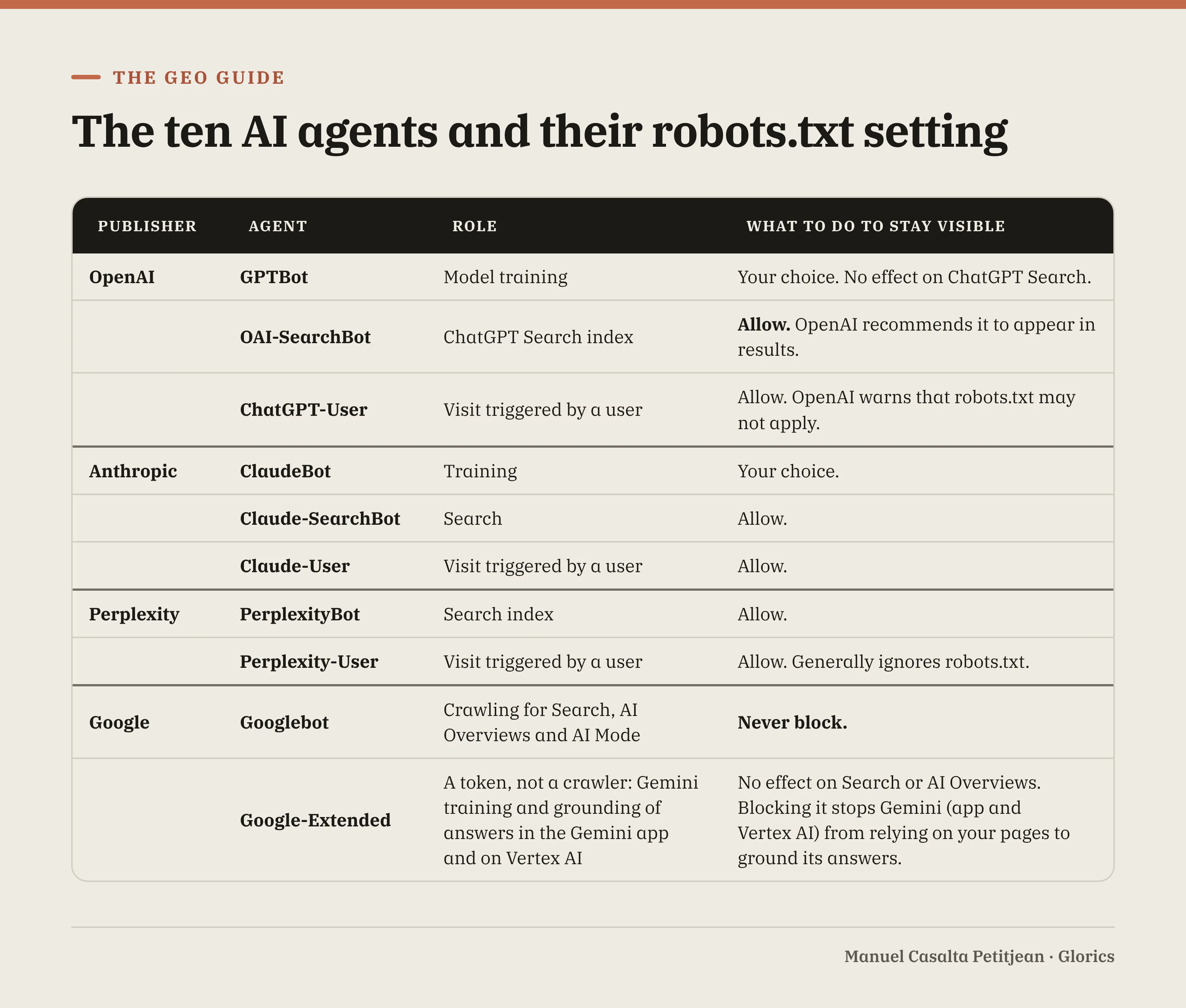
OpenAI also uses OAI-AdsBot to check the landing pages of its ads. Names and rules change: reread each publisher’s official documentation before you deploy.
What to remember:
- Blocking GPTBot does not remove you from ChatGPT Search. To stay citable while refusing training: block GPTBot, leave OAI-SearchBot and ChatGPT-User alone.
- Blocking Google-Extended does not remove you from AI Overviews, as Google documents. On the other hand, Gemini can no longer rely on your pages to ground its answers, in the Gemini app or on Vertex AI. BuzzStream observes that 92.3% of major news sites that block Google-Extended are still cited in AI answers, across all assistants.
- A block doesn’t erase everything. In the same study, 82.4% of sites that blocked OAI-SearchBot were still cited somewhere, through other assistants or content already known.
- Allow around 24 hours for a robots.txt change to be picked up by OpenAI’s search.
- robots.txt is not a security barrier. Private content is protected by authentication.
Template for a “citable but not trainable” setup:
User-agent: GPTBot
Disallow: /

User-agent: ClaudeBot
Disallow: /

# Warning: blocking Google-Extended also keeps Gemini (app and
# Vertex AI) away from your pages (no effect on AI Overviews).
User-agent: Google-Extended
Disallow: /

# OAI-SearchBot, ChatGPT-User, Claude-SearchBot, Claude-User,
# PerplexityBot and Googlebot: no rule = access allowed.
Refusing training is a business decision, not a technical one. It doesn’t stop models from talking about you: they also learn from what others write.
For context: in an Ahrefs study of around 140 million websites, GPTBot is the most blocked AI crawler, yet only 5.89% of sites block it (May 2025). Blocking remains the exception.
Controlling usage in Google
Search Console now offers a dedicated control in its settings: “Search generative AI”. It removes a site from AI Overviews, AI Mode and generative AI features in Discover, with no effect on rankings in the classic results. Google announced it on 3 June 2026, first as a test with a subset of UK sites, then opened it to all websites worldwide on 31 August 2026: in France, it has been available since that date. It does not cover the Gemini app, which falls under Google-Extended (see the robots.txt section): no single button takes you out of every Google surface.
Two consequences. First, opting out becomes a business decision to document: you give up the impressions and traffic from these surfaces. Second, restrict access to your Search Console property: a badly managed account can now take you out of AI Overviews in a single click.
The usual preview controls still apply, page by page: nosnippet, data-nosnippet, max-snippet and noindex. To appear, Google says it clearly: neither llms.txt nor special markup is needed. Being indexed and eligible for snippets is enough.
The other blockers
- WAFs and CDNs (web application firewalls and content delivery networks, such as Cloudflare) that block AI crawlers by default, or as soon as the request rate looks suspicious. Check the rules and the logs.
- Login walls, full-screen consent banners, interstitials.
- Essential content in PDFs, images or iframes.
- Infinite scroll without crawlable pagination.
- Wrong noindex or canonical tags, 5xx errors, redirect chains.
- Tabs and accordions loaded on demand.
- Badly tagged language versions (hreflang) on a multilingual site, for example FR and EN.
What about llms.txt?
No evidence that any major provider uses it to answer. Log analyses show that retrieval crawlers almost never request it. Low priority: fix everything else first, and don’t count on it.
Ahrefs put it to the test on 137,000 domains using its audience analytics tool: 28% publish an llms.txt file, and 97% of those files didn’t get a single visit in May 2026 (June 2026).
The 30-minute technical audit
- 1.Source code. Open the page with “view source”, not in the inspector. Is the main content there? Also test:
curl -s -A "OAI-SearchBot" https://www.example.com/pricing. This test checks the HTML served, not real access: a WAF that authenticates crawlers by their IP will treat your curl differently from the real crawler. Access is checked in the logs (step 5). - 2.Rendering without scripts. Turn off JavaScript in the browser settings and reload the page. Prices, text, tables: note what disappears.
- 3.robots.txt. No Disallow rule should target OAI-SearchBot, Claude-SearchBot, PerplexityBot, Googlebot or Bingbot.
- 4.Control question. In a temporary chat, give an assistant the URL of a key page and ask it a question whose answer is only on that page: the exact price, the delivery time, the length of the warranty. A wrong, vague or made-up answer should set off alarm bells.
- 5.Server logs. Are AI user agents getting through, and with which HTTP status codes?
- 6.Indexing. Check Google Search Console and Bing Webmaster Tools. In Search Console, also check the status of the “Search generative AI” control.
- 7.Intent signals. Do the title, meta description and H1 of the target pages clearly announce the topic?
- 8.Broken links. Assistants sometimes make up URLs: in an Ahrefs study of 16 million cited URLs, they sent visitors to 404 pages 2.87 times as often as Google does (September 2025). Use your logs or your analytics tool to find 404s whose referrer is an assistant, then redirect every plausible URL to the page that actually answers it.
New: Ahrefs now audits AI readability
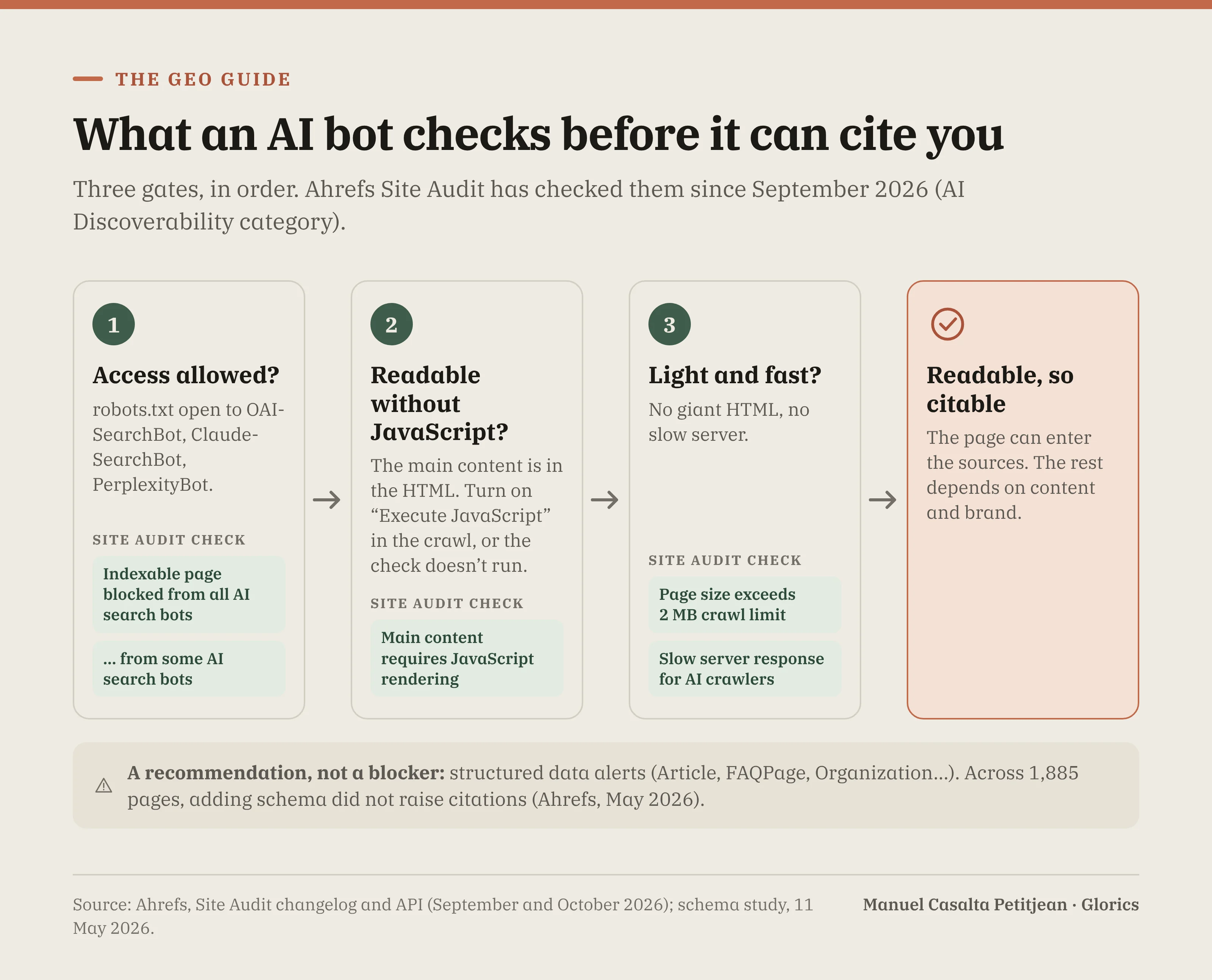
Since 4 September 2026, Ahrefs Site Audit has an “AI Discoverability” category. It flags, page by page, what stops an AI bot from reading a site. Three blockers really matter.
- robots.txt. Ahrefs flags indexable pages closed to all AI search bots, or to some of them. A page closed to OAI-SearchBot can’t be read by ChatGPT search.
- JavaScript. “Most AI bots, including ChatGPT and Claude fetches, don’t execute JavaScript,” Ahrefs notes. This check, added on 24 September, only runs if “Execute JavaScript” is turned on in the crawl.
- Weight and speed. Ahrefs flags pages over 2 MB and servers that respond slowly to AI bots.
Structured data alerts are recommendations, not blockers: adding schema did not raise citations (Ahrefs, May 2026).
Checked on 29 October 2026: Ouest-France, a major French daily, opens only its shopping and tourism sections to AI search bots.
5. Pillar 2: be identifiable
An assistant won’t recommend a company it doesn’t know how to classify. In my article on local SEO (in French, January 2026), I wrote that targeting “Avocat Paris” (“Paris lawyer”) is budget suicide against the sector’s giants, and that victory lies in geographic granularity and search intent. “Roofer in Bristol” drowns our roofer among websites and directories. “Slate roof repair after a storm in Clifton, Bristol” leaves him a spot. Same logic for Vinaxe: “management software” leads nowhere, “cellar software for small estates selling direct” points to an obvious answer.
The mirror test
In my article on personal branding (in French, September 2026), I suggested a simple test for a founder or CEO: ask an LLM who they are, then judge the portrait. It applies to the brand too. In a temporary chat, on several assistants, ask: “What do you know about Vinaxe?” Then compare the answer with your positioning statement. A sharp portrait: the foundation is there. A vague or wrong portrait (a generalist, a discontinued business, a namesake): your problem is positioning before it is content.
The positioning statement
A single sentence, repeated word for word everywhere: website, LinkedIn, directories, press releases, author profiles.
[Brand] is [precise category] for [target] that [problem solved or difference].
Applied to Vinaxe: “Vinaxe is cellar management software for wine estates under 20 hectares that want to track stock, cellar door sales and shipments without a spreadsheet.”
Why word for word? Because engines have to reconcile what they read: decide that the brand cited by the press, by a directory and on LinkedIn really is the same entity. The more the clues match, the more reliable the reconciliation.
Natural credibility
Ahrefs promoted the same conference on two queries. It appeared in 66.4% of answers to “best SEO conferences 2026”, against 15.8% for “best marketing conferences 2026”. Same content, four times more mentions where the brand is an obvious answer.
Ask yourself the question that follows: would your brand look like a natural recommendation if you hadn’t written the page yourself?
Locked-up markets
Home insurance, online banking, energy suppliers, mobile plans: the leaders are cited on authority, even with an average website. A new entrant targets a sub-segment (company size, trade, use case, region), never the generic category. Another route: topics nobody is defending (see “Orphan topics”, section 6).
Lemlist illustrates this well. Launched in 2018 with 1,000 dollars and no domain authority, up against HubSpot, Outreach or Mailshake, the tool did not take on “cold email” head-on. It set up shop where its prospects were already searching: LinkedIn, G2, Capterra, Reddit. The product and the timing also played a part: it’s a case, not a proof.
The entity
Models need to be able to check that you exist. Checklist:
- a complete About page, legal notice and identified team;
- active and consistent social profiles;
- a Google Business Profile listing if you have a local business;
- a presence in the reference directories of your sector;
- Organization markup with sameAs (the property that links your site to those profiles), in the server-side HTML.
Don’t invent a Wikipedia page: notability rules apply there, and self-promotion is penalised.
The founder is part of this file, but as a source, not as a subject. Among five French tech founders I studied for Ahrefs, each accounts for between 2% and 13% of their own brand’s appearances in ChatGPT and Perplexity. The founder of Mistral AI appears in 10 answers, his brand in 124 (Ahrefs Brand Radar, September 2026). AIs answer product questions with product names.
The founder matters elsewhere: in the sources. The file on the founder of Qonto (the French business banking neobank) opens with an article from Le Monde, France’s leading national daily, cited in 14 answers, then with the “about” and “our story” pages of the website. Reference press and in-house pages: that is the basis on which AIs decide who is who. To test your own file, see the mirror test in the toolkit.
Claiming your business in ChatGPT
On 10 November 2026, OpenAI launched Businesses in ChatGPT in beta, for an audience it puts at 1.2 billion weekly users. Think Google Business Profile, but inside ChatGPT. In Business Hub, a business claims its profile, then gets it verified: a code by phone or email, a DNS record or a Shopify store, then an identity check. It can then correct its description, category, logo, delivery and return policies, and upload a product feed with pricing and availability.
The real change is the data. Over 28 days: mentions, website clicks, and the themes of the answers where the business appears. Until now, we all estimated this with prompt samples. Watch the definition: for an online business, OpenAI counts a mention only when ChatGPT references its website. The brand name alone doesn’t count. That is closer to what this guide calls a citation (section 3). Below a certain threshold, the metric stays blank.
Three limits. OpenAI says it itself: claiming does not guarantee higher placement or sales. Business Agents, brand assistants that can be promoted through ChatGPT Ads, are limited to US ecommerce and online service businesses. Local stores and restaurants can, for now, only claim an existing US listing, and health is not mentioned anywhere. Check what Business Hub offers in your country. My advice: claim early, reuse your positioning statement word for word, and compare these figures with your own tracking.
In-house experts sign their work
The founder is not the only one who can feed this file. In every company, some people really know: the product manager, the salesperson who hears the objections, the technician who works in the field, the customer service team that reads the real questions. They rarely sit in the digital team, and that is precisely what makes them valuable.
Find them, then give each of them a proper author page:
- a short, factual biography;
- their credentials: job, years of experience, degree or certification;
- links to their public profiles, LinkedIn first;
- the list of their articles.
Then have them sign their work. A “the marketing team” byline builds no entity: nobody can verify it, nobody can recommend it. A named author can. Mark up their page with Person and sameAs, on the same principle as the Organization markup in the checklist, and link them to the company with worksFor. The authors’ authority then adds to the brand’s.
For Vinaxe, the head of support, a former cellar master, will sign a guide on tracking cellar door stock with more credibility than any copywriter.
6. Pillar 3: be citable
A cited page is a page that is found, readable, and useful for a specific passage. GEO content is not written “for LLMs”. It is written for readers, and structured to be split up.
“Best X” pages: the picture has become more complicated
In 2025, Glen Allsopp (Ahrefs) analysed 750 recommendation prompts in ChatGPT: “best [category]” listicles were the most cited page type, at 43.8% of sources. That is where the “do comparisons” advice comes from. The French SERP paints the same picture: on “meilleur logiciel emailing” (“best email marketing software”), the top 10 contains only high-authority listicles and comparisons, without a single branded product page. Asked the same question, ChatGPT cites G2, Reddit or Trustpilot (my Barnacle article, 2026).
Since then, the data has become more nuanced.
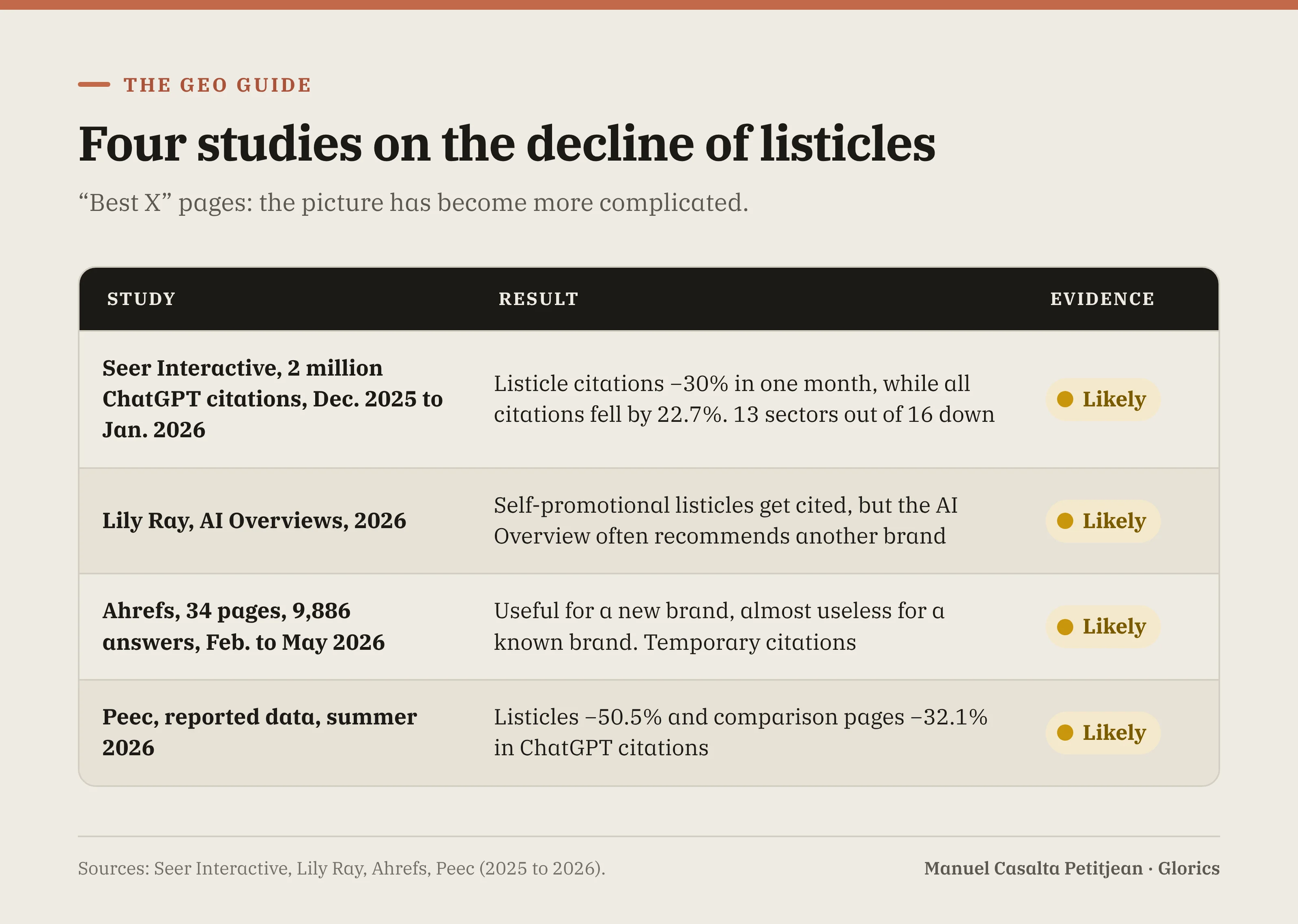
All is not lost. In Seer’s sample, 78 URLs kept gaining citations during the decline. What is falling back are generic, self-promotional pages. Credible comparisons hold up, especially on Google surfaces and in Perplexity.
If you publish a comparison, four requirements:
- 1.Show your method: criteria, test protocol, dates, and your interests declared in black and white. A comparison of cellar software signed by Vinaxe must say so from the first line.
- 2.No mass production. Google classes mass-generating pages without added value as scaled content abuse under its spam policies.
- 3.Update for real. Outdated prices and features feed AIs with errors, about you as well as your competitors. Ahrefs speaks of a “documentation tax” to plan for from the start.
- 4.Go after other people’s comparisons too. A placement in a third-party list carries more weight than a page where you judge your own product. As I wrote in my Barnacle SEO article (in French): your site will never rank for “best X tool”, but the page that does rank can cite you in first position (see pillar 4).
Before structuring a page, identify the question each section answers: each type of question calls for its own format.
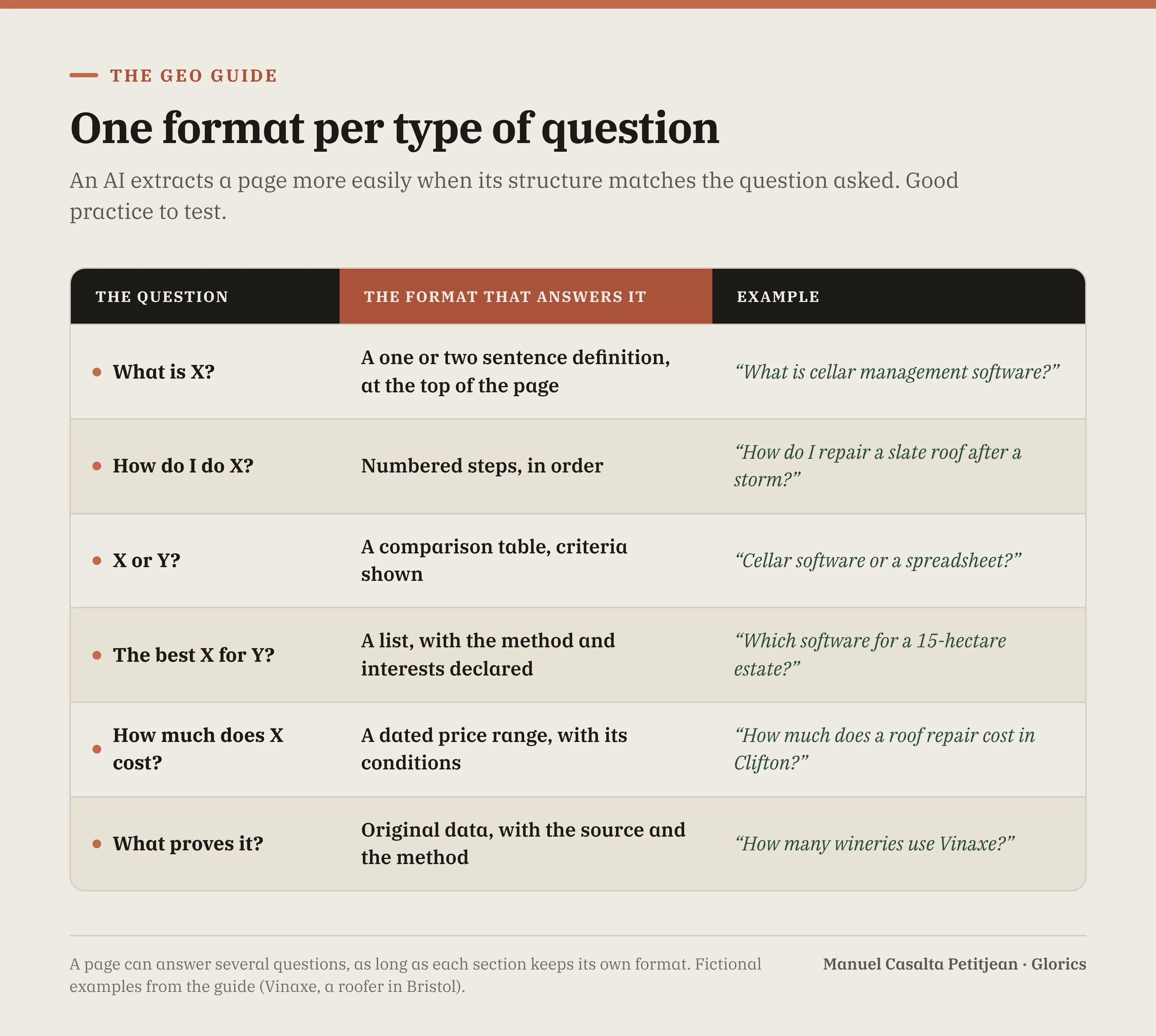
Anatomy of an extractable page
In my Indy case study (in French, August 2026), I looked at what the most cited pages have in common. Four traits keep coming back:
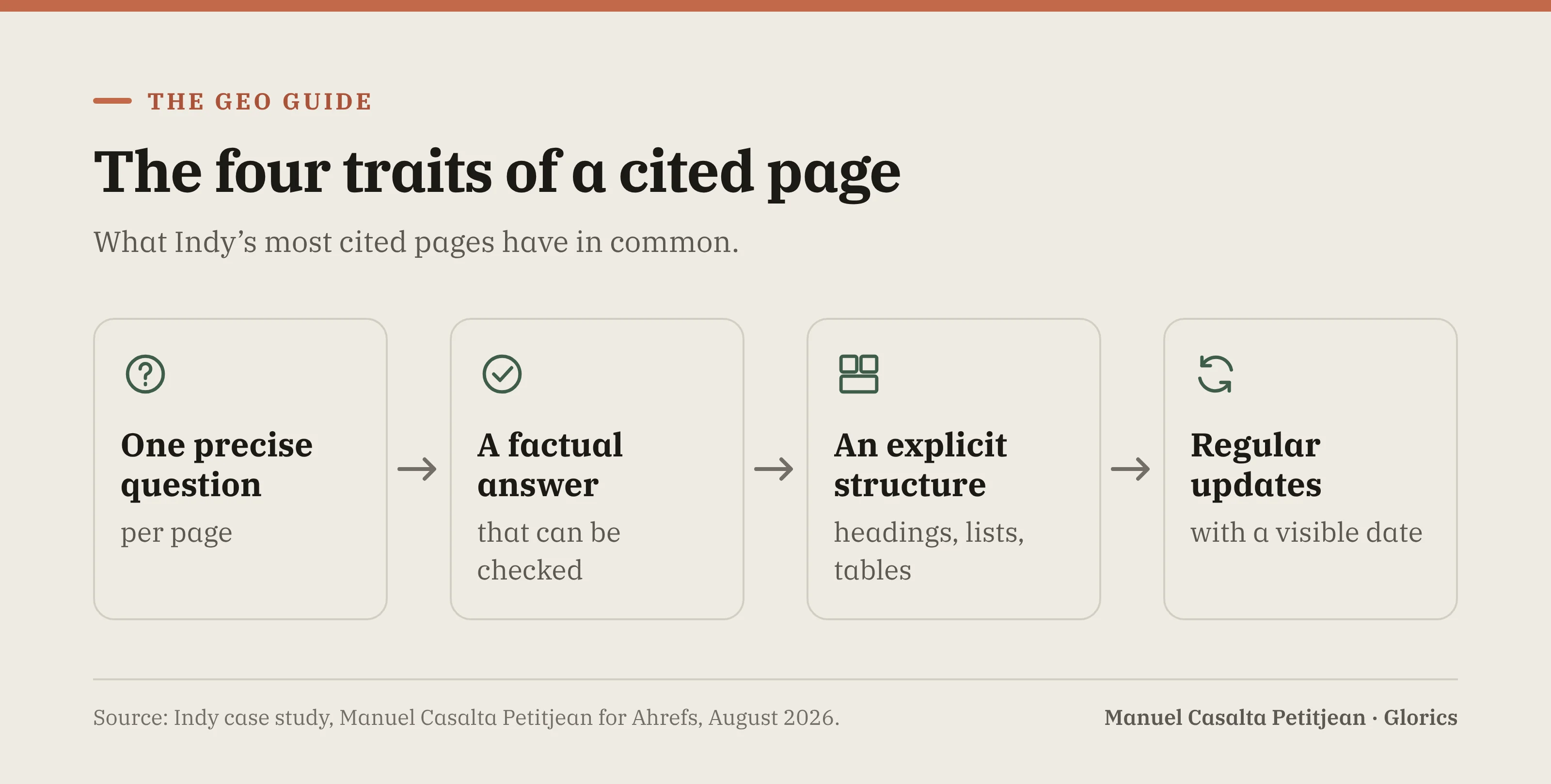
The rules that follow derive from them, together with how retrieval works (sorting results, then reading passage by passage). Most have no published causal proof. Treat them as good practice to test.
- 1.One precise question per page, phrased the way the user asks it. For Vinaxe: “how much does cellar software cost for a 15-hectare estate?” rather than “our plans”.
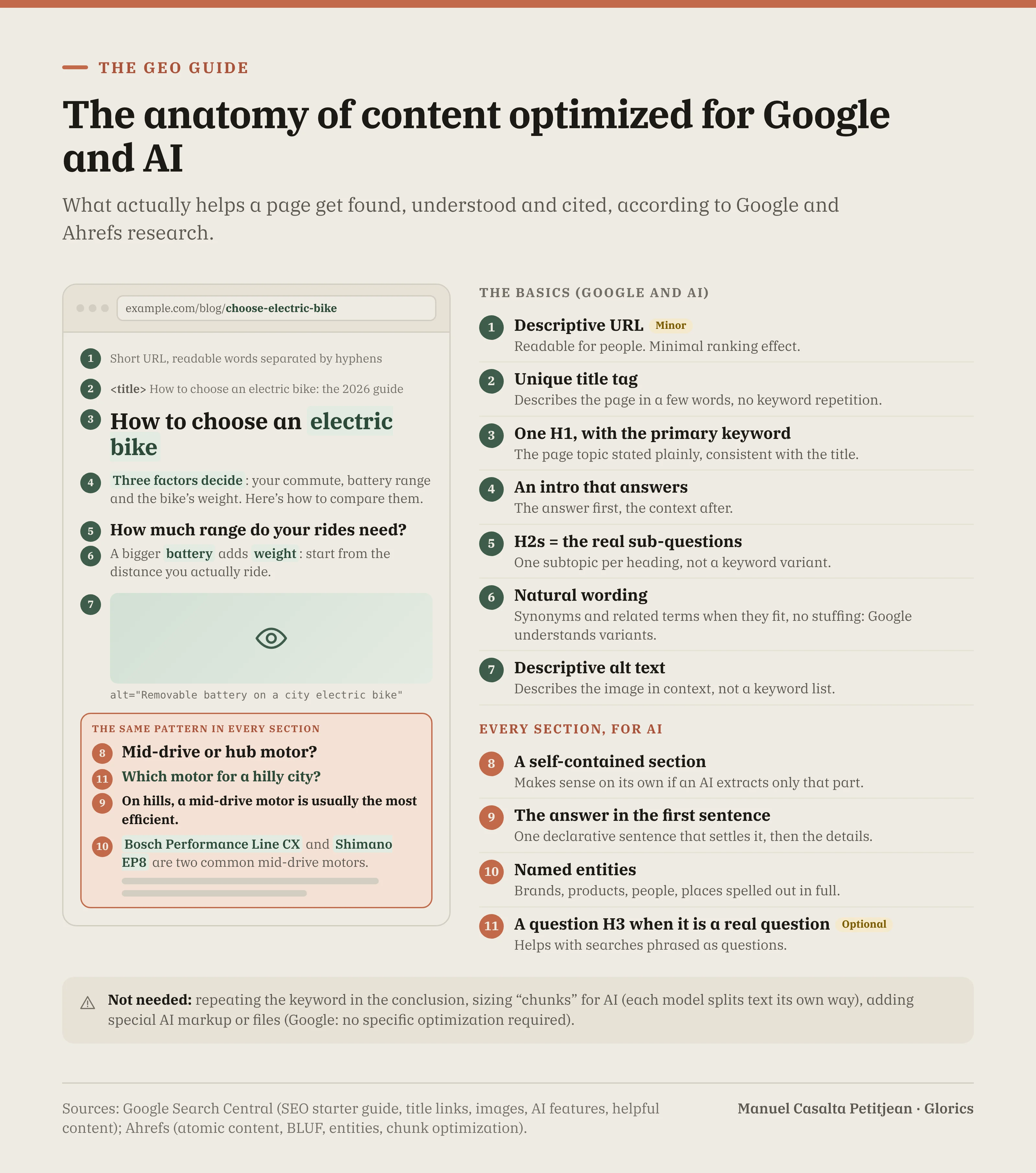
- 2.The answer first. Each section opens with a sentence that answers and stands on its own: a figure, a price scale, a condition, not a promise.
- 3.The top of the page counts double. Across 1.2 million answers, 44.2% of ChatGPT’s citations come from the first 30% of the text (Indig, 2026). Put the essentials in the first third of the page.
- 4.Self-contained passages. Name the subject instead of writing “it” or “this solution”. A passage cut out of the page must make sense without the rest.
- 5.An explicit structure: headings that announce their content, lists, tables in HTML (never as images). You can’t control how AI systems split a page, so make every section stand on its own.
- 6.Regular updates. I wrote it in the Indy study: a dated article stops being cited long before it loses its ranking.
- 7.Complete figures: value, unit, date, source.
- 8.Density before length. Long pages are not penalised: in Indig’s data, pages over 20,000 characters collected 10.18 citations on average, against 2.39 under 500 characters. But a long, diluted page buries its best passages. Aim for full coverage of the topic, without padding. Ahrefs’ research adds a nuance: in AI Overviews, the correlation between word count and being cited is close to zero (0.04), and 53.4% of cited pages are under 1,000 words (December 2025). Length isn’t a criterion in itself: coverage is.
- 9.A single version per page. Serving crawlers content that differs from what visitors see is cloaking, and Google penalises it.
- 10.An identified author, with their author page (section 5), a genuine update date, visible sources. Especially in health, finance and legal.
Freshness carries weight
Seer Interactive observes that 75% of the pages cited by assistants were updated within the year, whereas only 42% were published within the year. Gemini is the most demanding (78%), Perplexity the most tolerant (65%). An old page can be cited. A page that has never been reviewed, much less so.
Ahrefs’ research across 17 million citations points the same way: pages cited by assistants are on average 25.7% fresher than those in organic results, with ChatGPT the most sensitive to freshness and AI Overviews the least (July 2025). A second analysis adds nuance: among the pages retrieved for a given prompt, ChatGPT tends to cite the more established ones rather than the very newest (Ahrefs, April 2026). Freshness helps you get into the shortlist. It doesn’t replace relevance.
In practice, start with pages that were once cited or ranked well and have since slipped: they are the most rewarding updates, provided you bring something new and a genuine revision date.
Official pages are coming back
In its experiment, when Ahrefs, a very well-known brand, entered an answer where it had been absent, 94% of these new mentions came from third-party content, and only 6% from pages published by the team. A single brand, then, but a signal consistent with the correlations in the next section. For an established brand, in-house pages are not enough. Their main job is to make sure third parties and models cite you accurately.
Pages to look after first: documentation, pricing, FAQ, about, use cases, and a factual “alternatives to X” page. Since August 2026, ChatGPT has been querying certain domains directly, and official pages are gaining citations (Otterly) 50.
My study points the same way, in accounting for freelancers. From one monthly reading to the next, 60% of citations of official brand sites are kept, against 36% for comparison sites and blogs. It isn’t automatic. On the question “Is Indy reliable?” (asked in French), Copilot, Gemini and Perplexity never cite indy.fr. On “What does Indy offer freelancers?”, the same site is cited in almost every reading.
Orphan topics
A brand page becomes the reference source when nobody else answers well. At Indy, the pages ChatGPT cites most are not product pages. They are practical guides: the fee scale of chartered accountants, the comparison of online accounting software, the guide to free accounting (Brand Radar, 31 July 2026).
The queries targeted are thankless: “how much does a chartered accountant charge”, “net minimum wage (SMIC) amount”. Nobody was fighting to answer them. Look for these ownerless topics in your sector: a factual, up-to-date page can become the reference there within a few months.
Proprietary data
Internal studies, statistics from your own database, unique datasets: a model cannot produce them itself. It cannot invent a real fact it has never read. That is what makes this content so sought after.
For a piece of data to be picked up:
- visible methodology and sample size;
- collection date;
- a downloadable table;
- a citable phrasing: “according to our survey of 340 estates selling direct…”;
- a stable URL that won’t change at the next redesign.
- a name for your method or metric, used the same way everywhere: a named concept is easier to cite than an idea with no name.
When the buyer is an agent
Content doesn’t stop at text. In my ManoMano case study (in French, April 2026), I looked at what happens when the assistant buys on the user’s behalf. A shopping agent checks three certainties before validating an order: certified availability, a calculable total price (product, delivery and fees), guaranteed logistics, all marked up in the structured data. A site that misses just one risks being thrown out. On the product page of a €1,348 robotic lawnmower, audited in April 2026 (it may have changed since), the product, price and review markup was compliant, but the returns policy and delivery only existed as readable HTML: a score of 2 out of 4. For a human, the page is complete. For an agent, it isn’t.
A major caveat: autonomous purchasing is not the norm. On 24 March 2026, OpenAI changed course. Fully integrated payment inside ChatGPT (checkout) did not live up to its promises: product discovery stays in ChatGPT, but payment goes back to the merchant’s site or through dedicated apps, for now in the United States only. As I wrote at the time, if OpenAI backtracked, it was precisely because merchants’ product data was not clean enough to support autonomous payment. The rigour of structured data therefore matters from the discovery phase onwards.
7. Pillar 4: be recommended by others
I put it this way in my article on Barnacle SEO (in French, September 2026): modern SEO is no longer about “being the best site”, it is about “being cited by the best sites”. Links keep their value, but what third parties say about you, in so many words, carries at least as much weight.
What the studies measure
Across 75,000 brands, Ahrefs calculated the correlations between brand signals and visibility in AI. These are Spearman correlations: they measure whether two rankings move in the same direction, and the closer the figure gets to 1, the more they coincide.
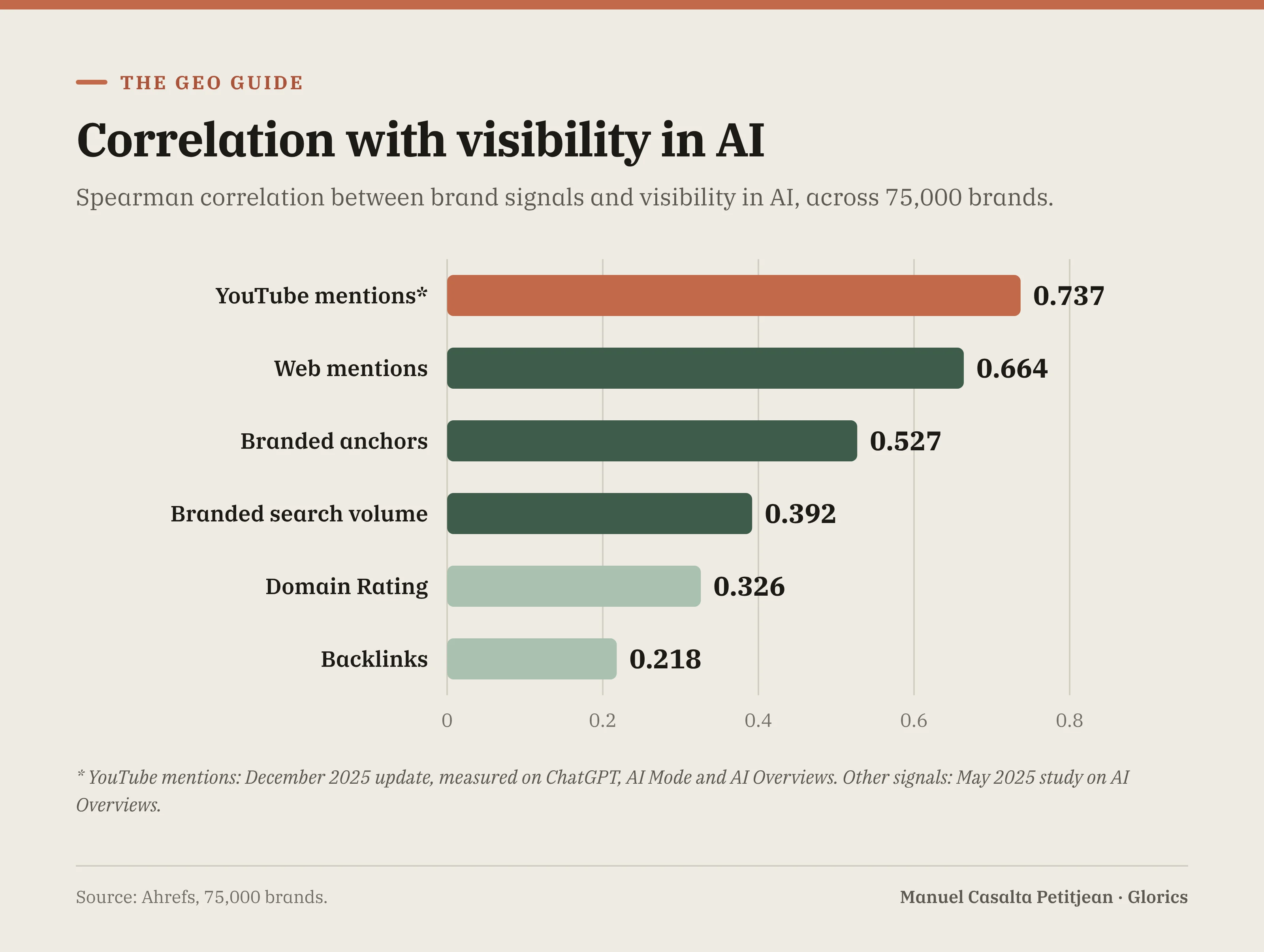
YouTube mentions: December 2025 update, measured on ChatGPT, AI Mode and AI Overviews. Other signals: May 2025 study on AI Overviews.
The December 2025 update brings three lessons:
- YouTube comes out on top (around 0.74) on all three surfaces, including ChatGPT, which Google does not own. A mention counts when the brand appears in a video’s title, description or transcript.
- Web mentions remain highly correlated, between 0.66 and 0.71 depending on the surface.
- AI Mode is the most sensitive to classic brand signals (branded anchors up to 0.63, branded search volume up to 0.47). ChatGPT is the least swayed by the dominance of big brands.
The limit to keep in mind: these are correlations. Big brands have more mentions, more searches, more links and more videos. Ahrefs says so itself. None of these studies proves that buying mentions lifts visibility.
What makes a good mention
Not all mentions are equal. The one that helps a model associate you with a need contains the service, the context and a piece of proof, in the same place.
The most telling example comes from reviews. In my article on local SEO, I advised guiding review requests. For our roofer: “If you’re happy with the repair to your slate roof, feel free to say so.” The customer then writes: “Roof fixed within two days of the storm, in Clifton.” Two five-star reviews are not equal: the one that names the service and the place links the business to a precise query.
The template: brand + category + target or context + verifiable element, in a single sentence. For Vinaxe: “Vinaxe, cellar management software for small estates selling direct, has equipped 400 wineries since 2021.”
After that, repetition does the rest, provided it is consistent. Lemlist’s name has been coming up on LinkedIn, G2, Capterra and Reddit for years. As I wrote in my article on personal branding, an image established through volume is very hard to change afterwards. Choose what should be repeated before you get it repeated.
Where the mention appears matters too. Across the top 50 domains in each system, being mentioned on heavily linked pages correlates strongly with visibility in AI Overviews (0.70), moderately in Perplexity (0.40) and only weakly in ChatGPT (0.12) (Ahrefs, July 2025). Again, that’s a correlation, and each assistant plays by its own rules.
The key sources
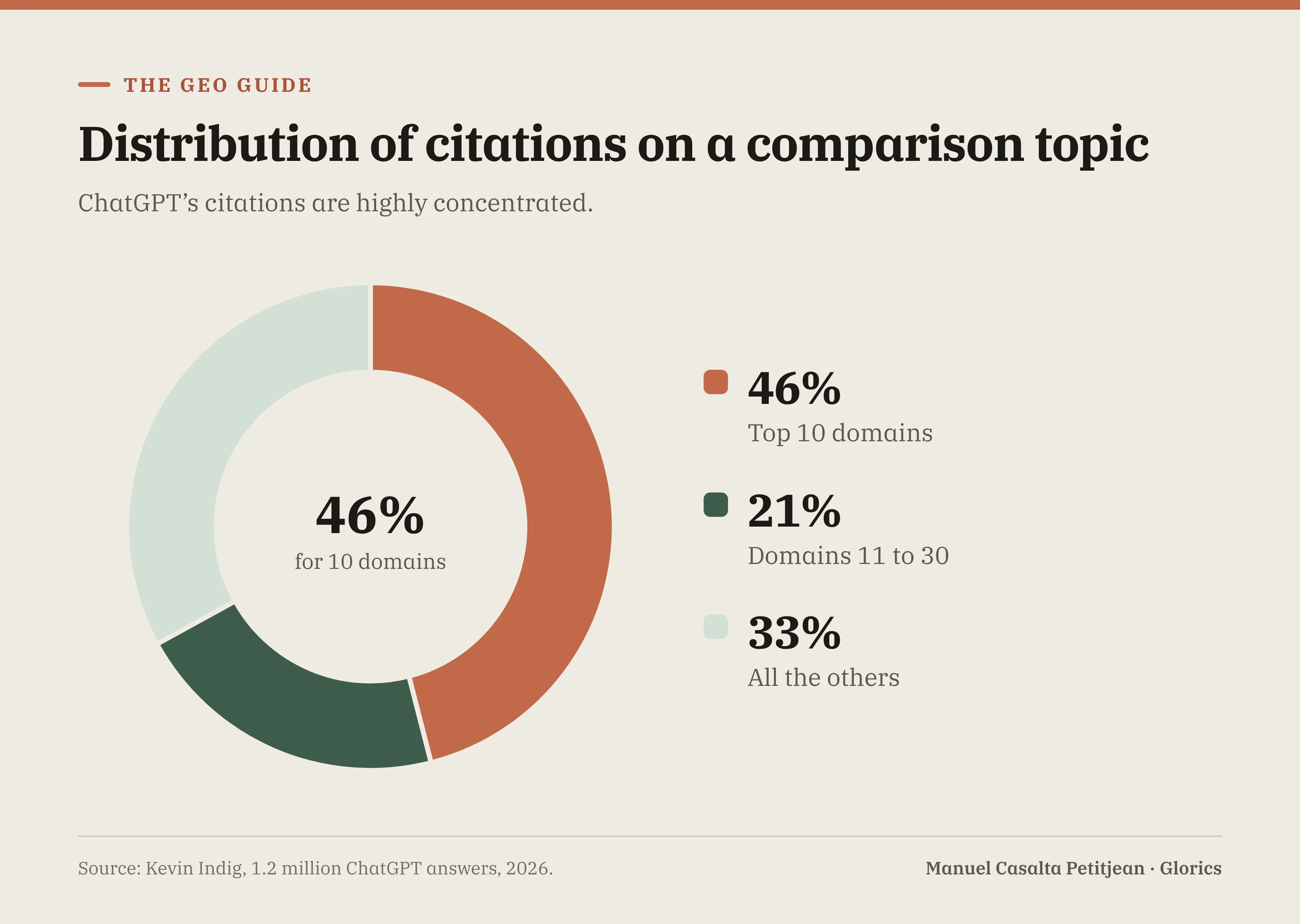
ChatGPT’s citations are highly concentrated. Across 1.2 million answers, around 30 domains capture 67% of the citations on a topic. On product comparison topics, the top 10 domains alone capture 46% (Indig, 2026).
The pattern holds in France. For the French tech brands I studied for Ahrefs, ChatGPT first consults a comparison site (moneyvox.fr, a French personal finance comparison site, 117 answers), the press (Le Monde, 71) and Reddit (70). LinkedIn only adds up to around twenty, without a single post by a founder (Ahrefs Brand Radar, September 2026).
In my Barnacle article, I called these domains “whales”: sites firmly established on your queries, which a smaller brand can attach itself to. The method I described, in five stages:
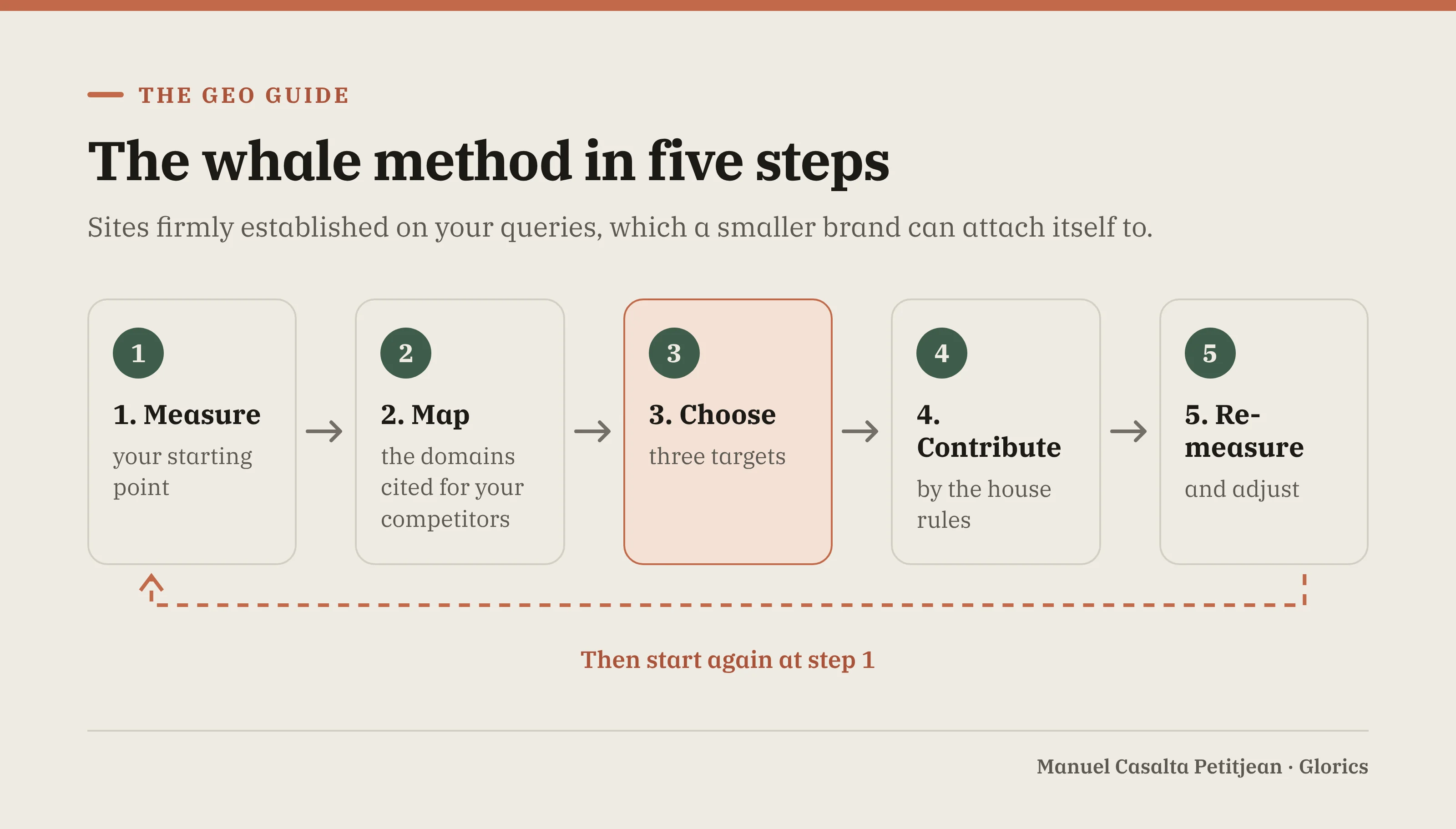
- 1.Measure your starting point on your prompt set (section 8), with several runs per prompt.
- 2.Map the domains AIs cite when they talk about your most visible competitors, with a tool or through “view sources” in the assistant. Example: for Smartlead, a cold email tool, G2 (52 answers) and Reddit (47) come out ahead of the brand’s own website (Brand Radar, 2026). In Ahrefs Brand Radar, the “Others only” filter isolates the answers where your competitors appear and you don’t, and the Cited Pages report lists the pages cited in those answers: a ready-made target list.
- 3.Choose three targets, not ten. Better to dominate three whales than to stagnate on ten. Cross-reference the domain’s weight in your competitors’ citations with the gap between their presence and yours.
- 4.Contribute by the house rules. A copy-paste of your blog on Reddit will be rejected: you don’t go onto the whale with your own codes, you adopt its codes. Depending on the type of domain:
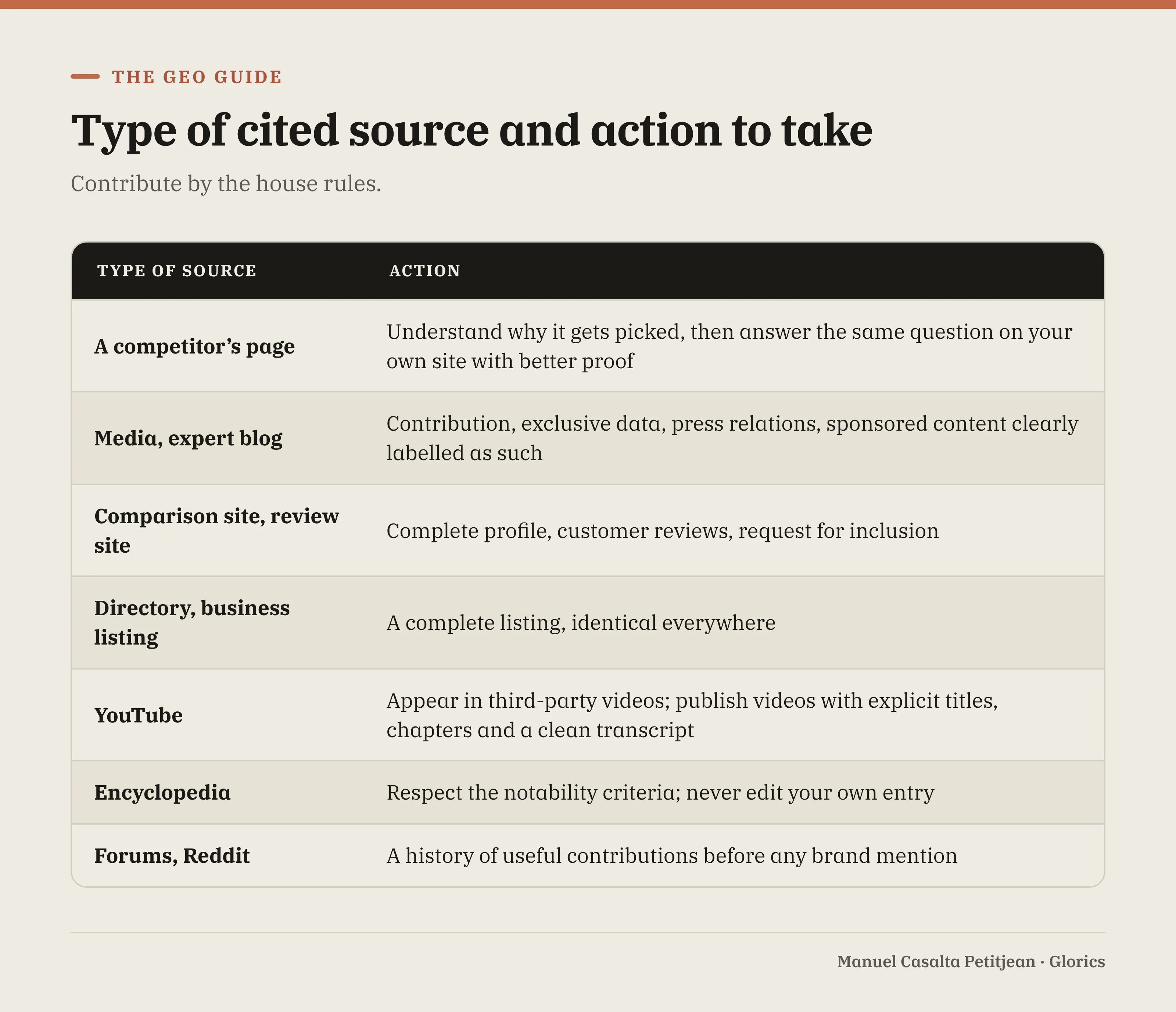
5. Re-measure, then adjust the list. It changes from one snapshot to the next.
YouTube and Reddit
YouTube. The lever is underrated. Its correlation with visibility is of the same order on ChatGPT, AI Mode and AI Overviews. A Surfer SEO analysis (2025) of 46 million citations puts YouTube at the top of AI Overview sources, with 23.3% of citations. In practice: explicit titles, chapters, clean transcripts, and a presence in other people’s videos.
Reddit. Its August 2026 drop concerns ChatGPT Search, not AI as a whole. It isn’t the first: in September 2025, the share of ChatGPT answers citing Reddit went from a peak of more than 14% to around 2% within a few weeks. One analyst attributed that episode to Google removing the num=100 parameter, rather than to a decision by OpenAI. Reddit is still present in 83.9% of Google’s “Discussions and forums” blocks (Ahrefs, August 2026).
Conclusion: don’t build a ChatGPT strategy on Reddit, and don’t abandon it for Google. And if you go there, follow the rule I gave in the Barnacle article: roughly 90% useful contributions for 10% brand mentions.
One cornerstone piece, repurposed everywhere
Whales, YouTube, forums, press: the list is daunting. Nobody can keep all these channels going by starting from scratch for each one. I start from a single cornerstone piece: solid expert content that answers a real question, with proof and, if possible, a piece of in-house data. Then I repurpose it.
- 1.A page on the website. This is the reference version, dated and structured, the one everything else points back to.
- 2.A long-form LinkedIn article. Signed by the expert, rewritten for that audience, with a link to the page.
- 3.Useful answers in forums. An answer to the question asked, not a summary of the article. The house rules and the 90/10 rule apply, and the August 2026 drop is a reminder not to bet everything on Reddit.
- 4.A short video. An explicit title, chapters, a clean transcript: that is what makes it readable for AIs.
- 5.A story for the press. A piece of data or a fresh angle interests a journalist. And it is press articles that may, later on, justify a line in an encyclopedic source, according to its own notability criteria.
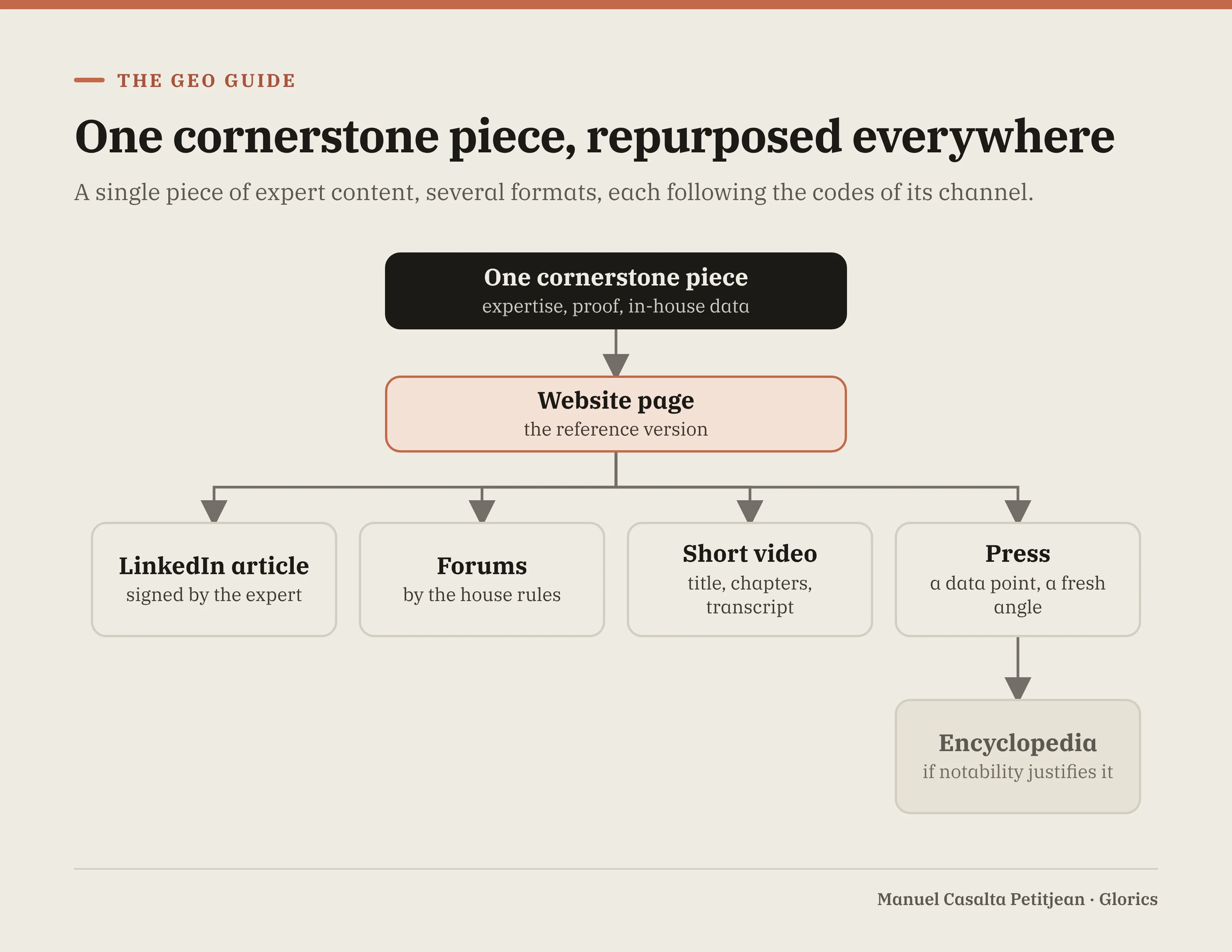
This is not manufacturing consensus: each format brings real value to its audience, under your name. Each version repeats the same positioning statement and points back to the reference page.
The same reasoning applies to what the company already produces. A webinar, a conference talk, an interview, a campaign: their lifespan is counted in weeks. Turned into a page on the website, then broken down into answers and excerpts, they can become citable sources for months. Before commissioning new content, take stock of what is lying dormant.
Ethics and risks
- Sponsored content. Label it as such. In France, undisclosed advertising counts as a misleading commercial practice, and the reputational risk is real.
- Barnacle, not parasite. Attaching yourself to a whale means bringing it real value: an expert answer, a tutorial, a deserved place in a comparison. Renting a subdirectory on an authoritative site to publish content without value there is parasite SEO. Since May 2024, Google has enforced its site reputation abuse policy through manual actions: the coupon and betting directories hosted by CNN, USA Today, Fortune or Outlook India were deindexed overnight.
- Manufacturing consensus. Since models end up treating as true what enough third parties repeat, there is a temptation to multiply the sources yourself. Citations are unstable, filters are improving, and a manufactured description becomes your reputation on the day it is exposed.
8. Measuring without kidding yourself
Why a screenshot proves nothing
The same question never gives the same answer twice. Everything makes it vary: the model version, the mode (fast or thinking), the language, the location, the account’s memory, the moment. In the Ahrefs experiment, a cited page was on average only cited one eligible day in three. When someone claims to have tripled their visibility in a week, ask just one question: over how many runs, and with what variance?
The rule: sample. Each prompt is run several times, over several days, with the same procedure, each run in a new conversation. Note the date, the assistant, the mode and the model version when it is displayed. Compare rates, not anecdotes.
I measured this effect in a sector I know. I tracked 28 questions on accounting for freelancers in the Ahrefs Brand Radar prompt database (France), from July to October 2026, on ChatGPT, Gemini, Copilot, Perplexity and AI Overviews. From one monthly reading to the next, 72% of the brands named were still there. Only 31% of the cited URLs were still cited. ChatGPT renews its sources the most: it keeps only 16% of its URLs. On ChatGPT and Copilot, barely 6% of the URLs cited in July were still cited in August, September and October. “Best X” questions are the least stable, with 25% of URLs kept.
The limits, to be clear: Ahrefs refreshes each question about once a month, and each reading is a single answer. So the study measures stability from one month to the next, not from one day to the next, and part of the turnover probably comes from the randomness of each answer. One sector, one country. The practical lesson still holds: a single citation proves nothing, either way. Measure over several readings before drawing conclusions, and track mentions first, because they move far less than sources.
A first sounding
Before tooling up, a manual baseline is enough:
- The assistants: ChatGPT, Gemini, Claude, Perplexity, Copilot, and Google’s AI Mode if possible. The Indy case shows why you should test them all, and more than once: at the end of July, Gemini almost never cited the most cited brand in its sector, then cited it more than 100 times per daily reading from the end of August (section 3).
- The conditions: a temporary chat, or a logged-out session. Private browsing isn’t enough if you stay logged in: the account’s memory and preferences follow you.
- The prompts: three phrasings of the same need, from three angles: a situation, a price, a material. For the roofer, by way of illustration: “my roof’s been leaking since the storm, I’m in Clifton, can someone come and tarp it tomorrow?”, “cheap roofer in Bedminster”, “who repairs slate roofs in Bristol?”.
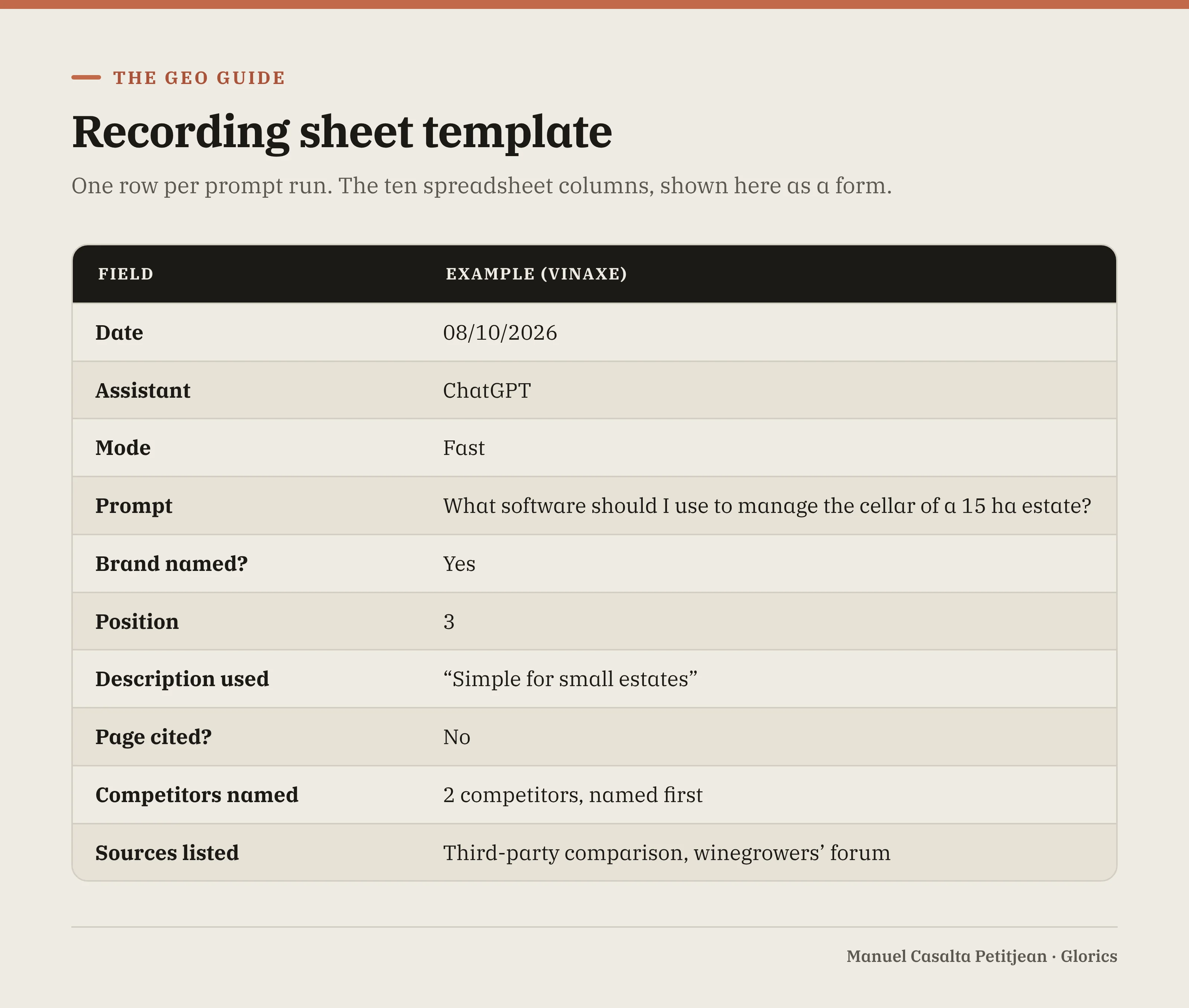
- The record: mentioned or not, at what rank, with what argument, and which sources are listed.
If you are named on none of the variants, you are absent from the consideration phase for that need. This test is a thermometer, not a measurement.
When a competitor gets cited and you don’t, open the page it gets cited for and put it next to yours. Is the question in the title? Is the answer given up front? Are the figures dated and sourced? The gap often shows up there before it’s a matter of authority.
Building your prompt set
No tool provides a reliable search volume for prompts: they are long, conversational, almost all unique. Think in intents. Good news: across 37,804 answers, Peec observes that highly crafted prompts and casual questions often bring up the same brands. Intent matters more than wording. The exception: on unbranded commercial queries, small variations in wording already change the brands cited.
- 1.Start from the intent families of your business, phrased the way your customers phrase them. For Vinaxe: the need (“which software should I choose to manage the cellar of a small wine estate?”), the comparison, the price, the integration. For the roofer: the emergency, the price, the material, the neighbourhood.
- 2.Add real-life situations, without naming your product. “I run 12 hectares in Saumur with a cellar door shop open in summer, how do I stop counting my bottles in Excel?”
- 3.Add orphan topics: the concrete questions in your sector that nobody is defending yet (section 6). Also collect real phrasings: long queries from Search Console, questions asked to support or in reviews, and the “grounding queries” in Bing Webmaster Tools, that is, grouped phrasings of the searches run before citing you, across Copilot, Bing and partner integrations (not users’ exact prompts).
- 4.Add a handful of branded prompts: “X reviews”, “alternatives to X”, “X or Y”. In the United States, AI Overviews now appear on most branded searches (section 2): what is said about you there can be worked on.
- 5.Group by intent family, so you can read the results by theme.
- 6.Write in the language of the target market. A prompt in English tests the English-language web; a prompt in French tests the French web.
Also look at what assistants actually search for. Brand Radar’s AI Responses report shows, for ChatGPT and Perplexity, the fan-out queries generated from a prompt. Don’t chase their volume: according to Ahrefs, more than 95% of these queries have no recurring search volume (March 2026). What matters is the angles they reveal, not the exact words.
How many prompts? The right number follows from your capacity to record results, not from a universal rule. Each prompt must be run several times, on each assistant tracked. With three runs on four assistants, each prompt costs twelve answers to record per wave: 25 prompts already make 300. Start with what you can record every week without cheating, then expand once the routine is running smoothly.
To follow the same questions every week without copying answers by hand, Ahrefs Brand Radar offers custom prompts: your own prompts, tracked daily, weekly or monthly on AI Overviews, AI Mode, ChatGPT, Perplexity, Gemini, Copilot and Claude. One check is one prompt on one assistant in one location, and each check is a single answer: read the rates over several weeks.
The KPIs
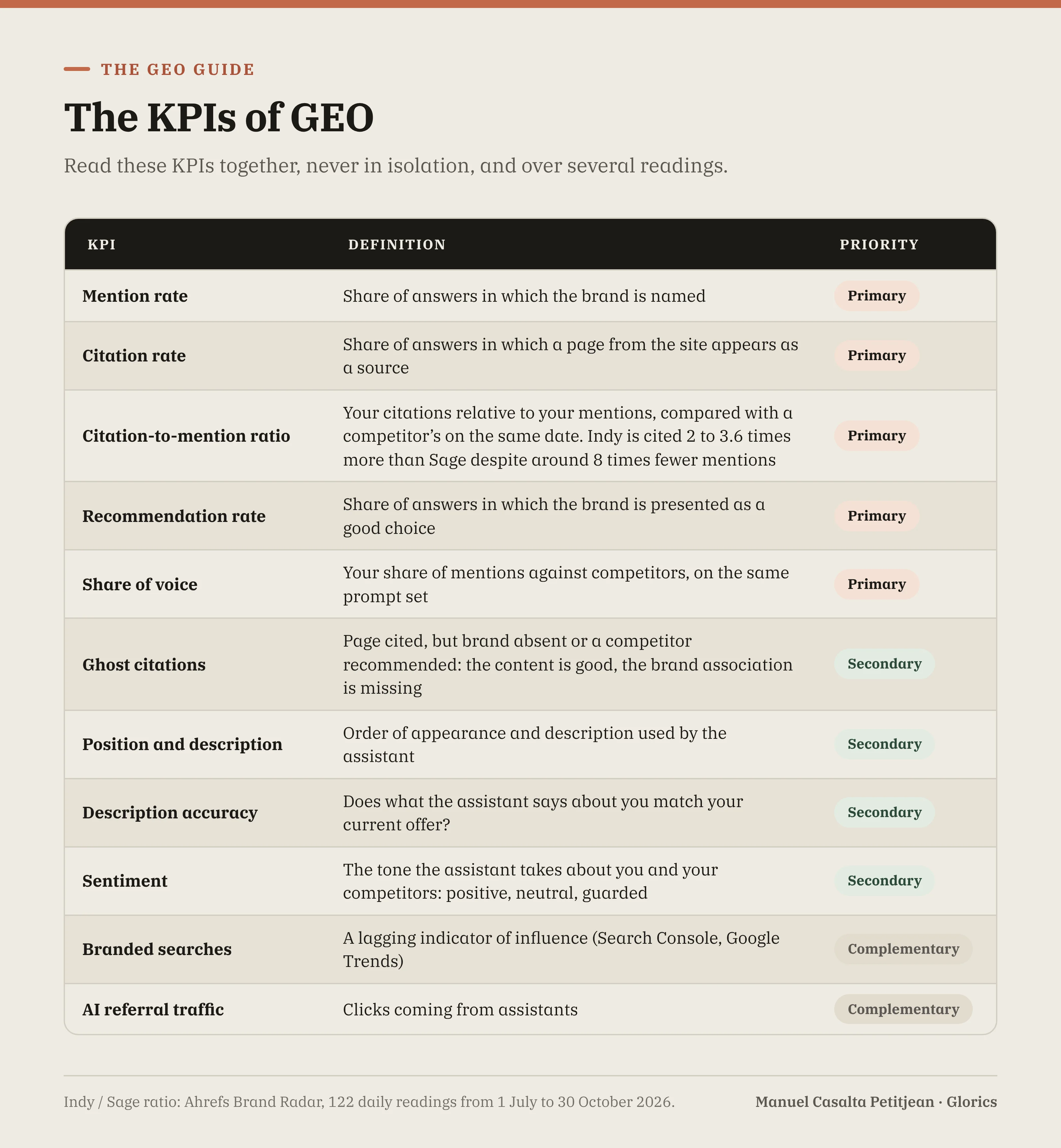
Read these KPIs together, never in isolation. Sage dominates its sector’s mentions, Indy its citations (section 3): the two brands are not playing the same game.
Read the citation rate over several readings, never just one. Mentions are steadier: in my study, 72% of the brands named stayed from one month to the next, against 31% of the cited URLs (earlier in this section).
AI traffic is not the goal. The goal is to be named, then searched for.
Tracking AI traffic
- Analytics. Since 13 May 2026, GA4 has automatically classified traffic from the main assistants into a native “AI Assistant” channel, with no configuration. Google gives ChatGPT, Gemini, DeepSeek, Copilot and Grok as examples, without publishing the full list. Perplexity is not named: check in your reports whether it lands in that channel or stays in “Referral”. So keep a custom channel group running in parallel, with the regular expression below as a “Source partially matches regex” condition, placed above “Referral”: below it, it captures nothing. ChatGPT also adds utm_source=chatgpt.com to many of its links.
- AI Overviews and AI Mode. In Analytics, their traffic is still counted as Google organic. Search Console, however, offers a “Generative AI performance” report, announced on 3 June 2026 and opened to all websites on 31 August 2026: impressions by page, country, device and date, but neither clicks nor queries. To find out which queries are involved, filter the keywords that trigger an AI Overview in your SEO tool.
- Ahrefs Web Analytics. Ahrefs’ audience analytics tool isolates traffic coming from AI assistants (ChatGPT, Perplexity, Gemini…) and shows which ones send you visits.
- Self-reported attribution. Add a “How did you hear about us?” question to your sign-up or quote forms, with AI assistants among the options. It captures what clicks miss: at Ahrefs, ChatGPT and Claude together account for 21.7% of sign-ups, based on what new customers report (October 2026). To turn these answers into revenue, see “Putting a number on the return”, further down in this section.
- Copilot. The AI Performance report in Bing Webmaster Tools counts your citations in Copilot, in Bing’s AI summaries and in some partner integrations, without separating them, page by page, with grouped grounding queries (not users’ exact prompts).
- Server logs. AI crawlers don’t run your analytics script: they don’t show up as visits. Only the logs, or a bot analytics tool, reveal them.
- AI crawlers. A bot analytics tool plugged into your CDN or host (Cloudflare, Vercel, CloudFront, Fastly) sorts bot visits by category, including AI search, without touching your site’s code. Ahrefs’ Bot Analytics is one example.
- Direct traffic. Some visits from assistants arrive with no referrer, from an app or a copied link, and end up as “direct”. A rise in direct traffic to deep pages that nobody types in by hand is a clue worth checking against your records.
- Homepage. Since May 2026, most ChatGPT clicks land there. Don’t just measure your content pages.
(chatgpt\.com|openai\.com|perplexity\.ai|gemini\.google\.com|copilot\.microsoft\.com|claude\.ai|chat\.mistral\.ai|deepseek\.com|grok\.com)With “partially matches regex”, the expression also captures subdomains such as www.perplexity.ai or chat.deepseek.com. With “matches regex”, GA4 requires the whole value to match, and those subdomains slip through. The expression includes Mistral’s Le Chat, not to be forgotten on the French market.
Putting a number on the return
Leadership doesn’t fund a mention rate: it wants to know what GEO brings in. Part of what assistants do leaves no click and no referrer, so no figure will be exact. Aim for an honest estimate, always calculated the same way.
The calculation is the same as for any marketing investment: (gains attributed to GEO − GEO spend) ÷ GEO spend × 100.
On the spend side, split two families. Dedicated spend exists only for GEO: an assistant tracking tool, a specific engagement. Count it in full. Shared spend also serves SEO or content: writing, your SEO suite, team time. Keep only the share devoted to GEO, estimated with the people involved: an order of magnitude is enough.
On the gains side, cross two readings:
- What analytics sees. Conversions from the “AI Assistant” channel (or your custom group), multiplied by the average value of a customer. If your CRM passes real amounts, use those.
- What customers report. Among respondents to “How did you hear about us?”, work out the share that names an assistant, then apply that share to all new customers for the period. This reading also counts customers who met the brand through an assistant without ever clicking from it.
Fictional example, in round numbers, to illustrate the calculation: over a quarter, a dental practice in Austin, Texas pays $1,500 for a tracking tool and $9,000 for content, half of which serves GEO, so $6,000 of GEO spend. Analytics records 10 first appointments coming from assistants; a new patient is worth $700 on average over the first year, so $7,000 and a 17% return. On the survey side, 8 respondents out of 100 name an AI: applied to the quarter’s 200 new patients, that 8% gives 16 patients, so $11,200 and an 87% return.
A gap between the two readings is normal: show them side by side, and state that both fall short of the real effect. Run the same calculation every quarter, on periods after your market’s AI Overviews launch date (next subsection): the trend is what you read, not the single figure.
Measurement is already improving: ChatGPT often adds utm_source=chatgpt.com to its links, and Bing’s AI Performance report counts your pages’ citations in Copilot. Ads arriving in assistants will make paid clicks trackable and will probably push platforms to give advertisers more data, some of which may help organic measurement; nothing guarantees, though, that unpaid visibility will ever be measured as well as paid, so the self-reported reading keeps its value. Direct traffic, for its part, probably includes some AI (mobile apps, copied links, a brand name typed after reading an answer), but also bookmarks, emails, QR codes, messaging apps and returning visitors. A rise in direct traffic to deep pages (articles, guides), with no campaign or awareness effect to explain it and alongside rising AI visibility, is a signal to check against the survey, not proof (see “Direct traffic” above).
A new baseline date
In France, 22 July 2026 cuts your curves in two. AI Overviews and AI Mode arrived that day, and the CTR of exposed domains fell straight afterwards (section 2). Comparing October 2026 with October 2025 therefore mixes two worlds. A drop in clicks may come from the AI Overview, not from your work. A rise may hide a decline relative to the rest of the market.
The rule: start again from a new baseline, from the end of July 2026, and compare later periods with each other, on the same pages and the same queries. Note the break date in your reports, so that nobody mistakes a mechanical drop for a failure. Search Console’s “Generative AI performance” report, open to all websites since 31 August 2026, lets you track the impressions of the pages concerned there. Outside France, use the launch date of the market you track.
The tools
Several platforms track visibility in AI: Ahrefs Brand Radar, Semrush, Peec, Promptwatch, Profound, Similarweb, Otterly. Brand Radar, for example, separates cited pages from “found” pages. Your selection criteria:
- languages and countries covered, starting with the ones you sell in;
- assistants tracked;
- sampling frequency;
- export of full answers, not just scores.
Nothing obliges you to buy a tool before you start. A spreadsheet, your prompt set and a weekly record are enough to get going.
9. Special cases
Health and sensitive topics (YMYL)
YMYL (Your Money or Your Life): that is Google’s term for topics that affect people’s health, money or safety. Health is the most exposed sector: 44.1% of medical queries trigger an AI Overview, more than double the average (Ahrefs, 146 million SERPs). In France, it also comes top of the Ahrefs panel, at 22%, with CTR down 20% from the very first days. An informational question with a short answer, and no transaction at the end, is exactly what the AI Overview absorbs.
ChatGPT’s targeting of specific domains, observed since August 2026, seems to favour sources that display expertise: institutions, specialist publishers. For a practitioner’s website or a network of health sites:
- identified authors, credentials displayed, dated medical review;
- primary sources cited (learned societies, health authorities);
- complete About and legal notice pages;
- an up-to-date Google Business Profile listing, reviews, reference health directories, identical information everywhere;
- content an AI cannot provide: real fees, waiting times, care pathways, appointment booking.
Local
Local searches rarely trigger an AI Overview: only 7.9% (Ahrefs, September 2025). The battle is therefore mostly fought in conversational assistants, which rely on business listings, reviews, directories and the local press.
“Roofer in Bristol” remains a dead end. You need an area, a service and a situation: “emergency roof tarping after hail in Bedminster”. Keep an eye on the consistency of your name, address and phone number across all these sources.
SaaS and products
For a software publisher like Vinaxe, two levers stand out from my case studies. The first is editorial: Indy answers its users’ practical questions better than anyone, and its most cited pages are guides, price scales and a comparison. The second is external: Lemlist’s presence in ChatGPT rests on G2, Capterra, Reddit and Trustpilot, fed by systematic review collection. On the website: public documentation, a clear pricing page, factual “alternatives” pages. And since a known brand’s new mentions mostly come from third parties (section 6), relationships with review sites, the trade press and video creators are part of GEO work.
10. A 90-day action plan
Each phase ends with a validation criterion: a measurement, not a date. Until it is met, you stay in the current phase.
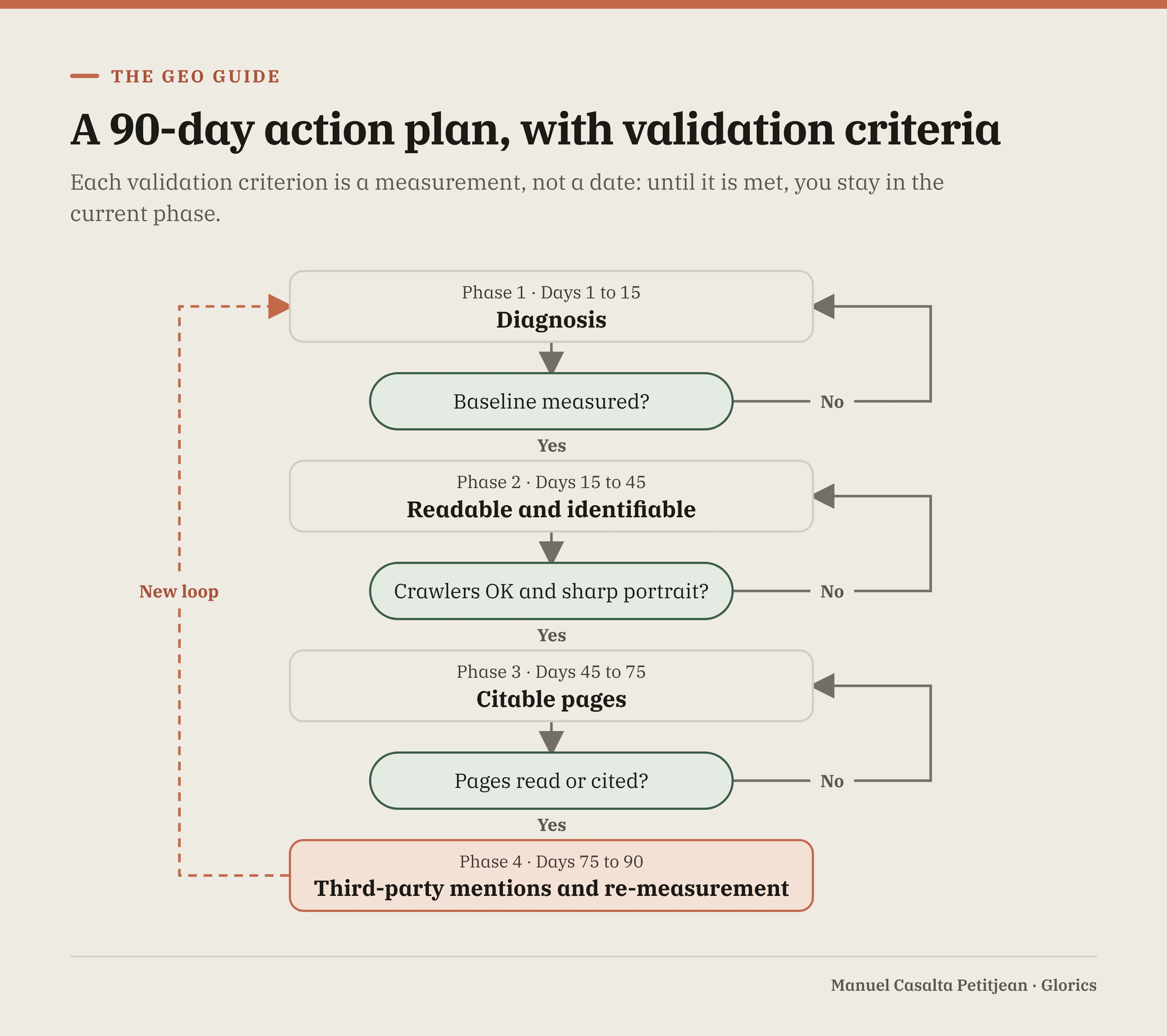
Let’s be honest about timescales: nobody has reliable public figures. My case studies give two boundaries. On an orphan topic, a factual, structured, up-to-date page can become the reference within a few months, for lack of competition. At the other end, Indy took ten years to build the authority that earns it 36% of its sector’s citations (Brand Radar, 31 July 2026, my Indy case study). In my Barnacle article, I mentioned 6 to 18 months for a presence on the whales to bear fruit. And the observation I made in my article on freelance SEO (in French) holds for everyone: on Google, competitive queries are won through years of authority; in AI, a niche that is still empty is won much faster. In a locked-up market, aim for the sub-segment.
What shortens the path: data that only you publish, accurate official pages, and targets chosen where your competitors are already cited and you are not.
Starter checklist
- First sounding: three phrasings of the same need, in a temporary chat, on ChatGPT, Gemini, Claude, Perplexity and Copilot
- Source code without JavaScript, robots.txt and logs: OAI-SearchBot, Claude-SearchBot, PerplexityBot, Googlebot and Bingbot allowed
- Indexing checked in Google Search Console and Bing Webmaster Tools
- “Search generative AI” control checked in Search Console, decision documented, access to the property restricted
- Mirror test: “What do you know about [Brand]?”, sharp, vague or wrong portrait
- Prompt set sized to your recording capacity: intent families, real-life situations, orphan topics, a few branded prompts
- Baseline: each prompt run several times; mention, citation and recommendation rates; citation-to-mention ratio; share of voice
- Key prompts tracked over time, tagged by intent, in a spreadsheet or a tool such as Brand Radar custom prompts
- A single positioning statement, repeated on the website, LinkedIn and directories
- Key pages: one precise question per page, verifiable answer at the top, explicit structure, genuine update date
- 404s coming from assistants found and redirected to the right page
- Pages once cited or well ranked, now slipping, updated first
- About page, legal notice, directory listings, Google Business Profile
- Profile claimed in ChatGPT’s Business Hub if your business is eligible, details identical to your website, mentions and clicks recorded every month
- Domains cited for your competitors mapped, three targets chosen, contribution plan per platform
- “AI Assistant” channel checked in GA4, custom channel group as a complement, crawler tracking in the logs
- “How did you hear about us?” question with an AI assistant option in your forms
- First return calculation: dedicated and shared spend, gains seen in analytics and gains reported by customers, repeated every quarter
- Search Console’s “Generative AI performance” report and Bing’s AI Performance report reviewed every month
- Homepage ready for a visitor arriving from an assistant
- New measurement after 4 to 6 weeks, compared with the baseline
11. Classic mistakes and myths
The mistakes
- Confusing awareness with authority. Lots of mentions and few citations: that is Sage’s profile. Being known doesn’t make you a source.
- Cutting back editorial output because “SEO is dead”. At Indy, it is precisely the SEO content that feeds the AI citations.
- Waiting for ads in ChatGPT before taking an interest. Awareness can be bought, authority cannot.
- Confusing being present with being visible. A G2 profile with three reviews won’t lift you. In the Barnacle article, I put the critical mass at 50 to 200 reviews depending on the category.
- Turning up on Reddit with a sales pitch, or depending on a single domain: its share can collapse in a few days.
- Publishing pages in bulk without added value.
- Scattering mentions without context, which link the brand to no need at all.
- Leaving contradictory information on the About page, in directories and on business listings.
- Blocking GPTBot in the belief that you are leaving ChatGPT Search, or Google-Extended in the belief that you are leaving AI Overviews. For the latter, the lever is the Search Console control.
- Working on content while JavaScript makes the site unreadable for OpenAI’s, Anthropic’s and Perplexity’s crawlers.
- Steering by a screenshot or by a single run.
- Displaying a fake update date. Models read the content, not just the date.
- Forgetting the homepage, which now receives most ChatGPT clicks.
The myths
12. Thirteen months that changed the game
This guide has a use-by date. Here is why.
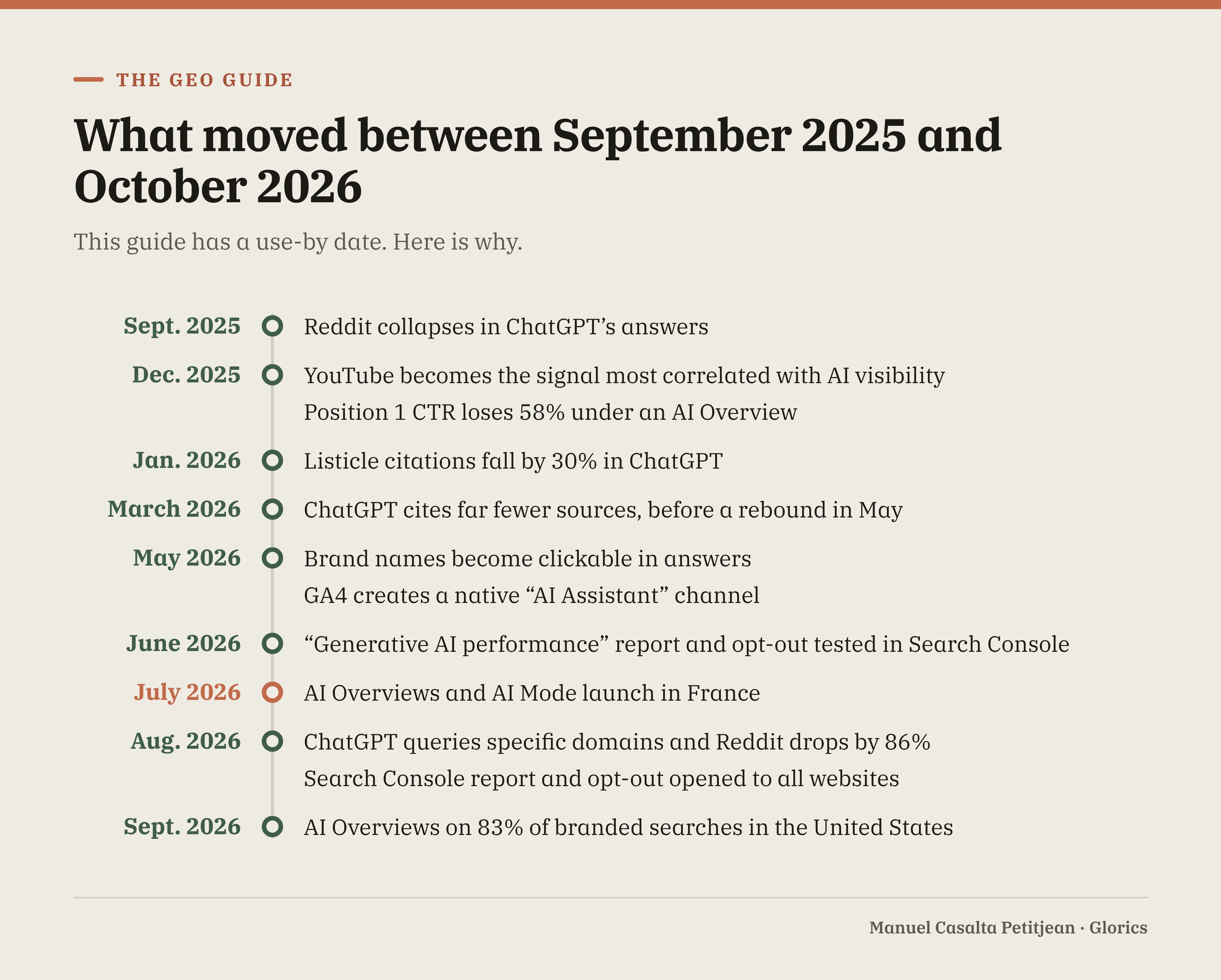
Each of these turns was detected by measurement, not by intuition. Keep your protocol, change your certainties.
Toolkit
Positioning statement
[Brand] is [precise category] for [target] that [problem solved or difference].
Mention template
[Brand], [category] for [target or context], [verifiable element: figure, date, award].
Mirror test
Who is [name of the founder or CEO]? What is their role, and on which topic are they a reference? What do you know about [Brand]? What does it offer, and which other companies would you present as comparable?
A sharp, consistent portrait signals a well-documented entity. A vague answer, or one that confuses you with a namesake, signals a file still to be built.
Recording sheet
Data sources
Figures checked as of 8 October 2026, with additions checked on 23 October 2026, updated 30 October 2026, completed on 11 November 2026.
- 1.Ahrefs, AI Overviews Cut CTR by 23.1% in France and French version (in French)
- 2.Ahrefs, AI Chatbot Traffic: What It Is, and How to Get More
- 3.Ahrefs, Self-Promotional Content Works, Until It Backfires
- 4.Ahrefs, Top Brand Visibility Factors in ChatGPT, AI Mode, and AI Overviews
- 5.Ahrefs, What Triggers AI Overviews?
- 6.Ahrefs, AI Overviews Currently Appear for 83% of Branded Searches and Reddit Appears in 83.9% of Google’s Discussions and Forums Results
- 7.Ahrefs, ChatGPT Has 12% of Google’s Search Volume but Google Sends 190x More Traffic to Websites
- 8.Ahrefs, 0.5% of Visitors Drove 12.1% of Signups
- 9.Ahrefs, How to Measure AI Search Visibility
- 10.Ahrefs, 76% then 38% of AI Overview Citations From the Top 10
- 11.Ahrefs, AI Search Overlap
- 12.Ahrefs, Top Mentioned Sources Are Not Shared Across AI Assistants
- 13.Ahrefs, AI Overviews vs AI Mode
- 14.Ahrefs, AI Citations vs Impressions
- 15.Ahrefs, Mentions on Highly Linked Pages
- 16.Ahrefs, AI Bot Block Rates
- 17.Ahrefs, llms.txt Study
- 18.Ahrefs, How Often Do AI Assistants Hallucinate Links?
- 19.Ahrefs, Short vs. Long Content in AI Overviews
- 20.Ahrefs, AI Assistants Prefer to Cite Fresher Content
- 21.Ahrefs, Why ChatGPT Cites One Page Over Another
- 22.Ahrefs, What is Query Fan-Out?
- 23.Ahrefs, Bot Analytics, How to Track AI Visibility and How to view fanout queries generated by AI, features
- 24.Conductor, 2026 AEO / GEO Benchmarks Report
- 25.Similarweb, ChatGPT Referral Traffic Near Triples Overnight
- 26.OpenAI, Overview of OpenAI Crawlers
- 27.Vercel and MERJ, The rise of the AI crawler ↩
- 28.PPC Land, Blocking AI crawlers doesn’t stop citations (BuzzStream data)
- 29.Search Engine Journal, Why Reddit’s ChatGPT Citation Drop Isn’t Fully Explained (Promptwatch data)
- 30.Promptwatch, Reddit Citations Are Dropping in ChatGPT
- 31.Seer Interactive, LLM Ghost Citations: Why Your Content Is Working and Your Brand Isn’t
- 32.Semrush, The Ghost Citations Study (with Kevin Indig)
- 33.Seer Interactive, The Listicle Window Is Closing in AI Search and 2026 round-up
- 34.Search Engine Land, ChatGPT citations favor a small group of domains (Kevin Indig study, including AirOps data)
- 35.AirOps, The Winners and Losers of AI Search: What Kevin Indig’s Data Shows About Visibility and Kevin Indig’s LinkedIn post (815,000 query-page pairs) ↩
- 36.Semrush, Only 25% of cited sources overlap between ChatGPT’s different reasoning modes (with Kevin Indig, May 2026) ↩
- 37.G2 Learn Hub, Decoding Google’s Role in Reddit’s Recent ChatGPT Citation Dip (Kevin Indig, September 2025 episode)
- 38.Surfer SEO, AI Citation Report 2025
- 39.Search Engine Journal, Prompt Tracking: Does prompt variance % impact brand mentions? (Peec data, sponsored article)
- 40.TechCrunch, Anthropic appears to be using Brave to power web search for its Claude chatbot
- 41.Let’s Data Science, Kevin Indig Finds 91% of AI Citations Appear on One Platform
- 42.Google, Google’s common crawlers (Google-Extended)
- 43.Google, New opportunities, control and insights for website owners (3 June 2026, updated 31 August 2026) and Search generative AI control (Search Console Help)
- 44.Blog du Modérateur, Comment exclure votre site des AI Overviews de Google and AI Overviews : comment mesurer la visibilité de votre site web (in French)
- 45.Google, Default channel group (Google Analytics Help, “AI Assistant” channel)
- 46.TechWyse, Google Analytics Adds Native AI Assistant Channel to GA4’s Default Channel Group
- 47.Search Engine Land, Bing Webmaster Tools officially adds AI Performance report
- 48.geotoolbox.ai, JavaScript SEO: What Google and AI Crawlers Actually See (September 2026 report)
- 49.seoClarity, Tracking the Decline of ChatGPT’s Citations ↩
- 50.Otterly, ChatGPT cut Reddit citations by at least 73% in August 2026 ↩
- 51.Ahrefs (Manuel Casalta Petitjean), ChatGPT Ads : pourquoi être cité par les IA comptera plus que votre budget (étude de cas Indy) (in French: why being cited by AI will matter more than your ad budget, Indy case study)
- 52.Ahrefs (Manuel Casalta Petitjean), Barnacle SEO : s’accrocher aux géants pour exister dans l’IA (in French: hitching a ride on the giants to exist in AI)
- 53.Ahrefs (Manuel Casalta Petitjean), Personal branding et SEO : votre dirigeant est une source, pas un sujet (in French: your founder is a source, not a subject)
- 54.Ahrefs (Manuel Casalta Petitjean), Commerce agentique : comment préparer votre e-commerce aux IA acheteuses en 2026 (étude de cas ManoMano) (in French: preparing your e-commerce site for AI shopping agents, ManoMano case study)
- 55.Ahrefs (Manuel Casalta Petitjean), SEO Local 2026 : le plan de bataille pour dominer la recherche de proximité en France (in French: the battle plan for winning local search in France)
- 56.Ahrefs (Manuel Casalta Petitjean), Devenir freelance SEO : le guide pour se lancer et être visible (in French: becoming a freelance SEO, getting started and getting seen)
- 57.Manuel Casalta Petitjean, retrospective Brand Radar study: 28 questions on accounting for freelancers, France, July to October 2026 (Ahrefs Brand Radar prompt database, monthly readings, five platforms)
- 58.Manuel Casalta Petitjean, daily Brand Radar readings for Indy and Sage: 122 readings, 1 July to 30 October 2026, France, five platforms
- 59.OpenAI, Introducing Businesses in ChatGPT (10 November 2026), Businesses in ChatGPT and Setting up your business on ChatGPT (OpenAI Help Center)
The day your next customer asks an assistant whom to choose, a few names will appear. The spot is still up for grabs. It might as well be you.
A question, a disagreement, a more recent figure? Say so in the comments and I will update the guide.
Manuel Casalta Petitjean
Runs Glorics, a lab, from London and Corsica. Search reputation for Ubisoft since 2020. Contributing author on the Ahrefs blog.
Cite this
Casalta Petitjean, M. (2026, 20 November). The GEO guide: getting cited by AI. Glorics. https://glorics.com/geo-guide-getting-cited-by-ai
Changelog
- 20 November 2026First published.
Related
- Getting cited by AI: SEO is now a distribution game
Essay · 16 min
- Getting cited by AI without giving up SEO
Guide · 22 min
- On the homepage