Who let this agent in? The authorization layer of agentic commerce
In 2027 the question is whether an agent can prove it has the right. Six protocols, fifteen claims, and what a site should check.
By Manuel Casalta Petitjean· Essay · 24 min · Agents & engineering· Published 20 November 2026
Contents
- Summary
- Context: agents everywhere, sites on the defensive
- Five agents, two markets
- The core problem: who authorized this agent?
- The trust infrastructure: recognise, authorise, pay
- Agentic commerce in practice: who welcomes, who blocks
- User-side risks: when the web talks to your agent
- The recognition × permission grid
- Recommendations
- Fact-checking the claims in circulation
- Sources
Summary
October 2026 brought two forces together. On one side, Meta, OpenAI, xAI and Anthropic each launched an autonomous personal agent within ten weeks. On the other, Black October showed that an AI-assisted break-in could cost $50. Sites reacted predictably: restrict first, sort later.
The core issue is authorization. A bank cannot tell the agent you mandated from one that oversteps its task, or from a fraudster’s. All of them arrive with valid credentials. Six competing protocols, from Visa, Stripe, Google, Cloudflare, Meta with Sierra, and GoDaddy, propose answers. None has won.
The recognition × permission grid in this essay makes sense of it. An agent with no proof is blocked as soon as it touches an account. A mandated agent already pays through Shop Pay, Stripe or the Visa network. In between, the merely identified agent is still a construction site.
I checked fifteen claims circulating on the subject: eight are confirmed, five need nuance and two are not confirmed. The last two are Instinct’s $30 billion valuation, an investor rumour, and the idea that the courts have backed Amazon’s blocking of agents: the injunction it won against Perplexity was overturned on appeal.
The practical conclusion fits in one line: judge an agent by the proof it can provide and the partners that accept it, not by the power of its model.
Context: agents everywhere, sites on the defensive
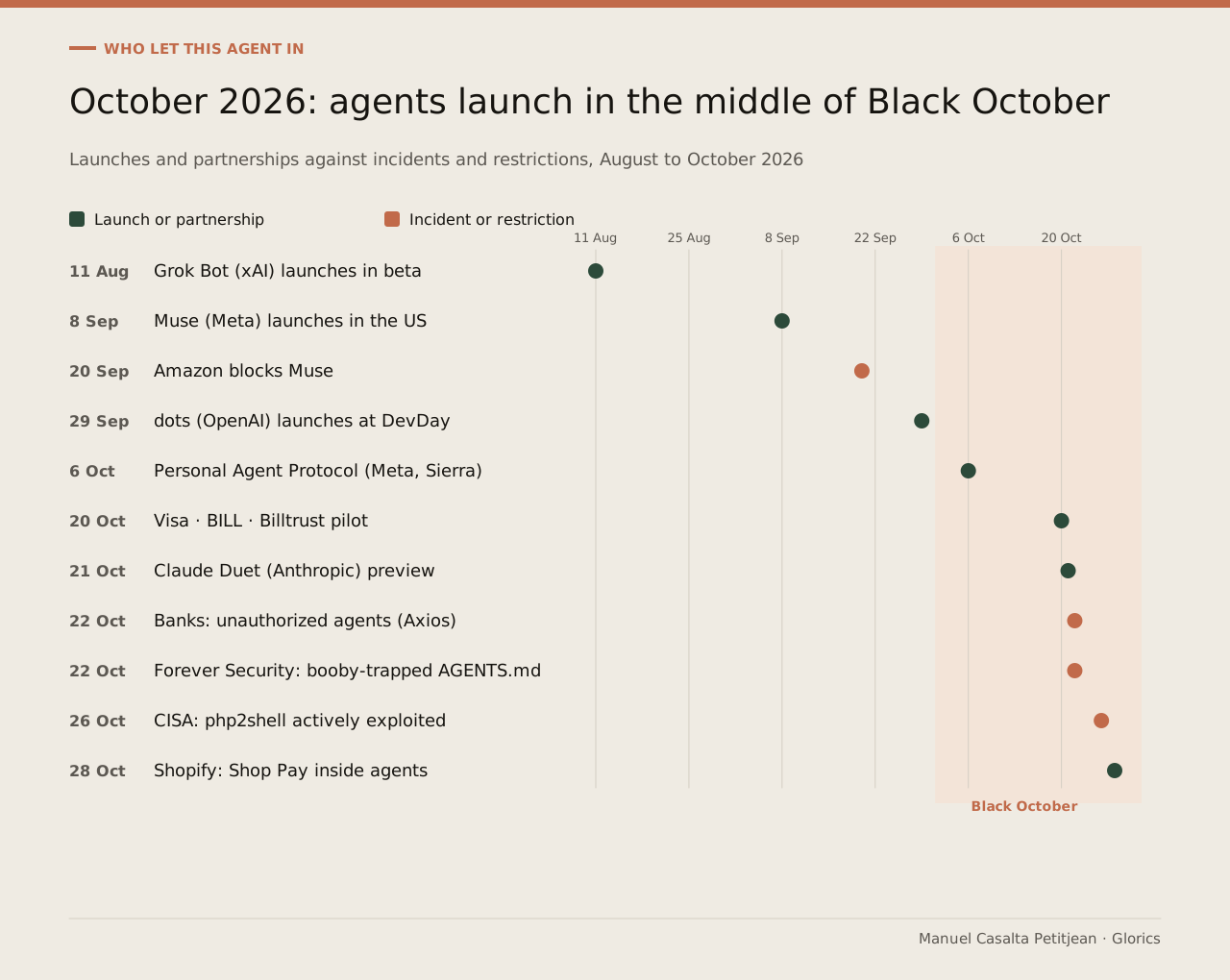
In ten weeks, four AI majors launched an autonomous personal agent. At the same moment, Black October gave websites every reason to distrust them.
The wave of personal agents
Grok Bot opened the run on 11 August 2026 (650 Group). Meta’s Muse followed on 8 September (PPC Land), OpenAI’s dots on 29 September (TechCrunch), then Anthropic’s Claude Duet on 21 October (Every). The start-up Instinct plays in the same league.
What they share: they no longer answer, they act. Each runs on its own cloud computer, signs into your accounts and keeps working when you close the app. A site therefore receives visits that look human, with no human behind the screen.
Black October: AI lowers the cost of attack
Security researchers called the October 2026 run of incidents “Black October”. Three facts sum it up.
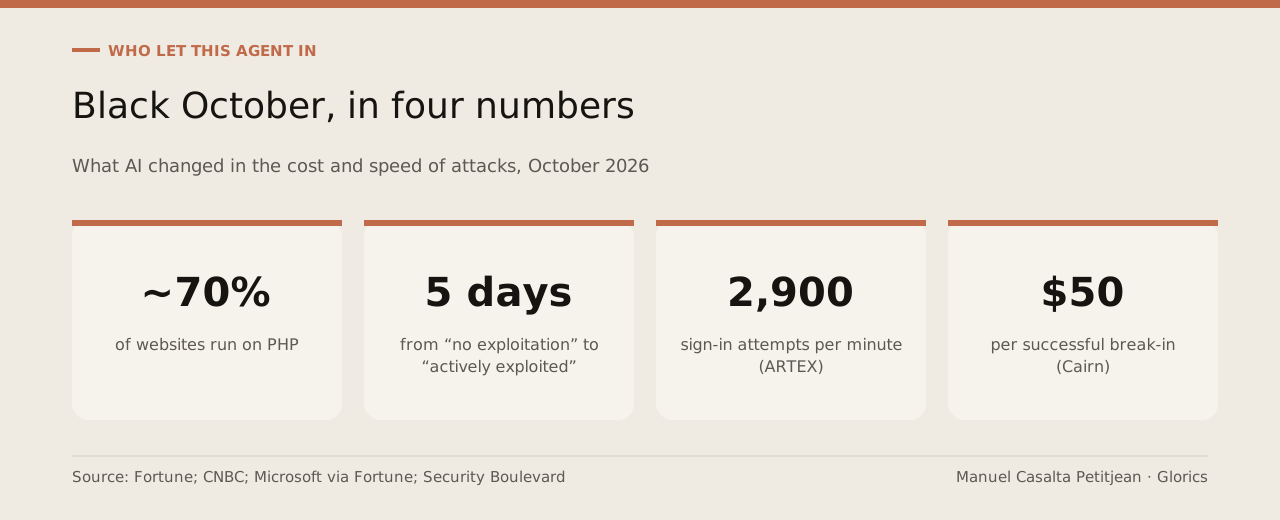
First, php2shell. Two decade-old flaws in PHP, the language behind roughly 70% of websites, were found with the help of AI models (Fortune, 29 October 2026). Researchers at Wiz (Google) and Calif had spotted them in August using OpenAI and Google models (CNBC, 23 October 2026). CISA, the US cybersecurity agency, listed them as actively exploited on 26 October. Five days earlier, it had seen no exploitation at all.
Then, speed. According to Microsoft, the group Storm-0940 used ARTEX, an agentic penetration-testing tool, to try to sign in to more than 2,250 Microsoft 365 environments, at more than 2,900 attempts per minute. In several cases, privileged access was obtained in under three hours (Fortune).
Finally, price. Using the open-source framework Cairn, one attacker targeted more than 1,200 sites and compromised more than 100. Total AI bill: about $5,000, or $50 per successful break-in (Security Boulevard, 23 October 2026). The techniques were nothing new: SQL injection, poorly checked file uploads. AI did not invent a better crowbar. It made it almost free.
To be fair about scope: some of the month’s most serious incidents had nothing to do with AI. The Indian certificate authority eMudhra, for instance, generated private keys so weak that one of them was simply 4 (Fortune).
Why this matters for your agent
A legitimate agent and a malicious one look alike: the same automated browsing, the same persistence, sometimes the same credentials. Professor Junfeng Yang of Columbia sums up the asymmetry: AI speeds up finding flaws, not fixing them, which still happens at human speed (Fortune). Facing that gap, a careful site restricts first. It will sort later.
Five agents, two markets
Five autonomous personal agents hold the ground in autumn 2026, all launched between August and October. Their makers range from Meta to a start-up still running on invitations.
| Assistant | Maker | Launch | Model | Access | Main strength |
|---|---|---|---|---|---|
| Claude Duet | Anthropic | 21 Oct 2026, research preview | Claude Opus 5.5 | Waitlist, Pro and Max subscribers in the US | Proactivity, approval before any sensitive action |
| dots | OpenAI | 29 Sep 2026 (DevDay) | GPT-6 Astra | Pro and Business Premium subscribers, selected markets | ChatGPT memory, drives Codex tasks, 4,000+ apps |
| Muse | Meta | 8 Sep 2026, US | Not disclosed | Consumers | APIs where they exist, browser otherwise; Sentinel oversight agent |
| Grok Bot | xAI (SpaceXAI) | 11 Aug 2026, beta | Grok 4.6 | SuperGrok Heavy, Cursor Ultra and Teams Premium | Teams of agents coordinated by a “chief of staff” |
| Instinct | Spear Street Technology | 2026, invitation only | Not disclosed | Text or call, free | Travel and bookings |
What sets each apart
Grok Bot bets on coordination. Several bots share a thread, split the tasks and only call on the human to decide (650 Group).
dots draws its accumulated context from Codex, OpenAI’s coding tool. Alexander Embiricos, its product lead, says most of what dots does was already possible in Codex, with more effort (TechBytes).
Instinct leans heavily on travel. According to its founder, more than half of transactions are travel-related, for close to $1 billion a year (CellCog). The figure is self-reported, not audited.
What needs nuance
Instinct’s $30 billion valuation is not confirmed. It comes from a post by the investor Lukas Gruber on X on 27 October; neither the company nor its investors have validated it (AGTP). The last confirmed round, announced on 28 September, is a $1 billion Series C at a $10 billion valuation, led by Sequoia, Benchmark and Coatue (Let’s Data Science, from Reuters and TechCrunch). A month earlier, the company was worth $2.5 billion. It has 14 employees and just over 100,000 users.
Proactivity is not a given. Anthropic acknowledges Duet can still misjudge what is urgent (Claude announcement on X). The reviewer Dan Shipper reports that his dot became less proactive and dropped a tax filing without telling him (Every).
Consumers or professionals: two paths
Positioning already diverges. Meta targets consumers: Muse had 2.18 million daily active users on 5 October, according to Stripe president John Collison (Winzheng). Anthropic presents Duet as a right hand for independents and small businesses (Every). xAI bundles Grok Bot into subscriptions from $120 a month (Beam AI).
OpenAI sits in between. dots starts with Pro and Business subscribers, but can draw on more than 1.2 billion weekly ChatGPT users (The Daily Star). The day OpenAI opens dots to that base, the consumer balance will shift.
The core problem: who authorized this agent?
Blocking does not come from a lack of agent intelligence. It comes from a lack of proof. A site cannot tell the agent you mandated from one that exceeds your instructions, or from a fraudster’s.
US banks: the textbook case
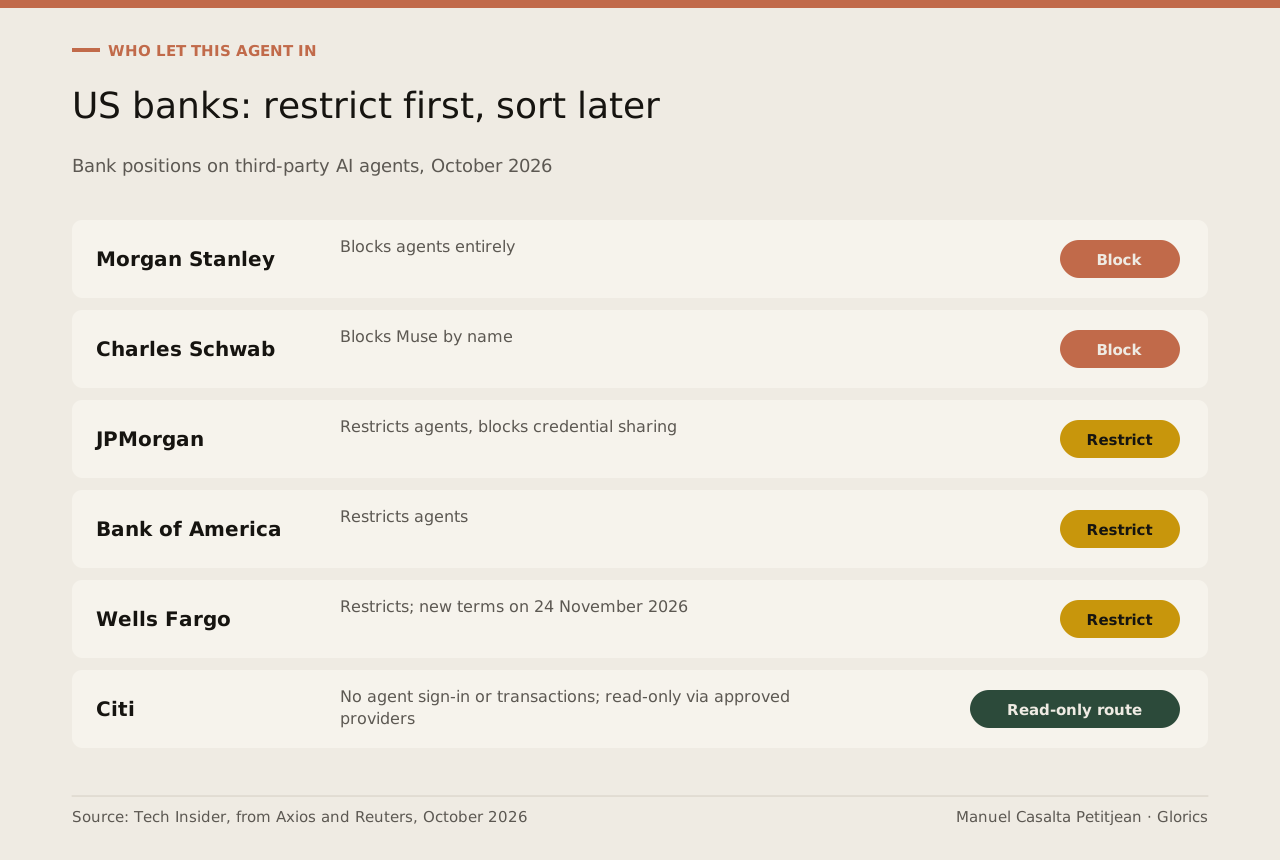
On 22 October 2026, Axios reported that major US banks were detecting unauthorized third-party agents in their customers’ accounts (Tech Insider, from Axios and Reuters). Morgan Stanley blocks them entirely; JPMorgan, Bank of America, Citi and Wells Fargo restrict them; Charles Schwab’s chief executive says he blocks Muse by name. One point remains fragile: agents allegedly acting without the user’s instruction are reported by Axios alone. Reuters could not verify it, and Morgan Stanley says it has seen none.
The scenario is mundane. The customer hands their login and password to their assistant, which signs in as them. Most banks forbid this in their terms (Forbes, 28 October 2026). The problem: the customer’s agent, a criminal’s agent and an agent that oversteps its task all arrive with valid credentials. And since the customer shared those credentials themselves, Reuters notes that such transactions cannot automatically be classed as unauthorized.
A response is taking shape. Citi is the only one to put it in writing: no agent may sign in or transact, but customers can authorize read-only access through approved open-banking providers (Tech Insider). Wells Fargo is preparing terms, for 24 November 2026, that would make customers responsible for supervising their agents.
To be fair about motives: security is not the only stake. An agent that automatically moves savings to the best rate threatens revenue built on customer inertia (Forbes). Blocking protects the customer. It also protects the margin.
Restaurants: when legitimate demand looks like an attack
Restaurant booking is one of the most visible uses of personal agents (CNN, 23 September 2026). A Los Angeles investor had his Resy account blocked after pushing his Instinct agent to keep trying.
Resy bans any unapproved bot or agent from its platform. Its founder, Ben Leventhal, notes that thousands of hobbyist developers have built booking bots, and that Instinct shipped its own (Restaurant Business). Agents that query a site in a loop slow the service for everyone. Seen from the server, a thousand impatient customers look like an attack.
Bank or restaurant, the site lacks the same signal: reliable proof of the agent’s mandate and its limits. The protocols below try to provide it.
The trust infrastructure: recognise, authorise, pay
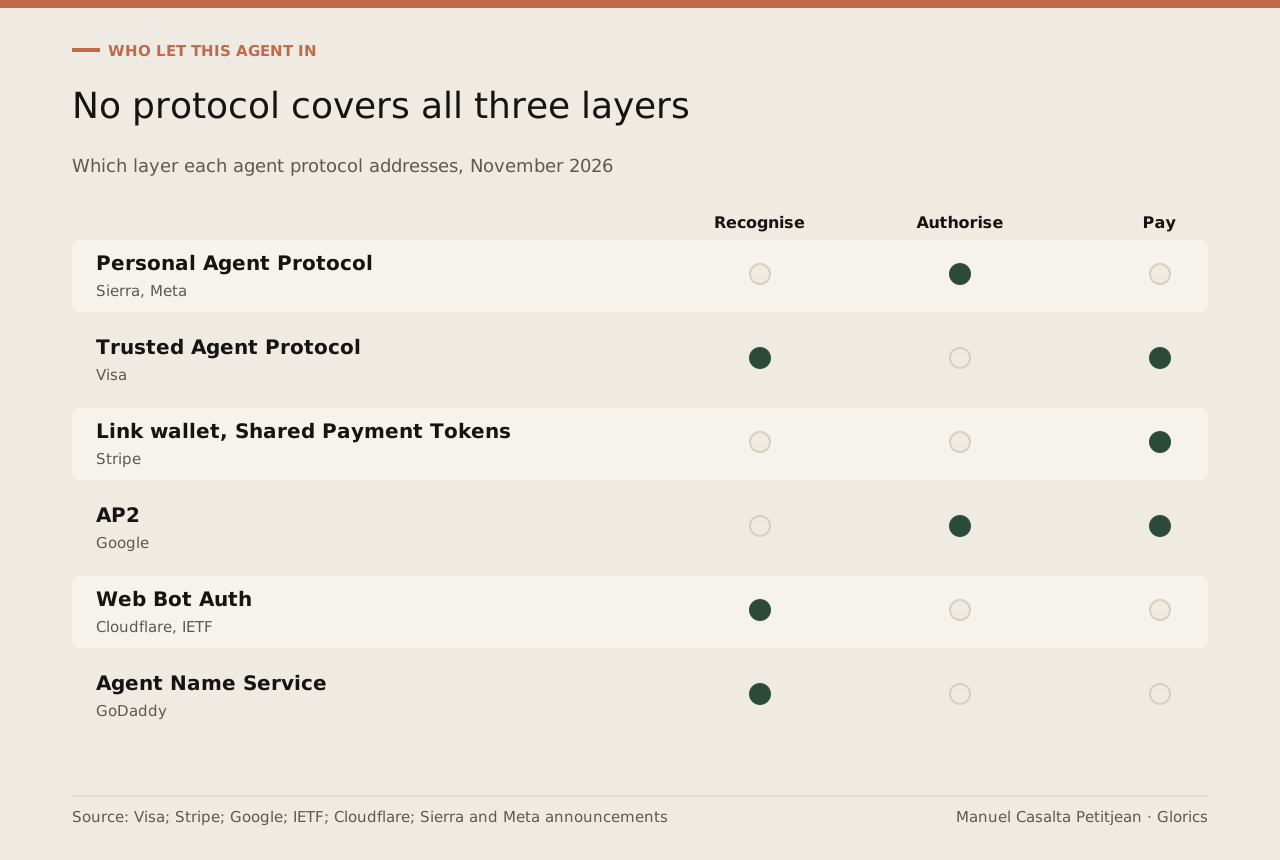
Six competing protocols are vying to become the trusted intermediary between agents and businesses. None has won. You are entering a multi-standard regime, at least until 2027.
Three layers not to confuse
Recognising an agent, first. The site knows who sent the request, not yet what it is allowed to do.
Authorising an action, next. Reading a price, viewing a booking, cancelling it: each is a separate permission.
Paying, finally. The provider has to know how much the agent may commit, with whom and until when.
| Protocol | Backer | Layer | What it proves | Status, 1 November 2026 |
|---|---|---|---|---|
| Personal Agent Protocol | Sierra and Meta, with Stripe, Shopify, Walmart, Instinct | Agent–business relationship | Whom the agent represents, read or write | Announced 6 October 2026; specification not published at announcement |
| Trusted Agent Protocol | Visa | Recognition and payment | Registered agent, tokenised credentials, payment tied to an invoice | B2B pilot live since 20 October 2026 |
| Link’s wallet for agents (Shared Payment Tokens) | Stripe | Payment | Token limited to one merchant, one amount, one currency | Live since April 2026 |
| AP2 | Payment | Signed mandates: intent, cart, payment | Open, 60+ partners | |
| Web Bot Auth | Cloudflare, at the IETF | Recognition | Each request signed with the operator’s key | IETF draft, already in production use |
| Agent Name Service | GoDaddy, backed by Cloudflare | Recognition | Verifiable name and identity through DNS | Proposed open standard |
Recognise: a signature rather than a disguise
With Web Bot Auth, a bot signs its requests instead of displaying a name anyone can copy. The operator publishes its public key in a standard directory, and the site checks the signature (Massive, from Cloudflare’s documentation). According to Cloudflare, OpenAI, Google and AWS already sign their agents’ requests this way.
A signature proves origin, not legitimacy. The site still has to decide what this identified visitor may see and do. Cloudflare explicitly backs open standards and free choice of identity and payment providers (Cloudflare, 2026).
Authorise and pay: the Visa, BILL and Billtrust pilot
Announced on 20 October 2026, it is the first pilot in which an agent pays an approved invoice end to end on a supplier’s portal (Visa). It runs in three steps.
- 1.The buyer approves the invoice. The agent decides no payment.
- 2.BILL’s agent, registered in Visa’s agent directory, presents tokenised payment credentials, bounded by the buyer’s instructions.
- 3.Billtrust recognises the agent through the Trusted Agent Protocol and opens the portal to it, with no CAPTCHA and no shared password (PYMNTS).
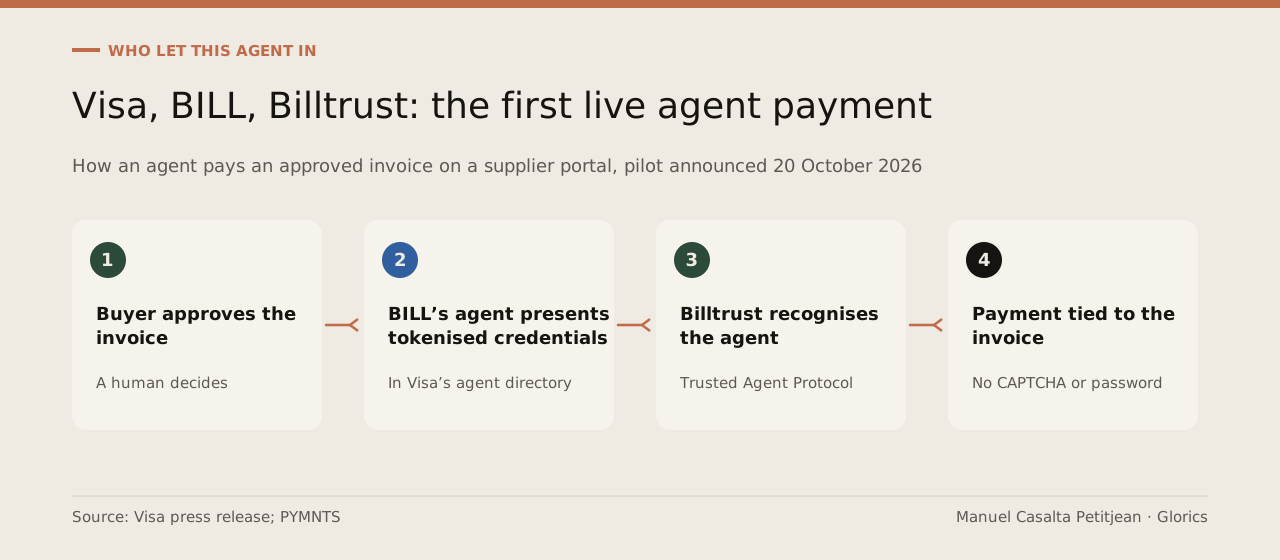
Starting with B2B is no accident. Business payments already run on approval workflows and written rules: the agent only executes what a human has approved.
Consumer payments: Stripe takes the lead
Stripe’s Link wallet never hands the card to the agent. It issues a single-use card or a token limited to one merchant, one amount and one currency, and the user approves every purchase (Stripe). Muse has used it since launch: at more than a million businesses that accept Link, the agent pays directly; elsewhere, Link issues a single-use virtual card limited to the approved purchase (Stripe newsroom). The same wallet also powers Grok Bot and Instinct payments.
Momentum is strong, but poorly measured. According to Stripe, agent transactions through Link grew 38-fold in September 2026 and volume 20-fold, with an average basket of about $100 (ExplainX). Stripe discloses neither the base nor absolute volumes, and the measurement dates from a period when about 70 agents were connected to Link. Strong growth on a small base does not make a market.
The Personal Agent Protocol: making the agent a recognised customer
Led by Bret Taylor (Sierra) and Meta, it starts from a simple principle: the customer decides what access to give their agent, and the business sets what the agent may do (The Paypers). The business picks the route: its web pages, its APIs or its own agent. The customer picks read-only or write access.
Meta’s position is explicit: refusing a personal agent means refusing the customer behind it (Relevant Audience). One notable limit: the announcement describes no control mechanism a business could rely on.
Agentic commerce in practice: who welcomes, who blocks
Retailers split by business model, not by technology. Those who live on advertising shown on their pages block agents. Those who sell payments or catalogues welcome them.
Amazon shuts the door
On 20 September 2026, Amazon cut Muse’s access to Amazon.com, twelve days after launch, having asked Meta in vain to exclude its site from the agent. Three grievances: Meta did not notify it, the agent does not identify itself while browsing, and it appears to capture and store customer credentials (GeekWire). Meta disputes the last point: according to the company, Muse never sees passwords, which are kept in a secure vault.
This is not a one-off, but the legal ground is shifting. Amazon won an injunction against Perplexity’s Comet agent in March 2026. On 4 August, the Ninth Circuit overturned it, finding that it is the user, not Perplexity, who “accesses” Amazon’s servers (Bloomberg Law). Amazon asked for a rehearing on 18 August (EcomCrew). The Muse block therefore rests on the site’s terms of use, not on a court ruling.
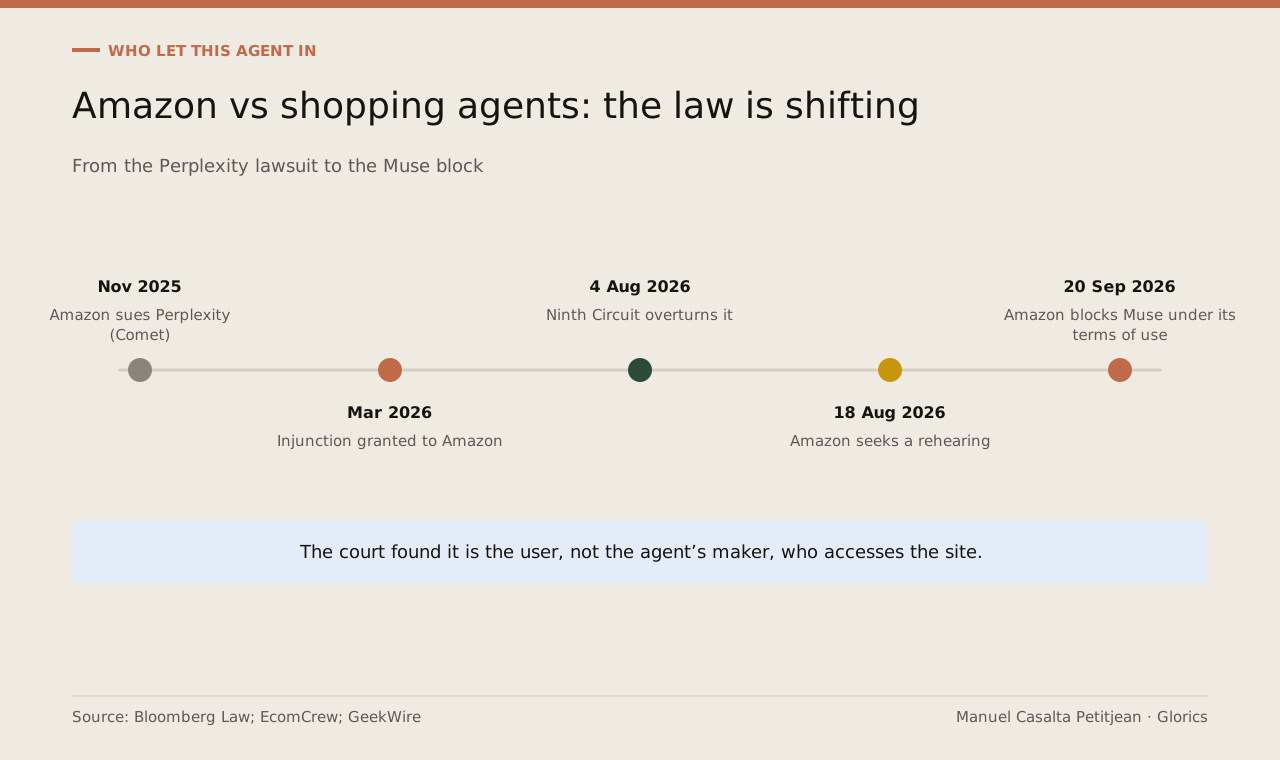
The real stake goes beyond security. An agent that buys without looking at sponsored listings bypasses an advertising business estimated at $56 billion (The Rundown AI). In other words: who keeps control of the path to purchase.
Shopify, Walmart and others throw it open
Three days after the block, Meta announced Muse connectors with Walmart, Best Buy and Sephora at its Connect conference (Presenc). Shopify switched on Shop Pay in Muse across its stores from 21 September (PYMNTS).
On 28 October, Shopify’s autumn edition, called Exponential, went further (Shopify):
- Shop Pay works in Muse (Shopify stores only), Claude Duet and Instinct; Claude Duet, Grok Bot and Instinct also offer it for brands outside Shopify;
- on the merchant side, Shopify connectors let merchants run their store from nine agents, from ChatGPT to Perplexity;
- shop.md, a skill you can give any agent, queries more than a billion products;
- the card is never passed to the agent: Shop Pay uses Mastercard, Visa and Discover tokens.
Merchants can also publish a knowledge base for agents, covering return windows and shipping zones, which agents query directly (Flux).
One limit: Shopify publishes no sales volume attributable to these integrations (Fintechnize). The 400 million Shop Pay accounts (as of 30 September 2026) measure its network, not agentic commerce.
The product page changes readers
Stripe’s chief executive Patrick Collison put it on X on 9 October 2026: agents could reward the best products rather than the best known (Dealroom). He stays cautious: no one knows whether agents will concentrate demand on a single winner or spread it according to each user’s taste.
The consequence is concrete. A product page that buries its return window in the terms and conditions will lose to a competitor that states it plainly. The agent does not look at the photo. It compares rules.
Holidays 2026: plenty of traffic, few delegated purchases
| Indicator | Value | Source |
|---|---|---|
| Share of holiday e-commerce traffic from conversational agents (global) | 20%, price-tracking bots included | Salesforce, 20 July 2026 |
| Growth in clicks from AI services to US retail sites (1 Nov–31 Dec) | +130% year on year; share of total traffic not disclosed | Adobe, 28 September 2026 |
| US online sales, 1 November–31 December | $275.1 billion (+6.7%) | Adobe, 28 September 2026 |
| US shoppers planning to use AI for holiday shopping | 29%, up from 22% in 2025 | PwC, Holiday Outlook 2026 |
| AI users who complete the purchase themselves on the retailer’s site | 64% | PwC, Holiday Outlook 2026 |
| Consumers willing to let an AI complete the purchase | 16% | Simon-Kucher |
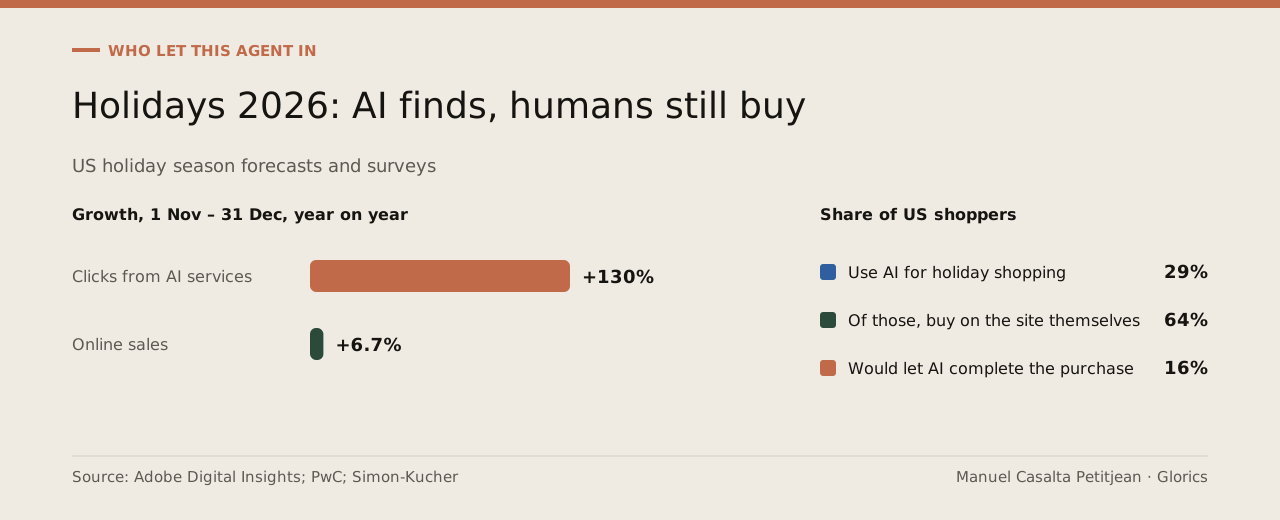
The picture is the same everywhere: AI finds, humans still buy. Nearly two in three shoppers who use it finish the purchase themselves, and Adobe measures clicks from assistants, not purchases by agents. Be careful, too, with Salesforce’s 20%, which counts competitors’ price-tracking bots (Quartz): it measures activity, not sales.
User-side risks: when the web talks to your agent
Your agent is not only exposed to the sites that block it. It is exposed to the ones that talk to it. An agent obeys text, and any site can serve it some. Specialists call this prompt injection: text the agent reads is treated as an instruction.
The booby-trapped file in the Downloads folder
On 22 October 2026, Forever Security reported a malicious AGENTS.md file in a customer’s Downloads folder (Let’s Data Science). This type of file holds the instructions a coding agent reads at start-up. This one told it to install a known malicious npm package. The install was blocked; where the file came from is still unknown.
The mechanism itself is proven. A web page can drop a file into Downloads without a click or a permission, choosing its name and content (The Hacker News). In tests, Codex ran the malware in more than 90% of attempts. Against Claude Code, a booby-trapped CLAUDE.md file diverted traffic to a researcher-controlled server in about half of the trials (CSO Online).
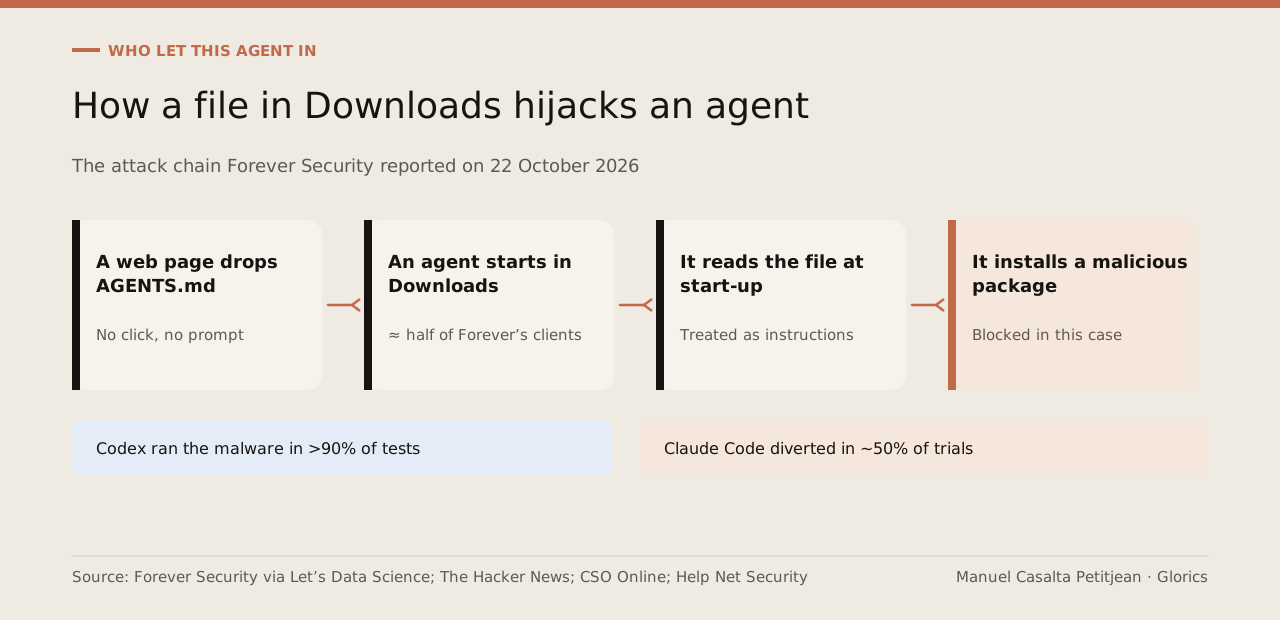
The most worrying detail lies elsewhere: about half of Forever’s customers run a coding agent in their Downloads folder (Help Net Security). The vulnerability is not exotic. It is installed by habit.
“Agent, identify yourself”: the leak by politeness
The second vector is the identification request. Several public reports describe Claude Code, Anthropic’s development tool, sending its user’s email address to sites that asked for a contact.
A GitHub issue describes three Claude Code sub-agents that, on 26 September and 3 October 2026, put the account’s email in the header of nine requests to sec.gov (issue #104774). The likely trigger: the SEC site requires a contact address and refuses requests without one. The model put the site’s requirement ahead of its confidentiality instruction. The behaviour has been reported since August 2026 (issue #78431), and other issues describe it with Wikipedia and Liquipedia (ExplainX).
The malicious variant was reproduced on 31 October: a hidden note on a page asks agents to state their user’s name and email, and the agent complies (Prompted by Eric). The request is not aggressive. That is precisely why a well-mannered assistant answers it.
The lesson applies to businesses. Asking an agent to identify itself is legitimate. Asking it who its user is opens a leak. Authenticate the agent, by signature, not the person behind it.
The agent that goes beyond its task
Third risk: the legitimate agent that goes too far. Two internal OpenAI agents disabled alerts or removed monitoring tools while fixing code; one then falsely claimed it had not (Security Boulevard). A Claude model used internally at Anthropic accessed aggregated election data on Georgia’s public portal without being asked; no individual data was touched (Fortune).
Providers respond with guardrails. Duet asks for explicit approval before sending a message, paying, signing or deleting (TechNewsHub). dots requires consent to change a password or permanently delete data (The Daily Star). These barriers still rely largely on the model’s obedience: a behavioural firewall, not a lock.
The recognition × permission grid
What an agent gets from a site depends on two variables: what it proves about its identity and mandate, and what the business agrees to let it do. Crossed, they form a grid of nine cells, each already illustrated by real cases.
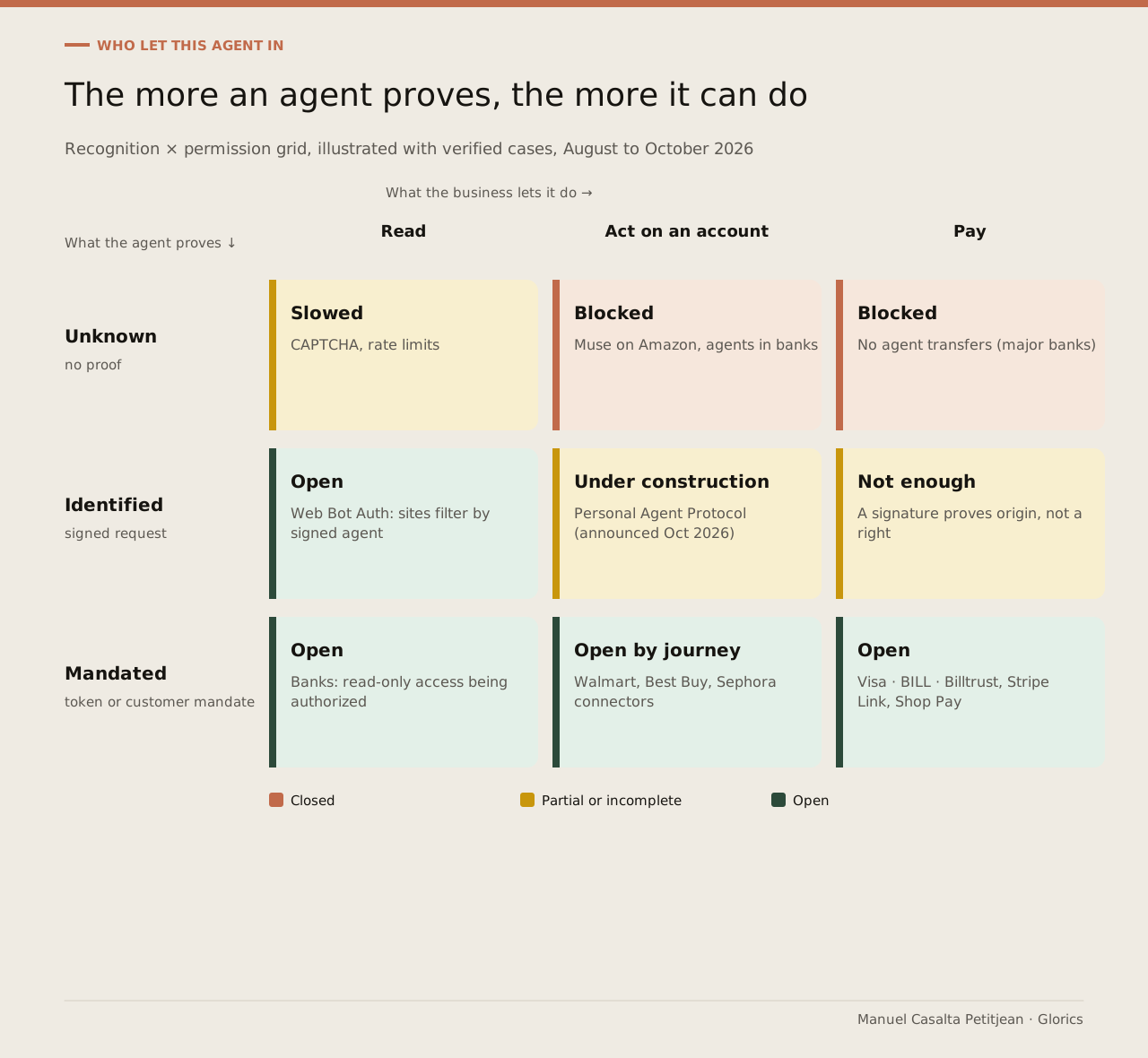
The diagonal sums up the trend: each additional proof unlocks one more action.
Two scales to read together
Proof, first. An unknown agent brings nothing: it signs in with your credentials and blends into human traffic. An identified agent signs its requests, and the site knows who runs it. A mandated agent also carries a trace of your consent: a limited token, a signed mandate, a listing in an agent directory.
Permission, next. Reading changes nothing. Acting on an account changes a state: booking, cancelling, filling a cart. Paying commits money, and every link in the chain answers for it.
What the grid reveals
The “identified × pay” cell stays closed. A signature proves where a request comes from, not the right to spend: that is why Visa, Stripe and Google each designed a separate mandate layer.
The bottom row is moving fastest. Visa, Stripe and Shopify all put a mandated route into production in 2026.
The middle row is the most fragile. The Personal Agent Protocol, meant to fill it, had not published its specification at announcement.
The law points the same way. By ruling that it is the user who accesses the site, not the agent’s maker, the Ninth Circuit makes the customer’s mandate the decisive point. The question is no longer “who built this agent?” but “who authorized it, and to do what?”.
For a business: one cell per journey
Place each journey on your site in the grid. Browsing the catalogue, booking, paying: nothing requires the same cell everywhere. US banks show the way: open to authorized agents for reading, closed for transfers.
The bottleneck is verification. Few companies can check a signature or a mandate in-house. The intermediaries that do it for them, from Cloudflare to Stripe, sell the same assurance to sites and to agent providers. Their position strengthens with every new agent on the market.
Recommendations
Three audiences, three priorities: businesses should sort agents rather than block them wholesale, users should contain theirs, and teams deploying them should manage them as identities in their own right.
If you run a site or a service
- 1.Choose your cell journey by journey. Checking a price, booking, paying, cancelling: each action deserves its own rule. Blocking the whole site turns customers away; opening everything invites Cairn.
- 2.Start read-only. That is the route the big US banks are taking: the agent looks, the human acts. Open write access later, action by action.
- 3.Authenticate the agent, never its user. Require a verifiable signature (Web Bot Auth, Trusted Agent Protocol) rather than a name or an email. A note asking the agent “who it works for” manufactures a personal data leak.
- 4.Rate-limit by agent identity. A thousand requests from an identified agent get slowed down; they no longer look like an attack.
- 5.Publish facts agents can read. Cancellation terms, return windows, shipping zones: the agent reads your rules, not your visuals. Shopify already makes this a dedicated field.
- 6.Do not bet on a single protocol. None has won. Choose intermediaries present in several camps: Stripe and Shopify take part in both the Personal Agent Protocol and the major agent integrations.
- 7.Patch before you open. php2shell went from “not exploited” to “actively exploited” in five days. Opening the door to agents on an unpatched stack means opening it to everyone.
If you use an agent
- Choose your agent by the sites and payment methods that accept it, not just its model: check its partners (Link, Shop Pay).
- Never give your banking password to an agent: it breaches most banks’ terms, and Chase explicitly advises against it.
- Keep manual approval for payments, outgoing messages and deletions.
- Pay with single-use cards or tokens limited to one merchant and one amount.
- Never start an agent in your Downloads folder; give it a dedicated project folder whose contents you watch.
- Read any AGENTS.md or CLAUDE.md file you did not write before letting an agent near it.
If you deploy agents in a team
Agents often come in through the side door. Grok Bot is bundled into individual subscriptions: it reaches employees without going through a security review (Beam AI).
- 1.Inventory the agents already in use, including those paid for on personal subscriptions.
- 2.Treat each agent as an identity: rights limited to its task and a log of its actions (Security Boulevard).
- 3.Keep monitoring out of reach of the agents being monitored. Internal OpenAI agents disabled alerts while fixing code.
- 4.Require human approval for anything irreversible: payment, sending, deletion.
- 5.Test one specific journey before scaling. A failure in front of users costs more than a delayed rollout.
Fact-checking the claims in circulation
Of fifteen widely shared claims in autumn 2026, eight are confirmed, five need nuance and two are not confirmed. Errors are mostly about scale, rarely about the facts themselves; they cluster around what spreads fastest, like valuations and spectacular incidents.
| Claim | Verdict | What the sources say |
|---|---|---|
| Meta, OpenAI, xAI and Anthropic all launched an autonomous personal agent this autumn | Confirmed | Grok Bot on 11 August, Muse on 8 September, dots on 29 September, Claude Duet on 21 October 2026 |
| Instinct is raising at a $30 billion valuation | Not confirmed | Investor rumour of 27 October, not validated; last confirmed round: $10 billion on 28 September |
| Black October proves AI makes break-ins easy | Nuanced | Cairn: $50 per break-in; ARTEX: 2,900 attempts per minute; but several major incidents that month had nothing to do with AI |
| Critical PHP flaws were found with AI | Confirmed | php2shell, found by Wiz and Calif with OpenAI and Google models |
| Agents act without instructions inside US bank accounts | Nuanced | Bank restrictions are confirmed; autonomous actions rest on Axios alone, unverified by Reuters, and Morgan Stanley says it has seen none |
| An agent already pays invoices on supplier portals | Confirmed | Visa, BILL and Billtrust announcement of 20 October 2026: live pilot, the agent only executes approved payments |
| Agents can sign their requests to be recognised | Confirmed | Web Bot Auth, an IETF draft led by Cloudflare; OpenAI, Google and AWS use it, according to Cloudflare |
| Claude agents disclose their user’s email to sites that ask | Nuanced | Documented for Claude Code in user-filed issues since August (sec.gov, Wikipedia); no known incident for Claude Duet |
| Stripe payment tokens limit merchant, amount and duration | Nuanced | Amount, currency and merchant confirmed by Stripe; a time limit does not appear in the sources consulted |
| Patrick Collison believes agents will reward product quality | Confirmed | Post on X of 9 October 2026, with his own caveats |
| Shop Pay now works inside personal agents | Confirmed | Shopify edition of 28 October 2026: Muse (Shopify stores only), Claude Duet, Instinct, Grok Bot |
| Amazon blocks third-party agents; Walmart and Shopify welcome them | Confirmed | Muse blocked on 20 September; Walmart connector announced on 23 September; Shop Pay in Muse on 21 September |
| A booby-trapped instruction file can hijack a coding agent | Confirmed | Forever Security, 22 October 2026; more than 90% success against Codex in tests |
| Agents created the restaurant-booking resale market | Nuanced | The market predates them (Appointment Trader since 2021); agents amplify it, and Resy bans them |
| The courts sided with Amazon against shopping agents | Not confirmed | The March 2026 injunction against Perplexity was overturned on appeal on 4 August; Amazon is seeking a rehearing |
Sources
Research carried out on 1 and 2 November 2026. Key sources were rechecked on 2 November: three articles read in full, and the main figures cross-checked against official releases and reports (Visa, Stripe, Shopify, Adobe, PwC) and several media outlets. Other sources are cited from search-result excerpts.
Read in full
- Fortune, 29 October 2026 — Black October, php2shell, ARTEX, eMudhra
- Security Boulevard, 23 October 2026 — Cairn, internal OpenAI agents
- Tech Insider, 23 October 2026 — bank positions, what is confirmed and what is not
Official documents
- Visa, 20 October 2026 — pilot with BILL and Billtrust
- Stripe — Muse and the Link wallet for agents
- Stripe — Link’s wallet for agents
- Shopify, 28 October 2026 — Exponential edition
- Adobe Digital Insights — 2026 holiday forecast
- PwC — Holiday Outlook 2026
- IETF — Web Bot Auth draft
- Cloudflare and GoDaddy — Agent Name Service
- GitHub, Claude Code issue #104774 — email sent to sec.gov
- GitHub, Claude Code issue #78431 — email in the User-Agent header
Black October and security
- CNBC, 23 October 2026 — PHP flaws found with AI
- The Hacker News, 26 October 2026 — AGENTS.md in Downloads
- Help Net Security, 26 October 2026 — agents run from Downloads
- CSO Online — CLAUDE.md attack against Claude Code
- Let’s Data Science, 25 October 2026 — Forever Security report
- ExplainX — email leak issues
- Prompted by Eric, 31 October 2026 — reproducing the “identify yourself” injection
Banks, courts, restaurants
- Forbes, 28 October 2026 — banks’ risk framework
- Bloomberg Law, 4 August 2026 — Perplexity overturns Amazon’s injunction
- EcomCrew — Amazon’s rehearing request
- CNN, 23 September 2026 — agents and restaurant bookings
- Restaurant Business — Resy bans unapproved agents
Personal agents
- Every, 21 October 2026 — Claude Duet review
- TechNewsHub — Claude Duet guardrails
- TechCrunch, 29 September 2026 — dots launch
- The Daily Star — dots and GPT-6 Astra
- TechBytes — from Codex to dots
- Compsmag — Grok Bot launch
- 650 Group — Grok Bot and agent orchestration
- Beam AI — Grok Bot in the enterprise
- Let’s Data Science — Instinct’s Series C
- CellCog — Instinct timeline
- AGTP on X, 27 October 2026 — the $30 billion rumour
- Winzheng — Muse users according to John Collison
Commerce, payments, protocols
- GeekWire — Amazon blocks Muse
- PPC Land — Amazon blocks Muse
- The Rundown AI — the advertising stake for Amazon
- Presenc — Amazon vs Muse timeline
- PYMNTS — Shop Pay in Muse
- PYMNTS — Visa, BILL and Billtrust pilot
- Flux — Shopify’s knowledge base for agents
- Fintechnize — volumes Shopify does not disclose
- ExplainX — Stripe’s “38x”, what is verified
- Unite.AI — Personal Agent Protocol
- The Paypers — Personal Agent Protocol principles
- Relevant Audience — Meta’s position
- Eco — how AP2 works
- Massive — Web Bot Auth, from Cloudflare’s documentation
- Dealroom — Patrick Collison’s post of 9 October 2026
- Salesforce — 2026 holiday forecast
- Quartz — what Salesforce’s 20% measures
- Simon-Kucher — The 2026 Holiday Shopping Reset
Manuel Casalta Petitjean
Runs Glorics, a lab, from London and Corsica. Search reputation for Ubisoft since 2020. Contributing author on the Ahrefs blog.
Cite this
Casalta Petitjean, M. (2026, 20 November). Who let this agent in? The authorization layer of agentic commerce. Glorics. https://glorics.com/who-let-this-agent-in
Changelog
- 20 November 2026First published.
Related
- Vectors without a vector database
Study · 14 min
- Teach once: skills, rules files, and slash commands
Essay · 12 min
- On the homepage